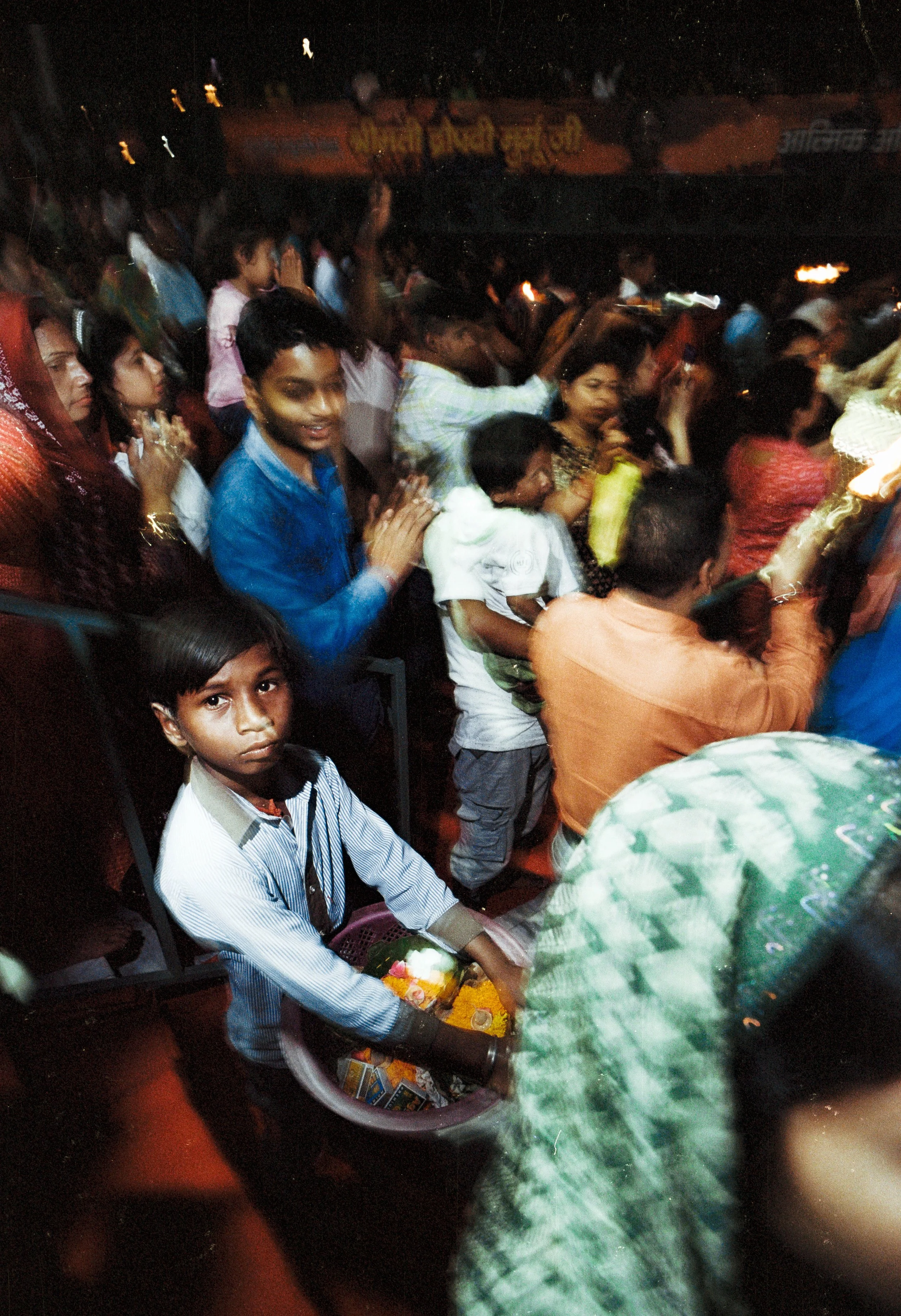
A Shared Glance During Aarti, 2024.

This remains one of my favorite photographs from India. During the evening aarti at Parmarth Niketan in Rishikesh, the crowd moved like a single body around me. Hands lifted diyas and oil lamps in adoration of Shiva while faces, fabrics, and gestures dissolved into streaks of red and gold. Then I noticed this young boy holding a basket of marigolds and devotional offerings. He caught my eye. I advanced the film, we exchanged a brief look, and I released the shutter with an off-camera flash.

Everything around him seems to move, yet he remains still, his gaze cutting through the blur. I love the grit, the imperfect light, and the tension between his quiet presence and the energy surrounding him. India was a time when I felt myself advancing deeply along the spiritual path, and this photograph holds something of that experience: movement and stillness, devotion and observation, all existing within the same breath. Photographed on Kodak Ektar 100.
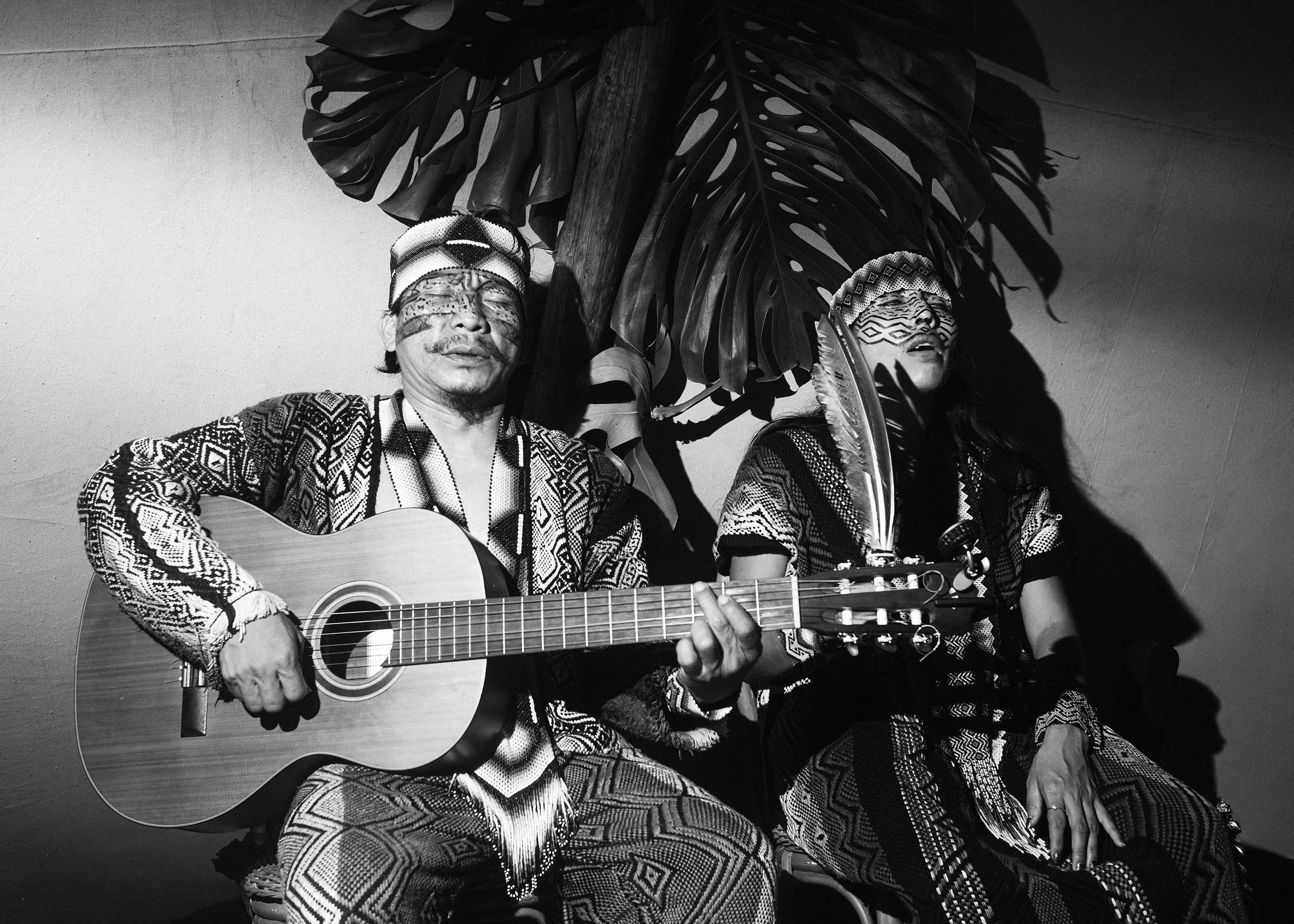
Chants of the Huni Kuin, 2024.

Sixteen years ago, as a sophomore in high school, I could not have imagined the photographs I would be making today. My subjects and intentions have shifted, but my desire to make honest images keeps growing. In this photograph, Txana Ikakuru and Batani Huni Kuin sit beneath broad leaves, one playing guitar while the other sings beside him. Light reveals the painted patterns across their faces, the woven details of their clothing, and the feathers rising between them, casting deep shadows on the wall. I made it during a Hapé evening ceremony and concert at Cantik Villa in Homestead, Florida. They had traveled from Boa Vista in the Brazilian Amazon to share their community’s traditions, knowledge, and sacred chants. Through my position and use of light, I wanted to preserve something of the atmosphere while remaining attentive to the people before me.

Ceremonial practices have become part of my spiritual journey, inviting me to listen and reflect on what I can apply to my own life. Alongside what I have learned in India, these encounters deepen my sense that the divine can reveal itself through different faces and voices, each rooted in a distinct tradition deserving care and respect. Photography asks that same attention of me. I keep learning how light, gesture, and the relationships within a frame can help us see more clearly. Even through burnout, carrying my camera can renew my curiosity and widen my awareness. Documenting our lives and sharing each other’s stories still matters deeply to me. The world needs thoughtful photographs. Honest ones. Images that help us recognize one another.
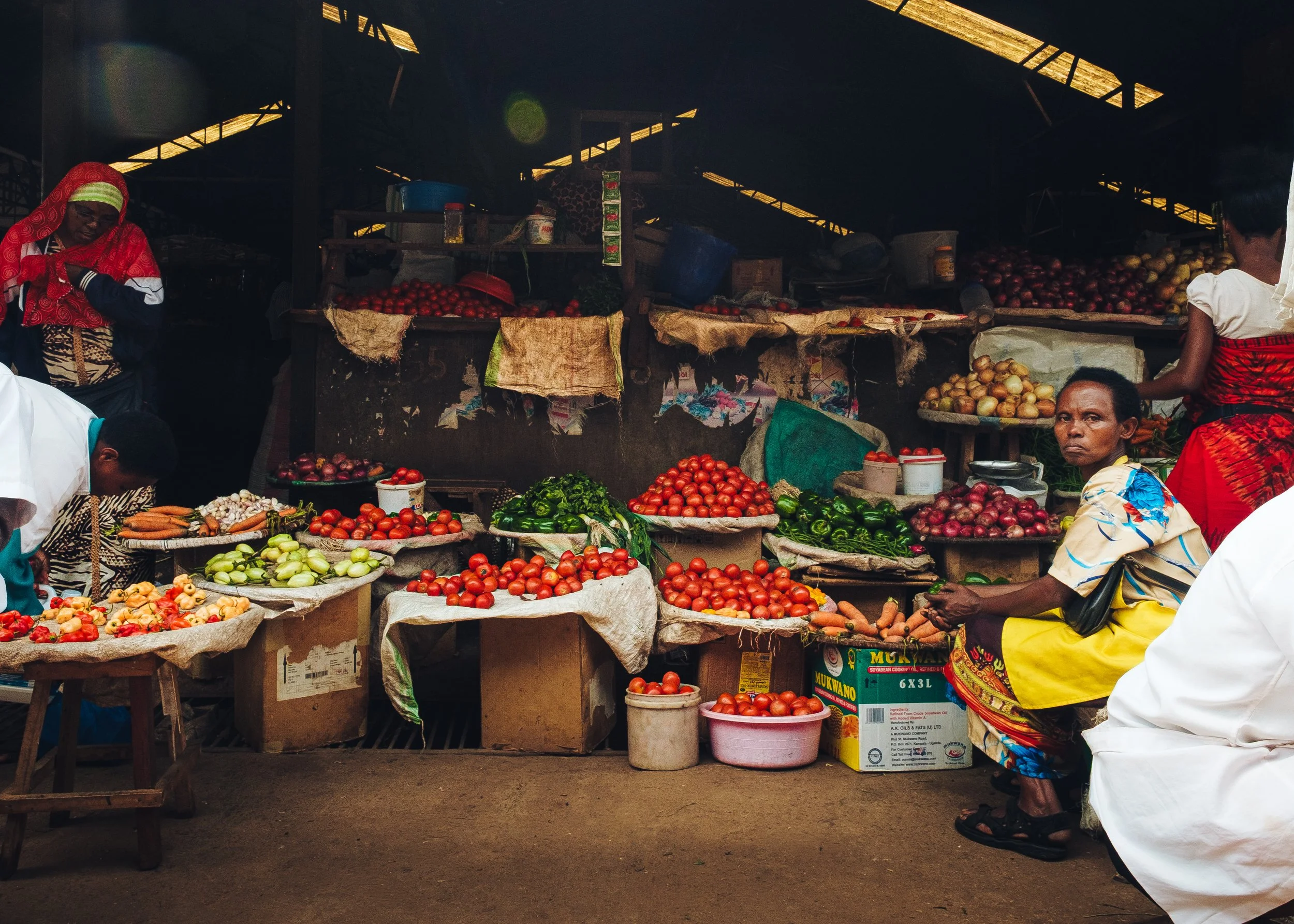
Among the Market Colors, 2019.

At Kimironko Market in Kigali, rows of tomatoes, onions, carrots, and green peppers fill trays and baskets beneath a dark roof. Narrow strips of daylight shine overhead, catching the produce and the worn cloth covering the displays. A seated woman looks toward my camera, her bright yellow skirt and floral blouse adding another layer of color. Around her, people lean over the stalls and pass through the edges of the frame. I made this photograph during my 2019 journey through Rwanda with my father.

Kimironko brings together everyday food shopping with stalls selling fabrics, clothing, and locally made goods. Walking through the market gave me time to notice the work behind each display and the people tending it. I was drawn to the arrangement of colors, but the woman’s glance gave the photograph its center. Looking at it now, I remember being a visitor in someone else’s working day, grateful for a brief encounter within the life of the city.
The Land in Their Steps

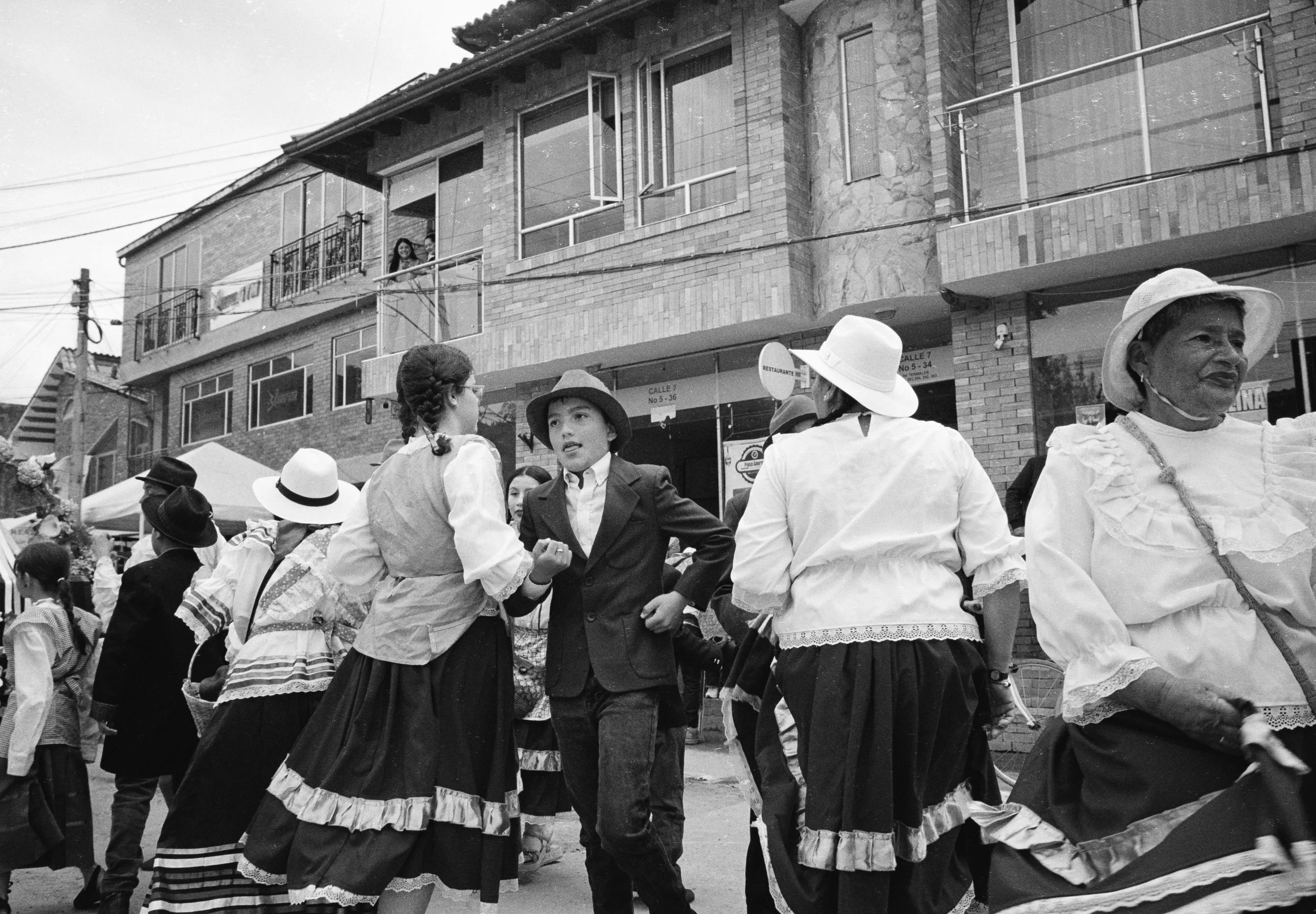
That morning in Tabio, horns and drums drew us into the streets for the Festival of Land and Work. In this photograph, a young pair dances amid wide-brimmed hats, ruffled blouses, and skirts lifted into motion. Behind them, someone watches from an upstairs balcony. I was drawn to how the celebration filled an ordinary street, bringing generations together through gestures and rhythms learned and shared.

With Sol on my shoulders and my Leica M6 in hand, I felt grateful to witness a community honoring the work that sustains it. These dancers brought me back to the farmers and families whose labor makes its way to our tables, often without our knowing their names. I thought of Saint Lucia and Jounen Kwéyòl, of the ways food, music, dress, and memory bring us together. Preserving heritage begins with people continuing to practice it, teaching the steps, telling the stories, and making room for the next generation to join.
Faith can move mountains, 2025.

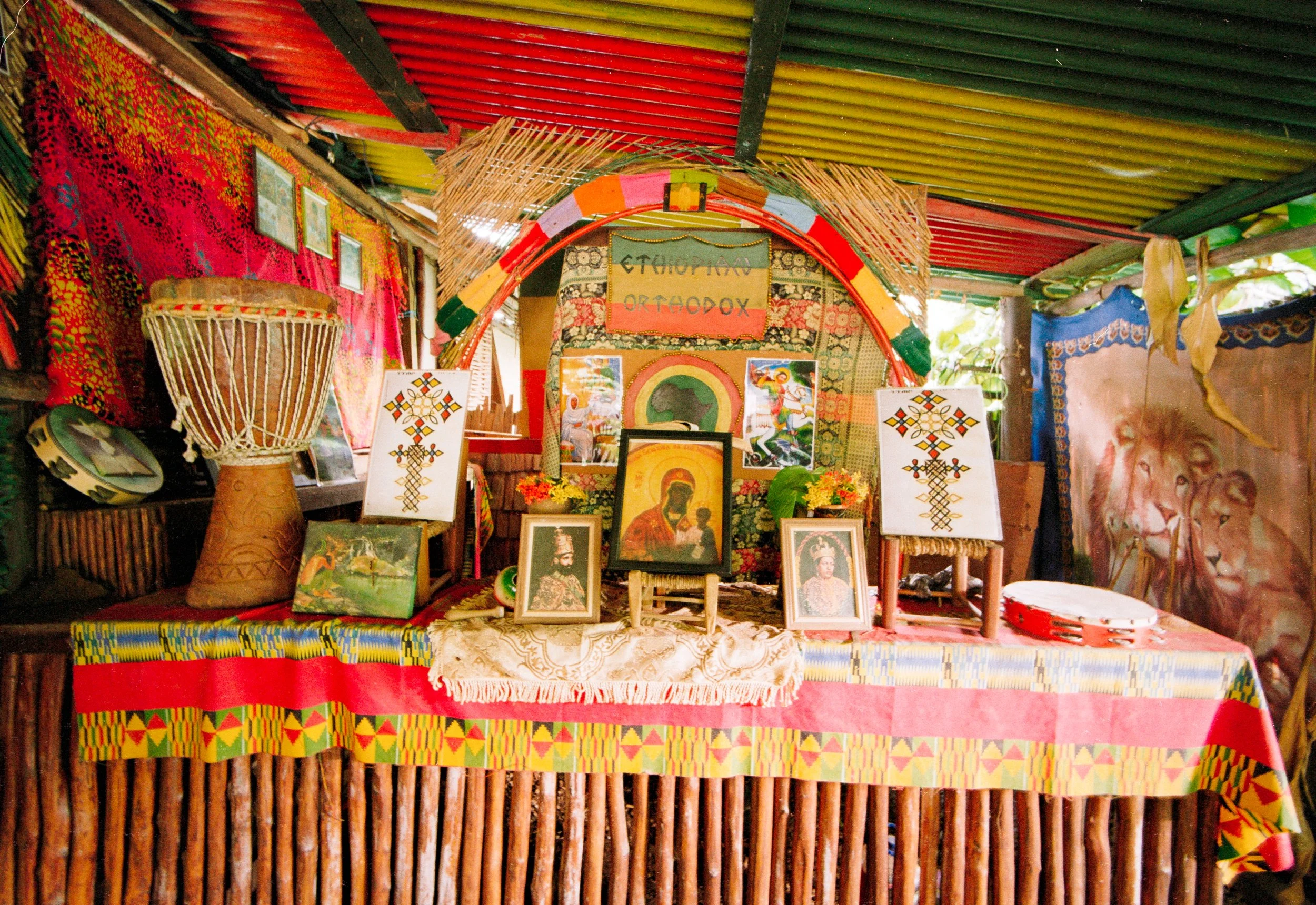
At Latille Falls in Saint Lucia, I paused before this Rastafarian altar honoring Emperor Haile Selassie I and Empress Menen. Their framed portraits sit beneath a painted arch, surrounding a central image of the Virgin and Child. Cross motifs, flowers, patterned cloth, drums, and tambourines fill the space, while painted lions watch from the side. Red, gold, and green extend across the altar and overhead beams. Photographing it on Kodak ColorPlus 200, I was drawn to the warmth of the colors and the care with which these objects had been brought together.

Saint Lucia is my homeland, an island of deep greens, changing blues, mountain ridges, and voices moving between English and Kwéyòl. Our histories live in our food, music, language, and the different ways people express their faith. Returning with a camera helps me give familiar places another moment of attention. Here, that meant looking closely at a small sanctuary within the landscape, where devotion takes visible form through photographs, instruments, and things carefully kept. Home lives in these details too, in what people cherish and make room for.
Honoring Our Elders, 2026.

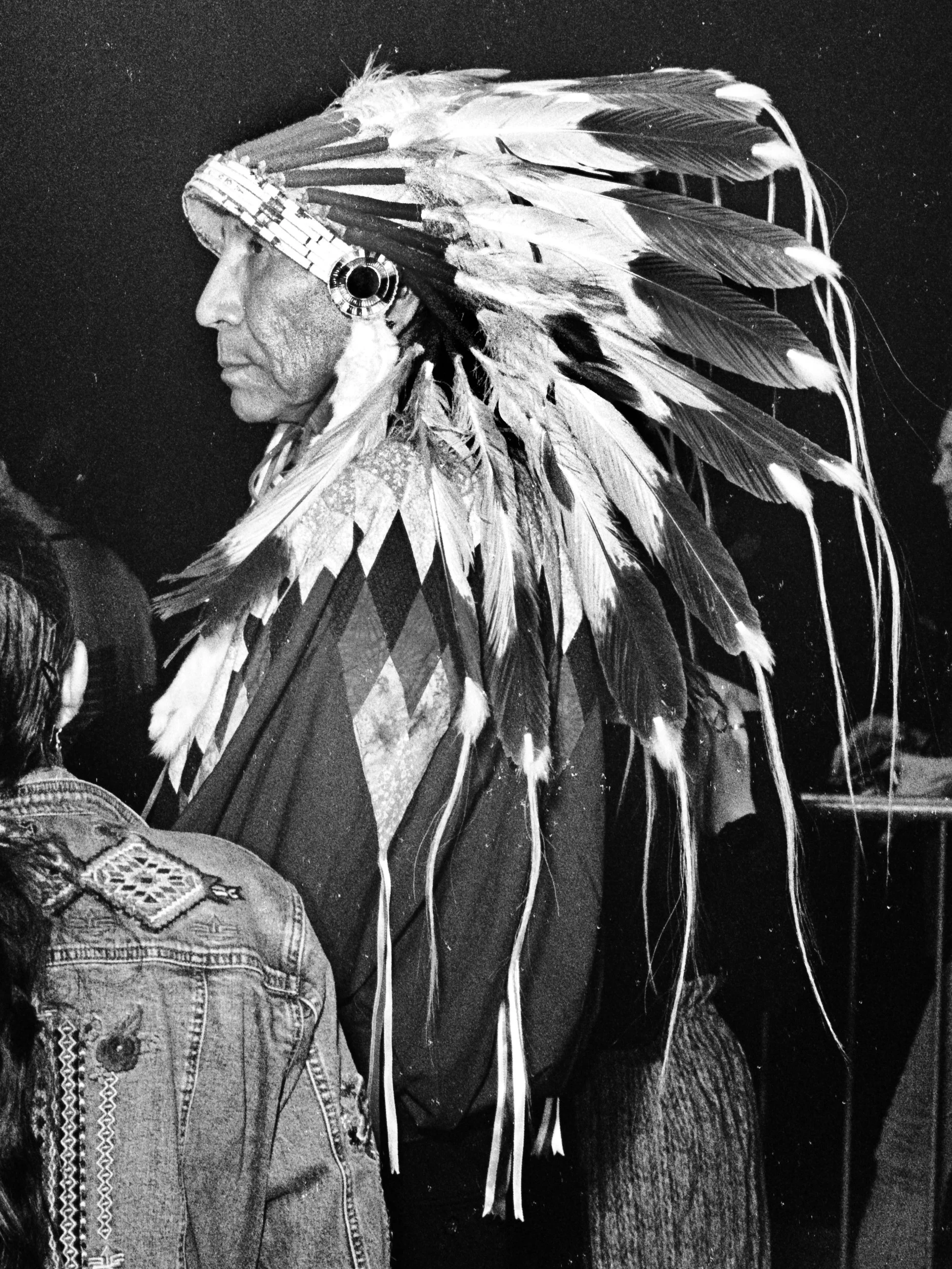
In “Honoring Our Elders,” I was drawn to the quiet presence of this Native American elder amid the movement of the powwow. Seen in profile, his face and the layered feathers of his regalia held my attention. I chose black and white to bring focus to his expression, the textures, and the stillness I felt in that moment. Making this photograph reminded me how much there is to learn when I slow down and observe.

The younger figure in the foreground led me to reflect on the generations gathered here, and how traditions continue through participation, teaching, and care. During the Grand Entry, veterans, leaders, and respected community members are honored. I’m grateful to have witnessed this gathering and to share a photograph that, for me, speaks to the importance of honoring our elders, listening to their stories, and respecting the living cultures they help carry forward.
Sensei Zen Takai, The Zen Samurai, 2025.

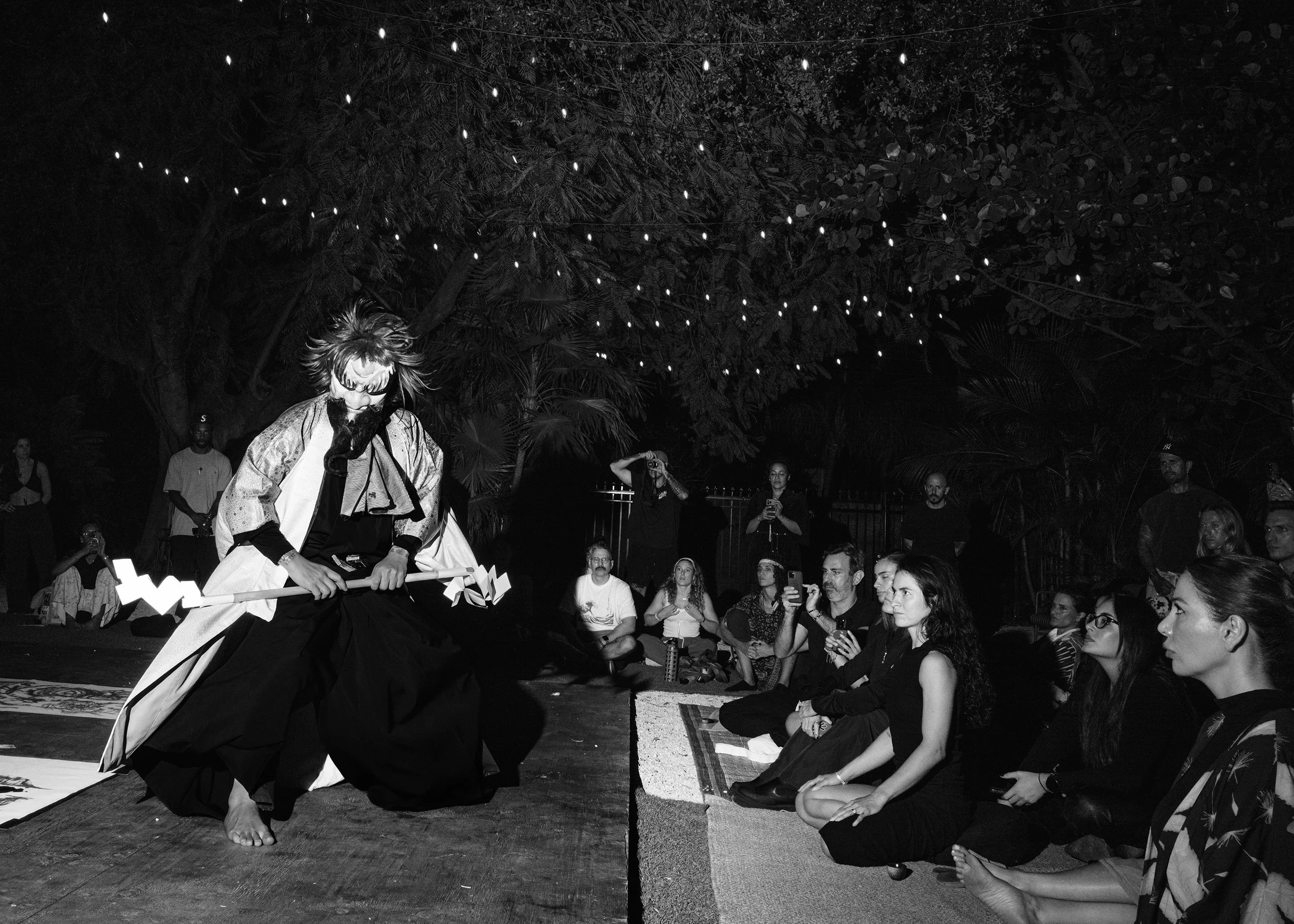
The Discipline of Presence. I’ve had a few opportunities now to photograph Sensei Zen Takai, The Zen Samurai, and each time I walk away understanding a little more about what sits underneath his practice. I made this photograph during an event by Chozen at The HUB, watching him move while everyone around him became quiet and attentive. What keeps drawing me back is that the movement never feels like movement for its own sake. There is discipline behind it, but also stillness. Awareness. A relationship between the body, the mind, and whatever is happening in the present moment.

Sensei describes his work as carrying forward the wisdom of a 16-generation Samurai lineage while finding ways for those teachings to remain useful in contemporary life. His practice moves through martial arts, meditation, calligraphy, poetry, movement, and other forms, with an emphasis on balance, intuition, emotional regulation, and what he calls maintaining a beginner’s mind. I especially appreciate that last part. His philosophy is not built around arriving at some final level of mastery. Even the teacher remains a student, continuing up the mountain alongside everyone else.

Photography has given me access to so many worlds that I may never have entered otherwise. Sometimes I meet someone once and make a photograph. Other times I’m fortunate enough to return, observe again, and slowly understand more. Photographing Sensei has been the latter. Each encounter reveals another layer, and I’m beginning to understand that some practices cannot be understood by simply watching them once. They ask for repetition. Attention. Time. Maybe photography works the same way. We keep returning to the world, trying to become quiet enough to see a little more clearly than we did before.
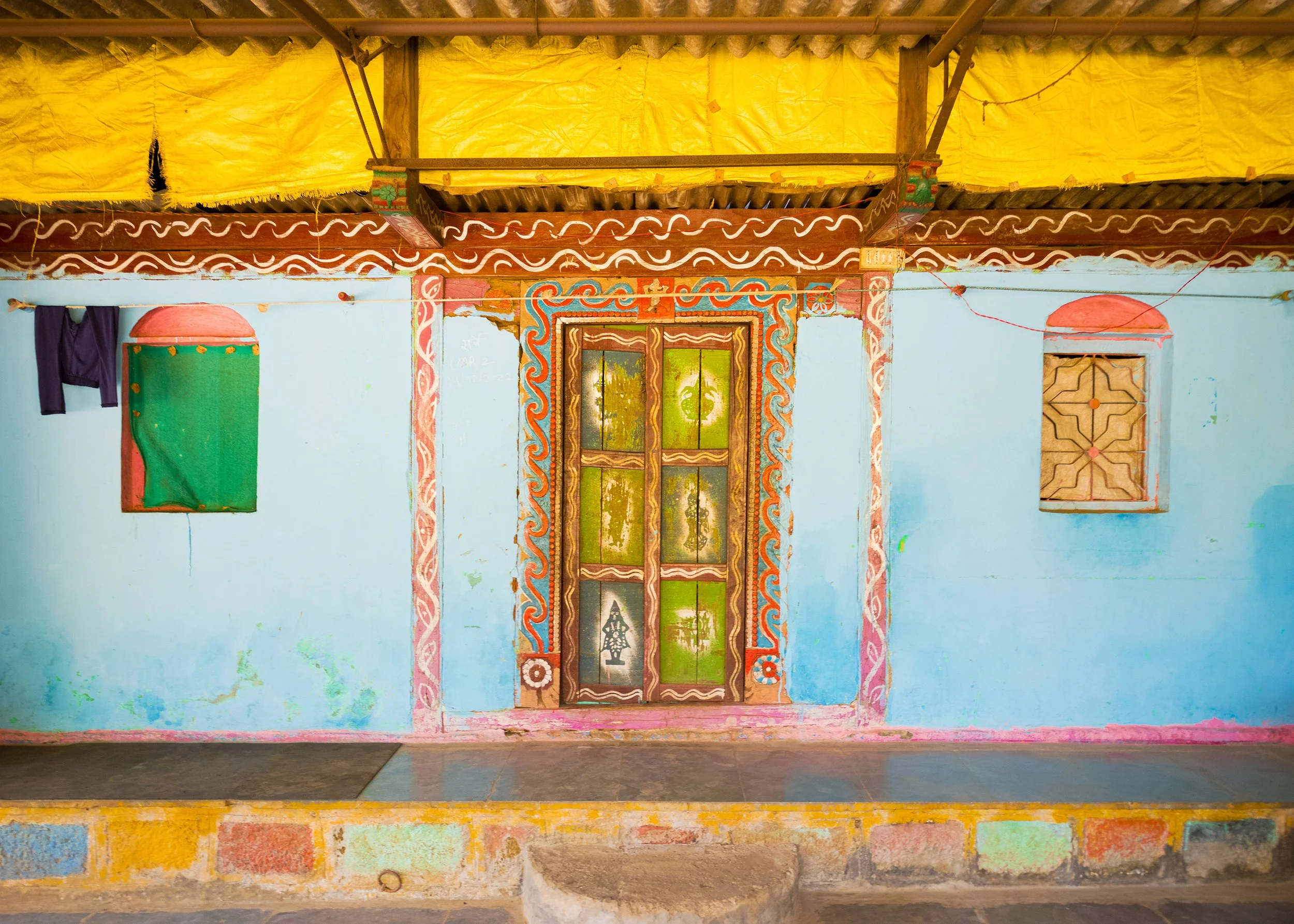
ehind the Door of the Mind Exists the Shoreless Lake of Peace, 2023

In “Behind the Door of the Mind Exists the Shoreless Lake of Peace, 2023,” I photographed a house front with my Leica M11 and a 21mm lens, placing its closed door at the center. Soft blue walls meet red, yellow, and green details, while a yellow cloth overhead warms the light. Clouded glass, cracked paint, and worn edges give the scene a lived-in texture. I was drawn to the balance of color and the stillness of this ordinary entrance.

The door became a way for me to reflect on the mind and the peace we seek within it. Its glass hints at something beyond without revealing it, inviting patience and attention. The title expresses my sense that peace can be encountered by becoming still enough to notice what is already present. Making this photograph was a moment of that practice: pausing, looking closely, and allowing a familiar form to deepen my reflection.
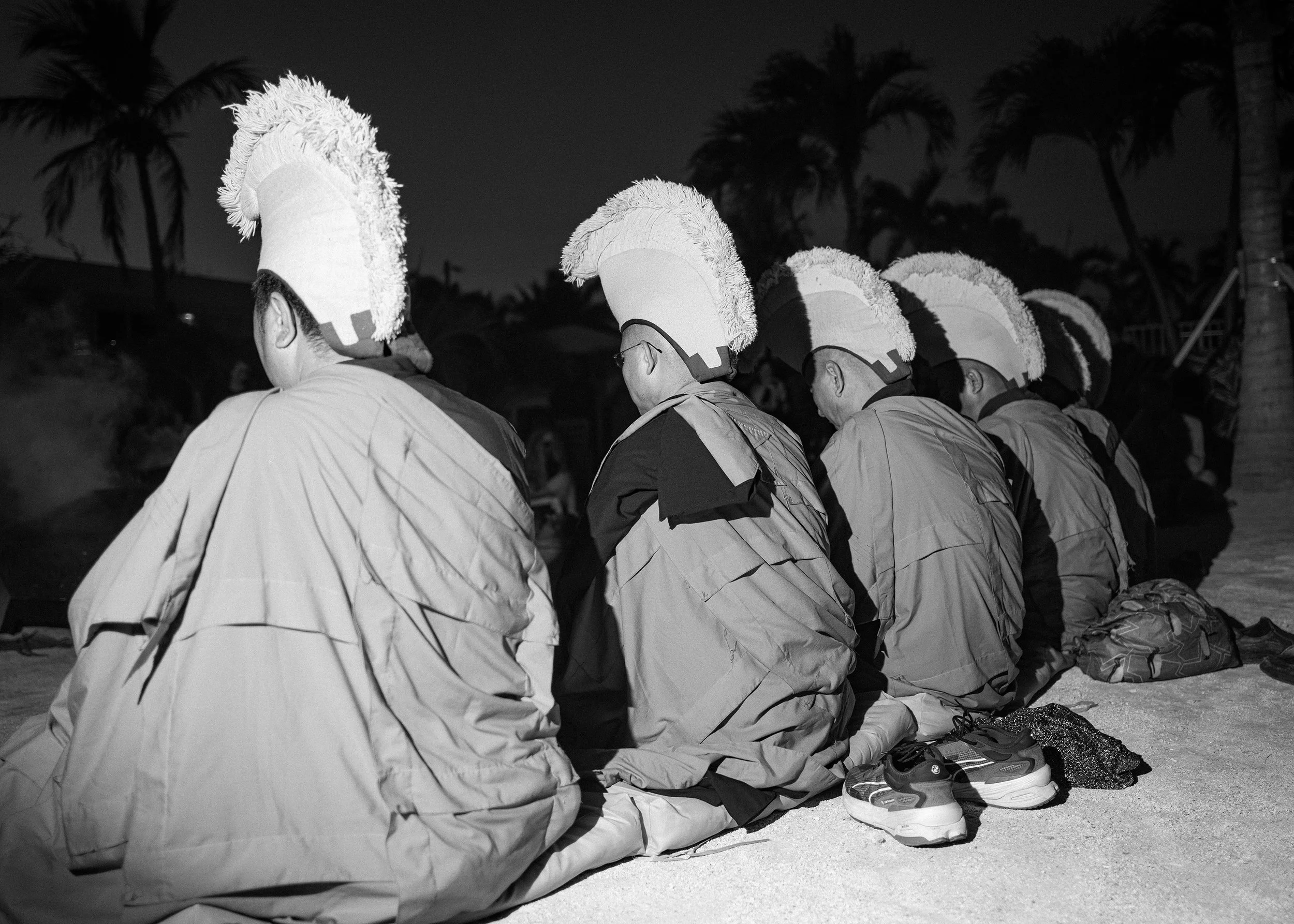
Maha Bekandze, 2025.

In “Maha Bekandze,” I photographed a line of Tibetan monks seated outdoors at night, their backs turned toward the camera and their heads slightly bowed. Light catches their layered robes and textured ceremonial headpieces, while palm trees recede into darkness. Shoes and bags rest at their feet, grounding this shared moment of prayer in the everyday details of their lives.

Made during a fire ceremony with monks connected to Drepung Gomang Monastery, the photograph reflects spiritual practice and the preservation of Tibetan traditions in exile. The title draws on a healing chant, echoing the care and compassion I associate with this gathering. For me, the image holds stillness alongside resilience, inviting attention to the people who sustain these teachings and share them across communities.

Glimpse of One’s Essential Universality, 2023.

I made “Glimpse of One’s Essential Universality” in Ellora, photographing a passing truck from the back of a moving bike. Using my Leica M11, a 21mm lens, and a slow shutter, I captured its yellows, oranges, and greens stretching across the frame. The road tilts, edges blur, and roadside figures nearly disappear into the movement. The photograph holds something of my first encounter with India: heat, color, and life unfolding faster than I could take it in.

As part of Swayam Jyotis, this image reflects my growing awareness of impermanence and the limits of perception. The blur carries the feeling of being immersed in a place while still learning how to see it. Its title speaks to a fleeting recognition of connection, a sense of something shared within the constant movement of life. Looking at it now, I return to that moment of traveling, observing, and allowing the experience to unfold.
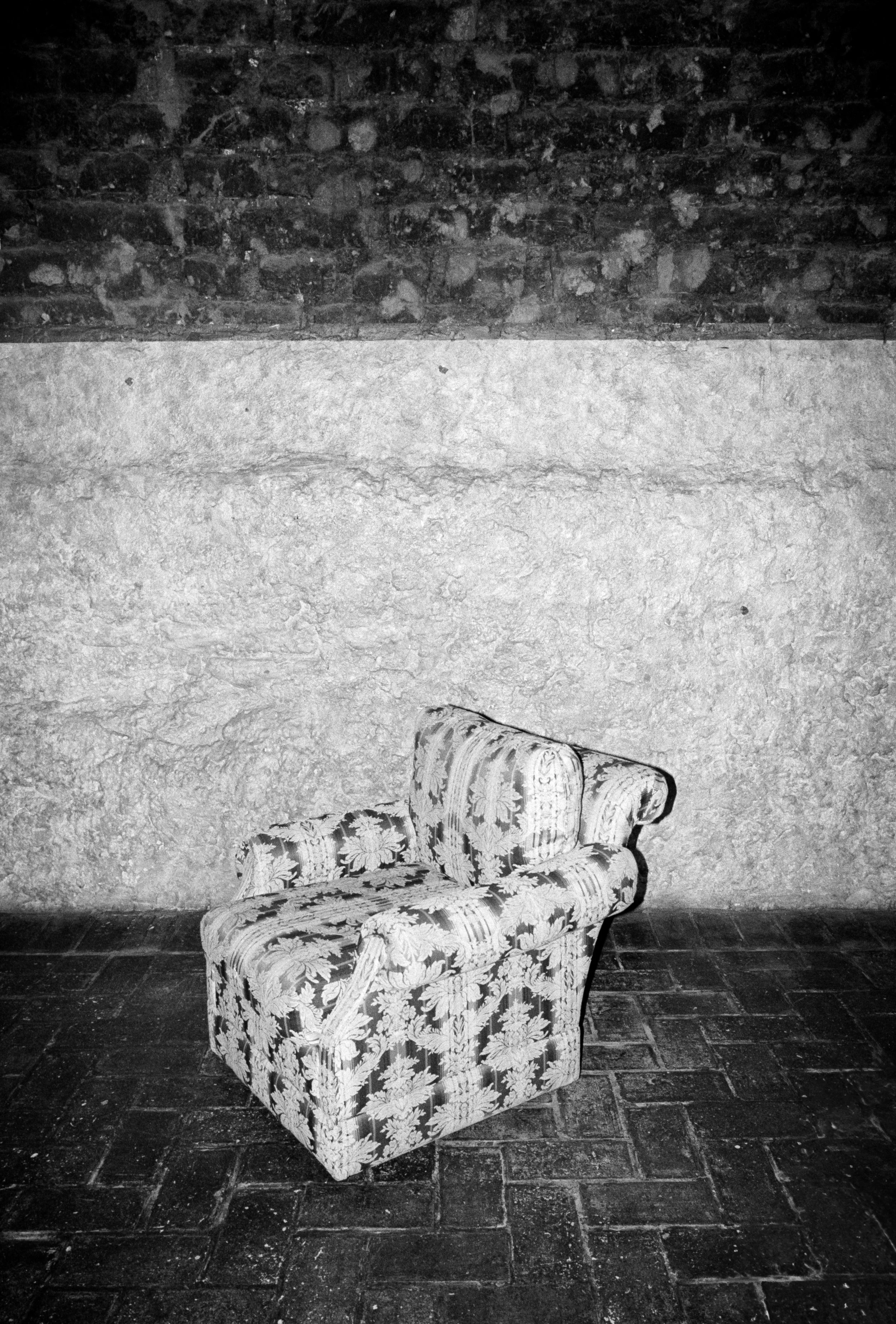
Hacienda Still Life, 2025.

I made this photograph shooting Kodak Tri-X 400 at a hacienda where I stayed in Ecuador, as part of my travels through Cuenca and the surrounding Andes. An empty armchair against a worn wall, people gathered around a guitarist, and framed family photographs drew my attention to the lives held within a place. The film’s grain and contrast bring out the textures of walls, fabric, and skin, giving these everyday scenes the feeling of memory.

Across the series, interiors, portraits, roads, and mountain landscapes trace my movement between solitude and shared experience. I was interested in how people inhabit the land and how history remains visible in ordinary details. These photographs hold small impressions of what I encountered, shaped by curiosity and a wish to look carefully. They remind me how much there is to learn by spending time in a place and paying attention.
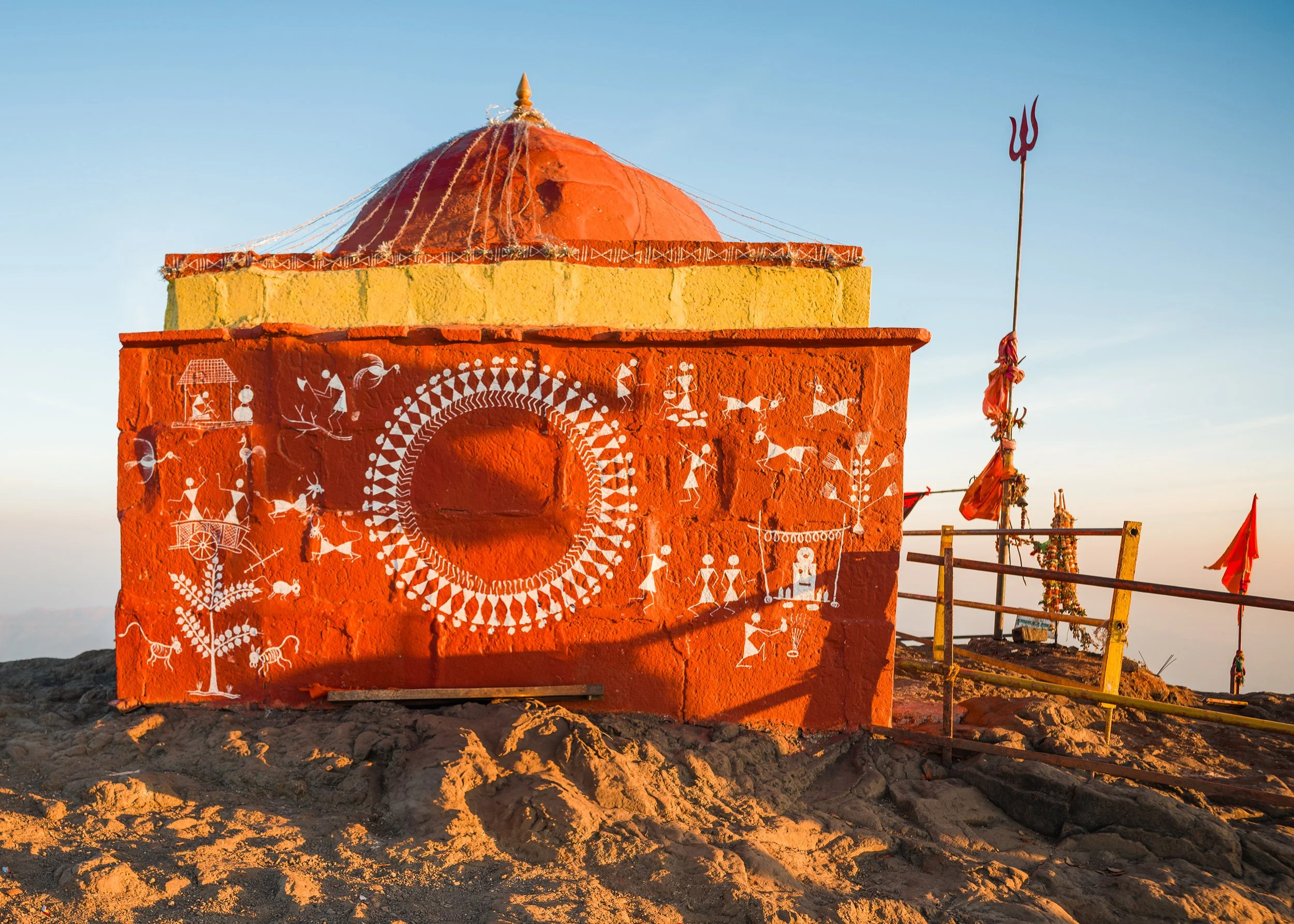
Kalsubai Peak, 2023
Kalsubai Peak, 2023

In “Kalsubai Peak, 2023,” I photographed a small red temple after a six-hour ascent begun in darkness with fellow yogis. White painted figures and animals wrap its walls, while morning light falls across the uneven ground. A railing and a trident tied with cloth stand to the right beneath an open sky. The 21mm Super Elmar lens allowed me to hold the temple and its surroundings together, giving a sense of the space we had climbed into.

The photograph carries my memory of that effort: fatigue, distractions, and the support of those walking beside me. Looking at it, I think about the restless mind and the clarity that sometimes comes through sustained attention. The open sky became a reminder of the self beyond life’s changing conditions. Reaching the summit gave me a moment to rest, look outward, and meet the journey with a wider perspective.
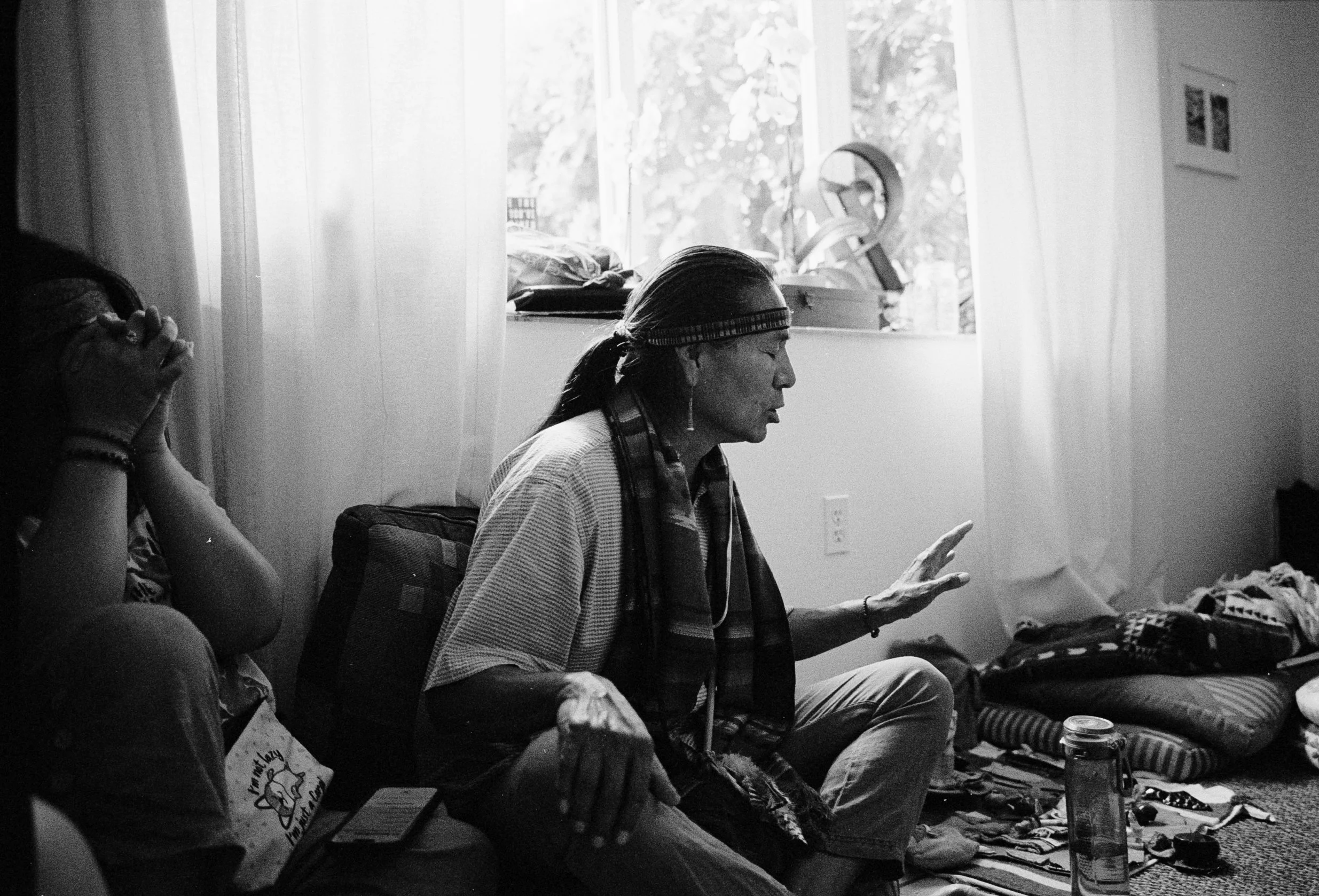
Beauty Way Daryl Slim, 2025.

I had the privilege of spending time with Darryl Slim, a Diné (Navajo) elder and traditional wellness educator, who guided us through a Beauty Way ceremony.

It was an opportunity to listen, learn more about the spiritual traditions of this land, and reflect on how I move through life. I left thinking about morality and principle. About keeping my word. About making choices that bring my actions closer to what I believe.

Darryl grew up in Sand Springs and Pinon on the Diné Nation. He learned traditional medicine from his grandparents, Danny and Aurora Joe. Today, he shares those teachings through ceremony, retreats, and personal mentoring, supporting people through grief, family challenges, and questions about their direction in life.

What stays with me is the responsibility to practice what I receive. To carry these lessons into how I speak, how I treat others, and how I care for the land beneath my feet.

Thank you, Darryl, for welcoming us and sharing your time, prayers, and guidance. I’m grateful for the opportunity to learn from you.

Learn more about his work at darrylslim.com.

Background and offerings drawn from Darryl’s website⁠.

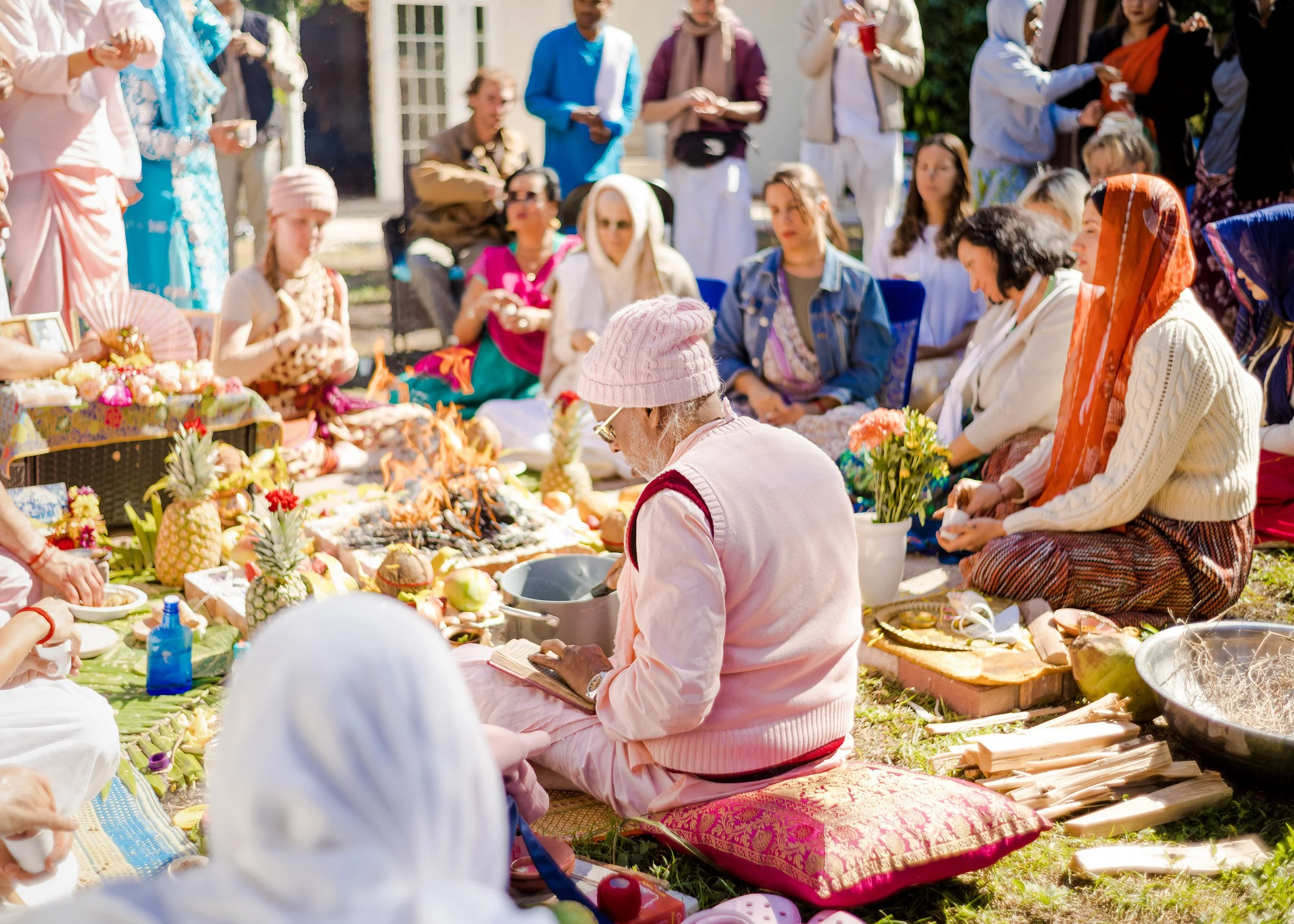
Sripad Bhaktivedanta Vana Maharaja, 2022.

I made this photograph of Sripad Bhaktivedanta Vana Maharaja during a fire ceremony at Sacred Vedic Arts in South Florida. Seated on a patterned cushion, he looks down at an open text as flames rise beside offerings of fruit and flowers. Devotees gather around him in the sunlight, sharing the ceremony. He was the first guru I met, at a time when I was beginning to study Vedic teachings and deepen my relationship with the divine. He gave me the name Nityananda, which I carry as a reminder of eternal bliss.

Born in West Bengal, Vana Maharaja entered the Gaudiya Vaishnava monastic community in 1981. He studied under Srila Bhaktivedanta Narayana Gosvami Maharaja and received initiation from Srila Bhaktivedanta Vamana Gosvami Maharaja. His life’s work centers on bhakti, loving devotion to Radha and Krishna, which he shares through teaching around the world. Looking at this photograph brings me back to those early days of listening and learning, when devotion began taking shape through prayer, community, and the guidance of teachers I was fortunate to meet.
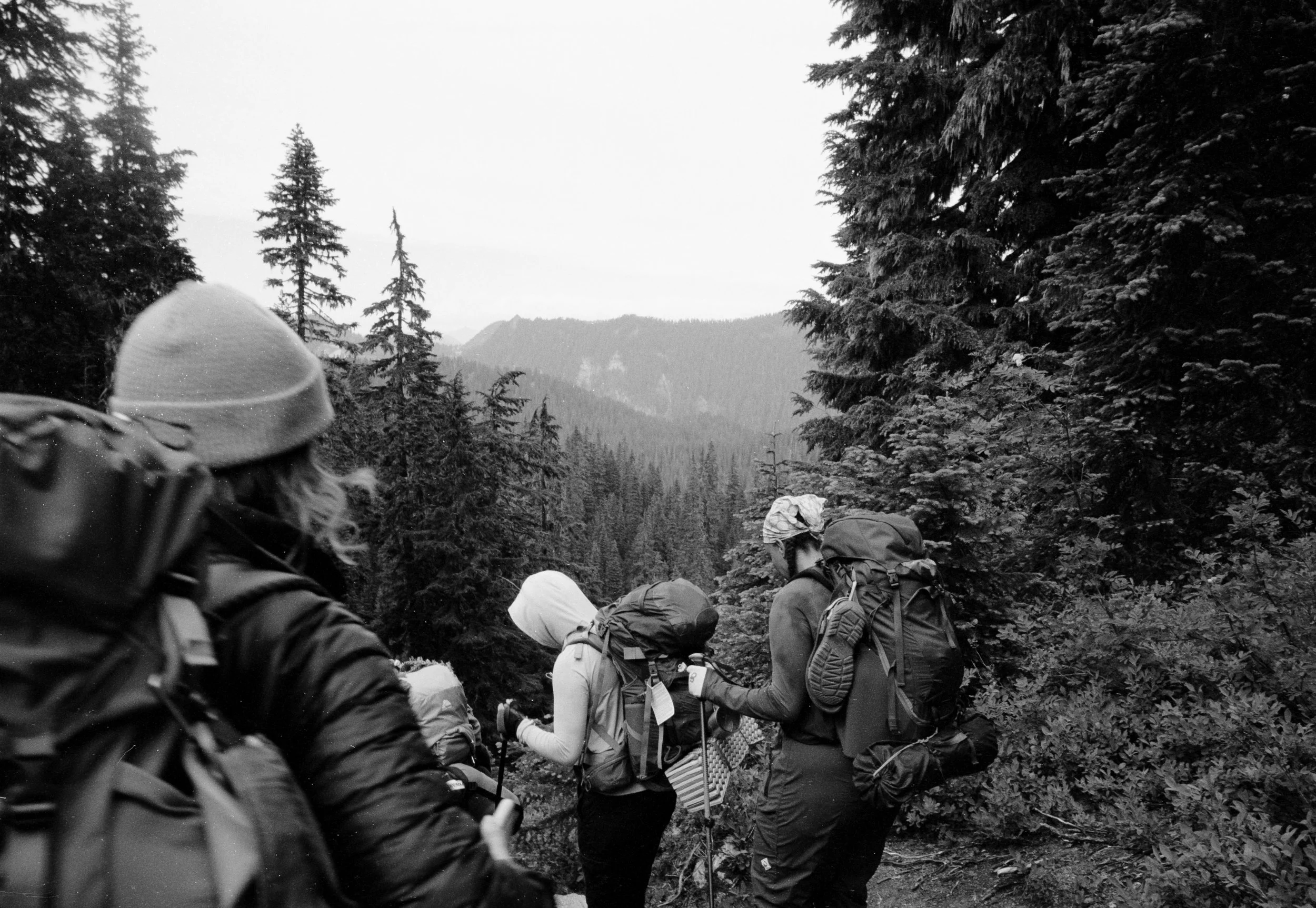
Learning the Pace of Belonging, 2025.

From behind my companions, I watched the trail open toward a valley of evergreens and a distant mountain ridge. Full packs, trekking poles, and layers against the mountain air filled the foreground, while the forest stretched far beyond us. I made this photograph during our July 2025 backpacking journey on Washington’s Pacific Crest Trail. Looking at it now, I remember how walking together brought attention back to simple things: finding steady footing, noticing someone’s pace, and making room for a pause.

Led by @pachamary04 and @ecocentrismo, our 11-mile round-trip expedition followed a skillshare approach, bringing Council, ritual, and ecopsychology into our time outdoors. There was room to listen to one another and to notice what the landscape stirred within us. For me, belonging became tangible through the shared effort of the walk—the weight we carried, the care we offered, and the forest surrounding us. Each step was a chance to practice being present in a world we are already part of.
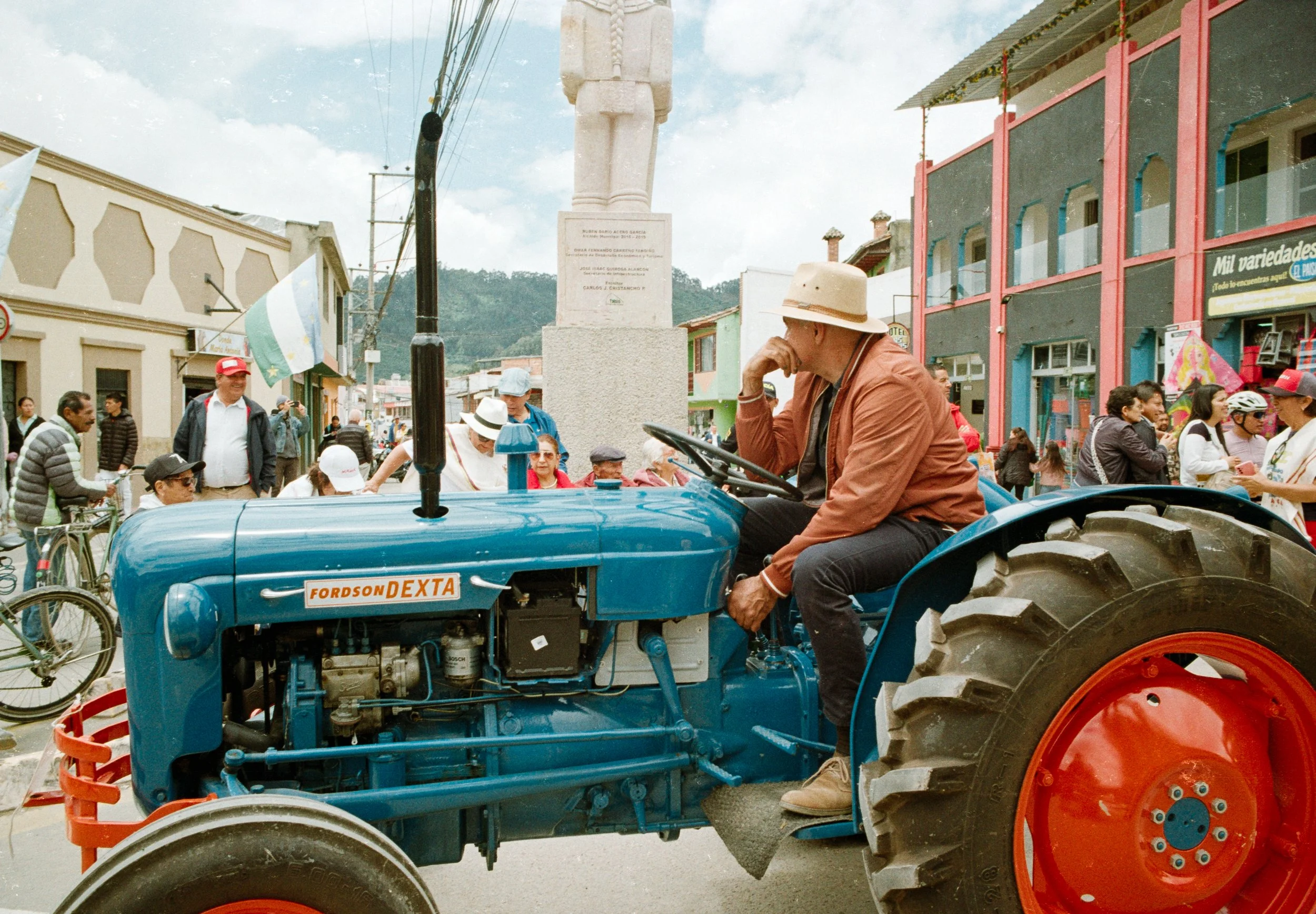
No One Around to Hear It, 2025

In this photograph from Tabio, a man leans forward on a vintage blue Fordson Dexta tractor, pausing amid the activity of the town square. Behind him, people gather near a monument, a Colombian flag waves, and pastel buildings sit beneath green hills and a clouded sky. Shot on Kodak ColorPlus 200, the scene holds soft blues and earthy tones, punctuated by the tractor’s red wheel rims.

I titled the photograph “No one around to hear it.” His stillness within the gathering made me think about the thoughts we carry privately, even when surrounded by others. I cannot know what occupied his mind, but his posture drew my attention to that possibility. The image holds a shared public space and a moment that feels quietly personal.
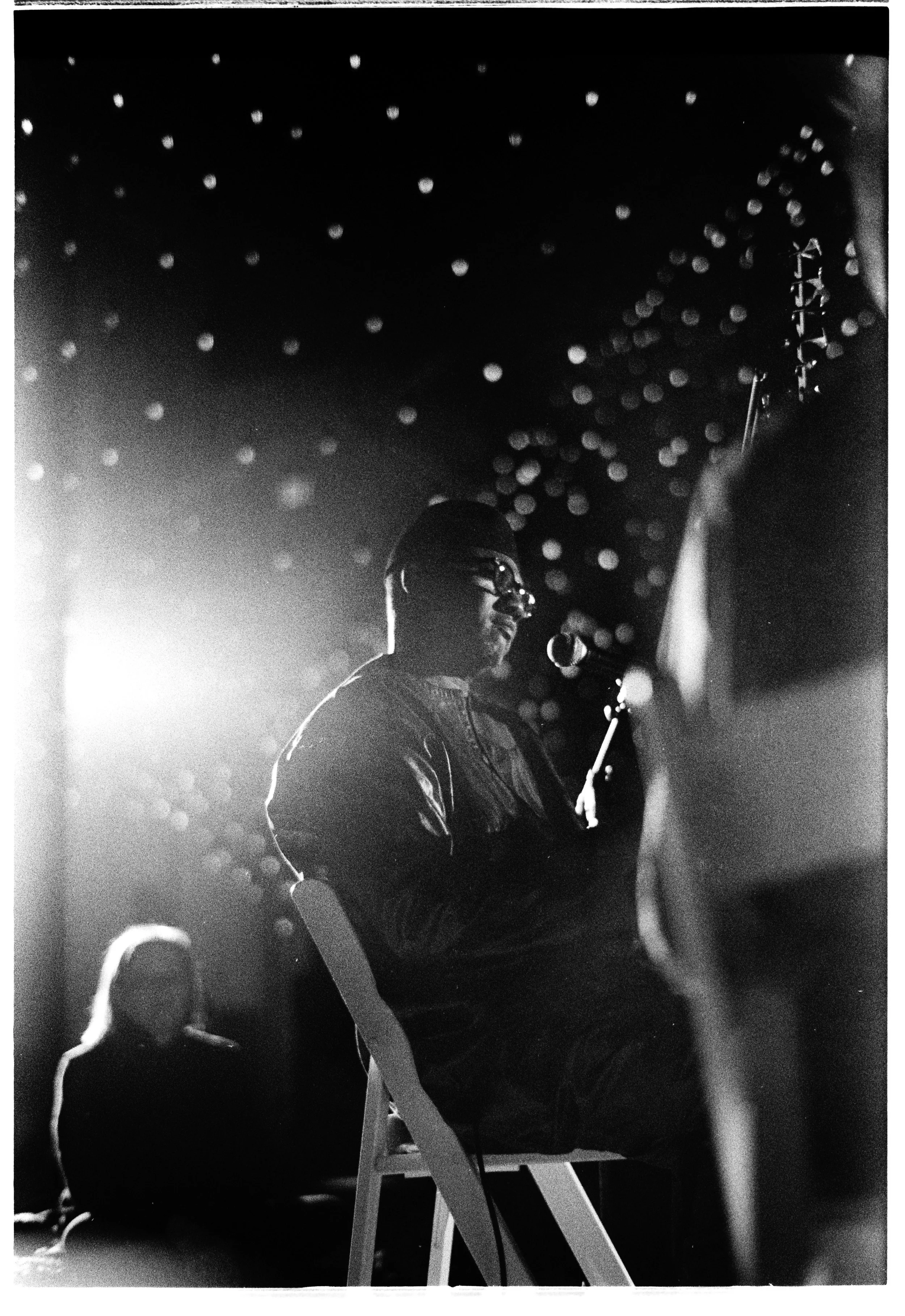
Where Listening Becomes Stillness, 2026.

Light spills from behind Ablaye Cissoko, tracing his shoulder while small points of light scatter across the darkness above him. Seated at the microphone, his face partly in shadow, he holds my attention within a frame softened by grain and a blurred figure in the foreground. I made this photograph during the Well-Being Concert presented by @liveartsmiami in partnership with Carnegie Hall. It was an unforgettable night, one that invited me to slow down, listen, and let the music guide my attention.

Born in Kolda, Senegal, into a family of griots, @ablayecissoko carries a lineage of storytelling and music through his voice and kora, the West African harp-lute. His work brings Mandinka traditions into conversation with contemporary music and artists from around the world. As someone who tells stories through photographs, I felt drawn to that continuity: a person carrying what he has inherited while making something distinctly his own. This portrait brings me back to the quiet pleasure of being there, sharing a room with others and giving ourselves time to listen.
What We Made in the Pause, 2025.

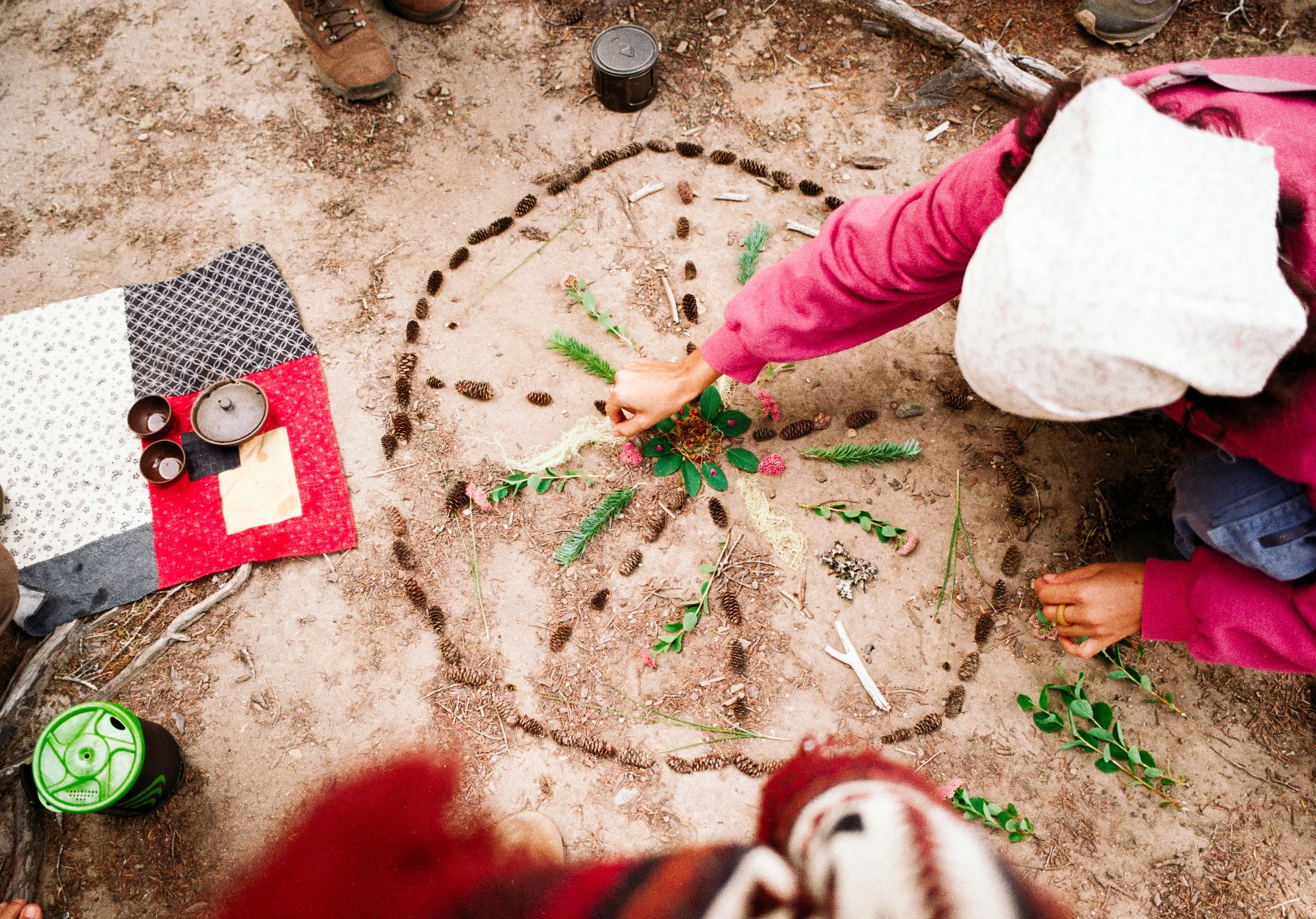
During our July 2025 backpacking trip on Washington’s Pacific Crest Trail, we stopped to rest and make something together. On the forest floor, our group arranged cones, twigs, leaves, flowers, and lichen into a natural mandala. In this photograph, a companion leans forward to place another piece near its center. Hiking boots edge into the frame, and a small tea set rests on a patchwork cloth nearby. I was drawn to the care in that gesture, each person contributing to a pattern taking shape between us.

This was part of the intentional time we shared with @pachamary04 and @ecocentrismo, bringing creativity and reflection into the journey. Making the mandala gave me a reason to look closer at what surrounded us: the shape of a leaf, the texture of a cone, the small colors against the soil. Our attention settled into the work of our hands. Looking at this photograph, I remember how much a simple pause can hold when we give it our attention.
Before the First Step, 2025.

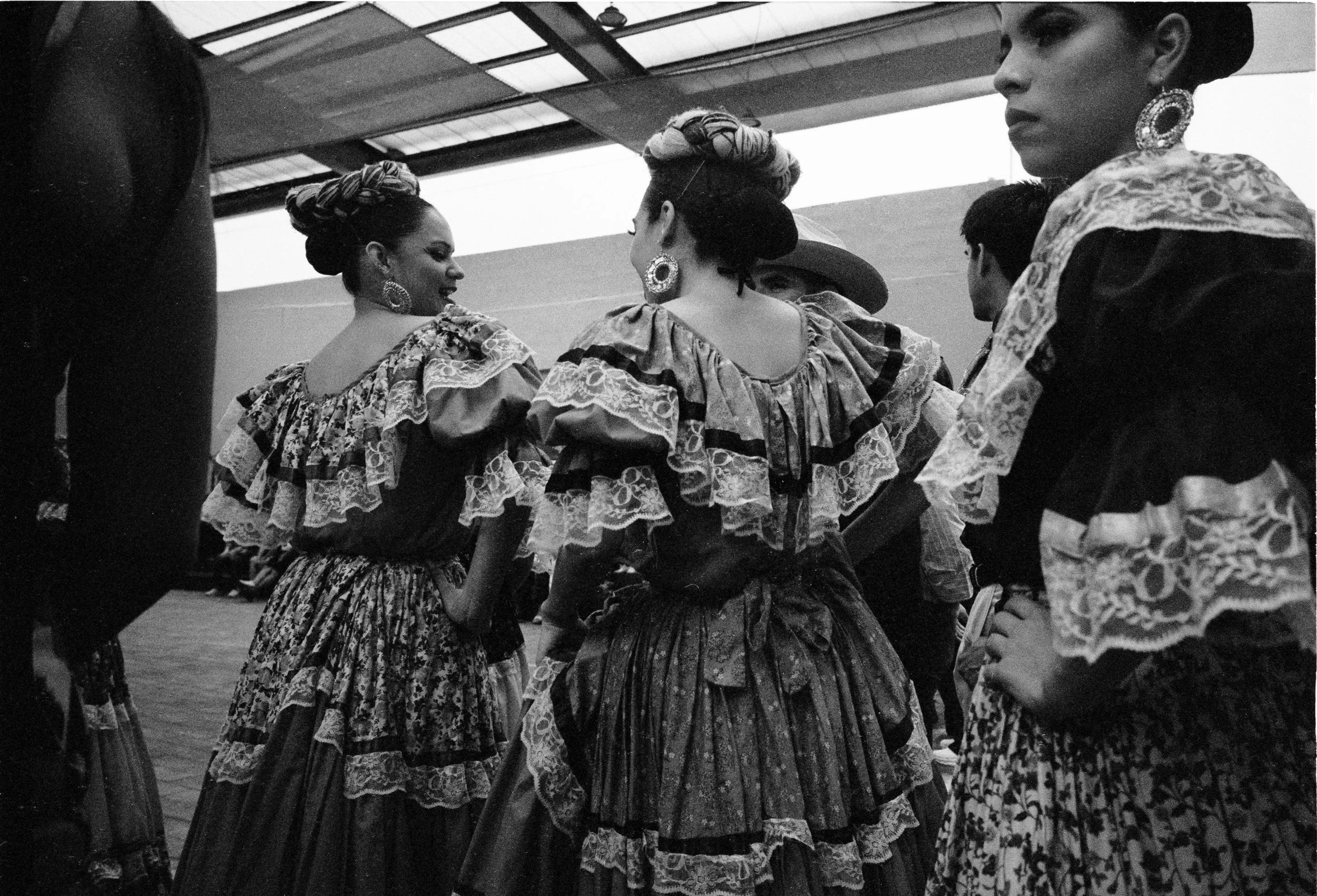
On my first day in Ecuador in 2025, I was walking through Guayaquil with my camera when I came across a local celebration filled with art, cacao, music, and traditional dance. These women were preparing to dance when I made this photograph. Lace and layered ruffles fill the frame, with large circular earrings and patterned fabric woven around their pinned hair. Two turn toward one another, while the woman nearest me looks beyond the frame, her hand resting at her waist. I was drawn to this moment of gathering before the dancing began.

Finding my way through an unfamiliar city, I felt grateful to encounter people sharing something meaningful to them. The photograph brings me back to the small gestures around a celebration: a conversation, a glance, the time spent getting ready. These moments matter to me as much as the dance itself. I photographed this on Ilford HP5 400 with my Leica M6, a 28mm Summicron f/2 lens, and an orange filter, holding the textures and expressions of that first day in black and white.
The Road Back to Delhi, 2024.

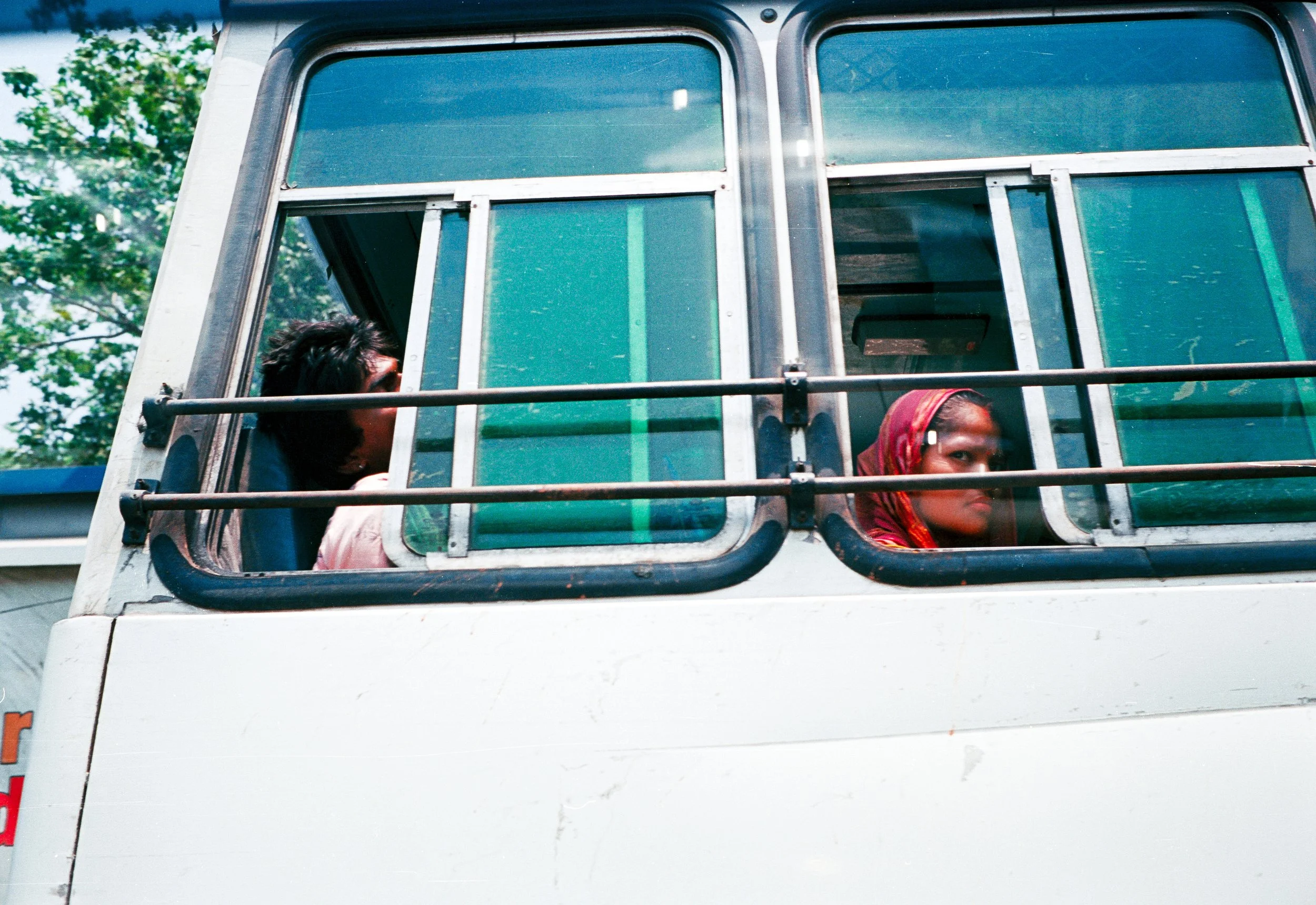
After leaving the ashram, I began the six-hour journey back to Delhi with only a couple rolls of film remaining. Through the green-tinted windows of a passing bus, a woman wrapped in red met my camera with a direct gaze while another passenger faded into shadow beside her. The silver frames and horizontal bars divide the scene into painted panels of turquoise, white, black, and red. Made in an instant between two moving vehicles, the photograph holds the quiet tension of departure: unfamiliar lives briefly meeting before the road carries each of us in a different direction.
Between Departures, 2025.

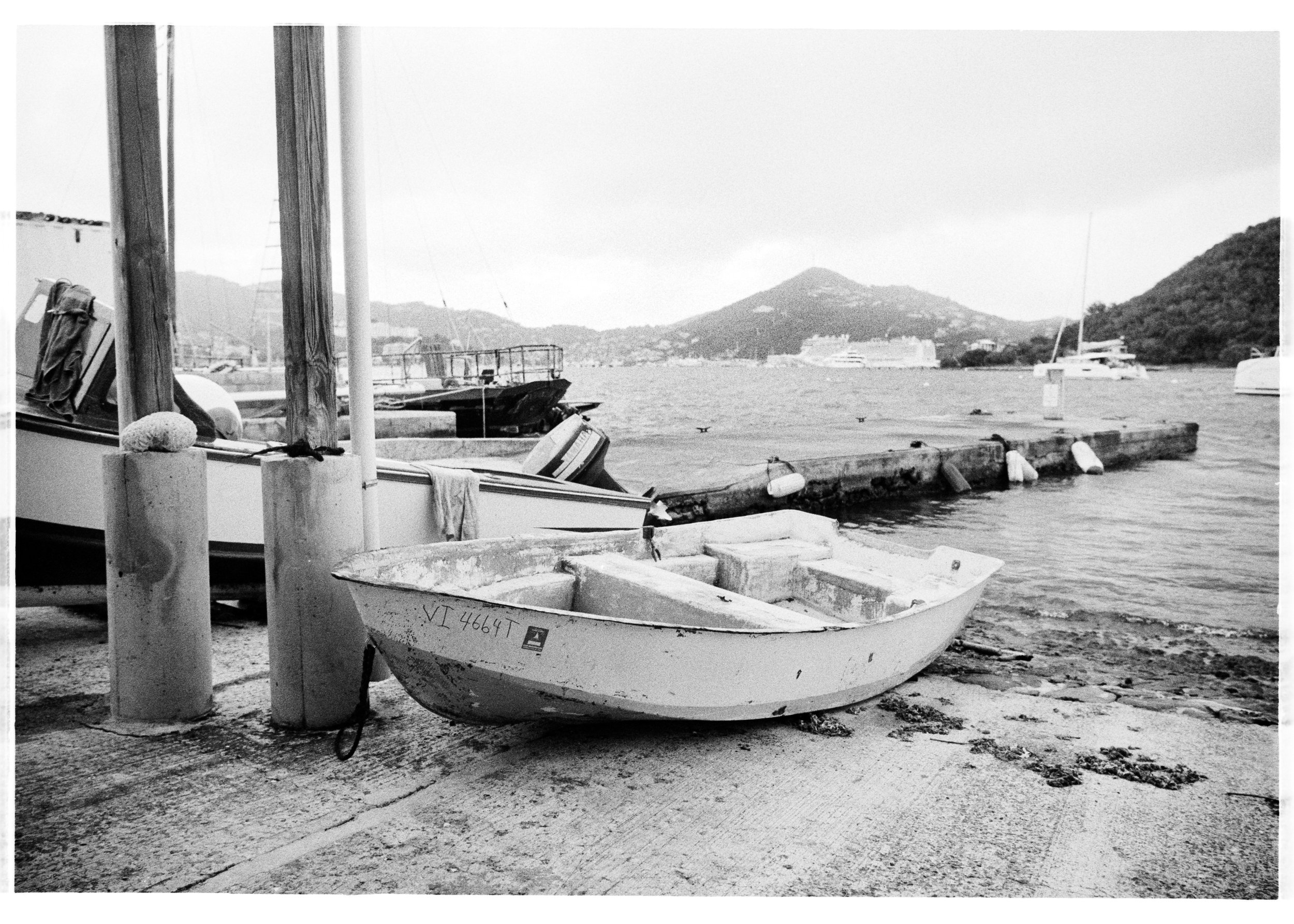
On an overcast day at Frenchtown Marina in St. Thomas, I stopped before this small boat resting at the water’s edge. Its worn paint, the upright posts, and the low dock drew my eye toward the harbor and hills beyond. Photographed on Kodak Tri-X 400 with my Leica MP and a 28mm lens, the soft light gave me space to study the textures of a place shaped by salt, weather, and use.

Frenchtown, historically known as Carenage, became home to families who migrated from Saint Barthélemy during the nineteenth century. Fishing helped sustain the community; residents built boats, made nets, and fashioned fish traps. Learning this history deepens what I see here. Coming from Saint Lucia, I feel close to these island stories of movement and making a living beside the sea. I don’t know this particular boat’s journeys, but its presence made me pause and consider the lives that begin and return along this shore
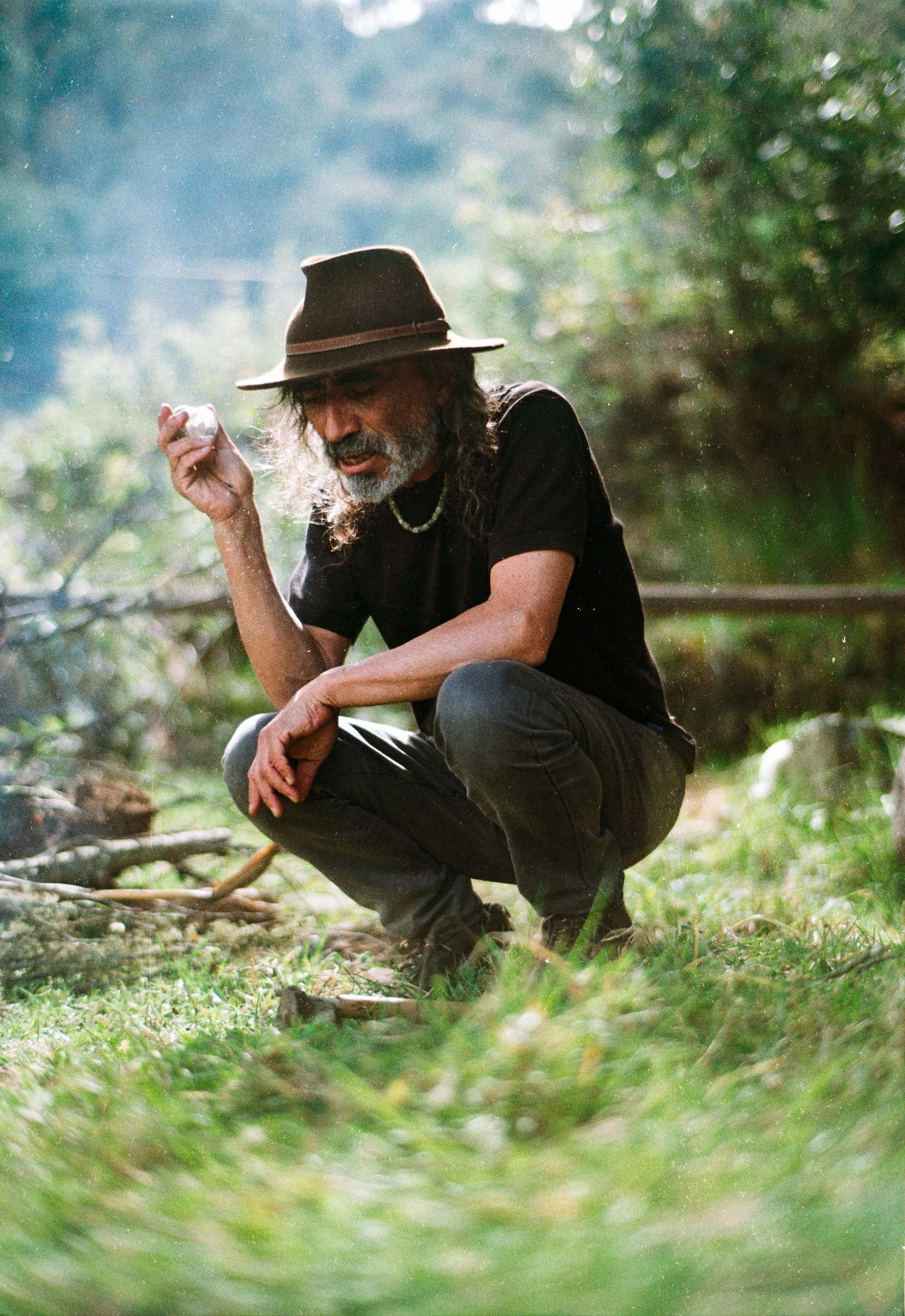
Taita Ivan Navarro, 2025.

I made this portrait of Taita Ivan Navarro during a hike through the mountains of Ecuador, just before we sat together for ceremonial prayer. He crouches close to the grass, one hand raised and the other resting across his knee. Sunlight catches his long hair and gray beard beneath a broad-brimmed hat, while the trees soften into green behind him. I remember his quiet manner, his deep eyes, and how comfortably he moved through the land. He was an excellent musician, too, someone whose presence encouraged me to slow down and listen.

Originally from Chile, Taita Ivan brings more than four decades of experience to his ceremonial work. His offerings include limpias, spiritual cleansing practices, and ceremonies centered on connection with nature. What stayed with me was the person I encountered on that walk: thoughtful, attentive, and generous with what he knew. This photograph holds a pause before our gathering began, when I could give him my attention and carry a small memory of our time together.
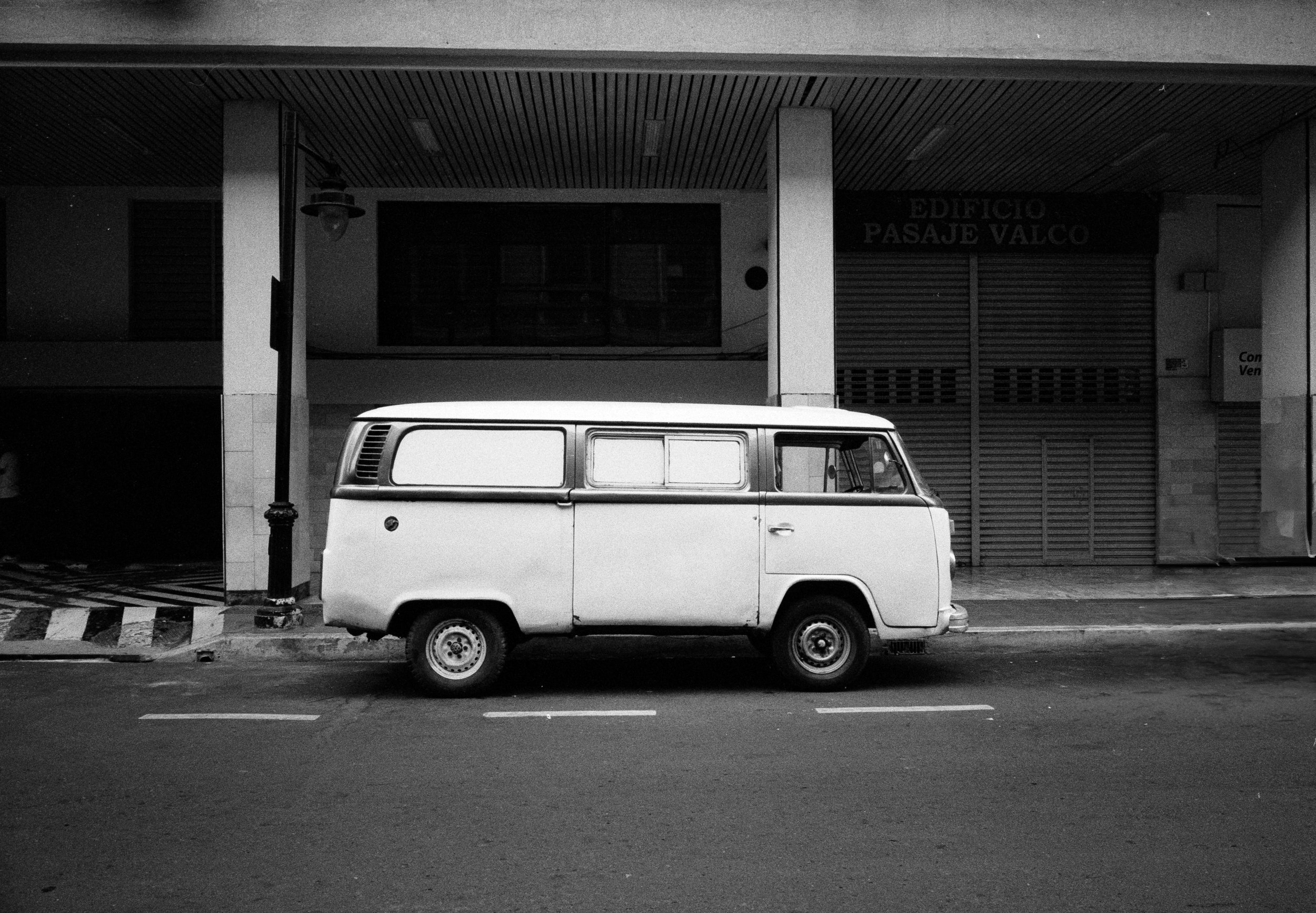
Crooked the road, 2025.

My Ecuadorian journey began in Guayaquil, where I met my friend Danil before our expedition to Cuenca. We left the Airbnb to explore the streets beneath an overcast sky. There was a melancholy to the day and a noticeable police presence, but I felt safe walking with my Leica M6 and 28mm Summicron. Of the fifteen rolls I brought, two were Ilford HP5 400. I enjoy these unplanned walks. They give me time to find my footing in a new place, and the camera’s discreet design helps me photograph without drawing much attention.

This VW Bus stood out from that first roll. I’ve always loved them as street furniture, carrying traces of another era into the present. I’m constantly looking for older, uncommon things, and vintage vehicles bring music, romance, and imagined journeys to mind. There is something tender about photographing a machine that has lasted this long, still here before it finally runs out of steam. Its wear reminds me that a life well traveled leaves marks. I keep walking, looking, and learning as I go.
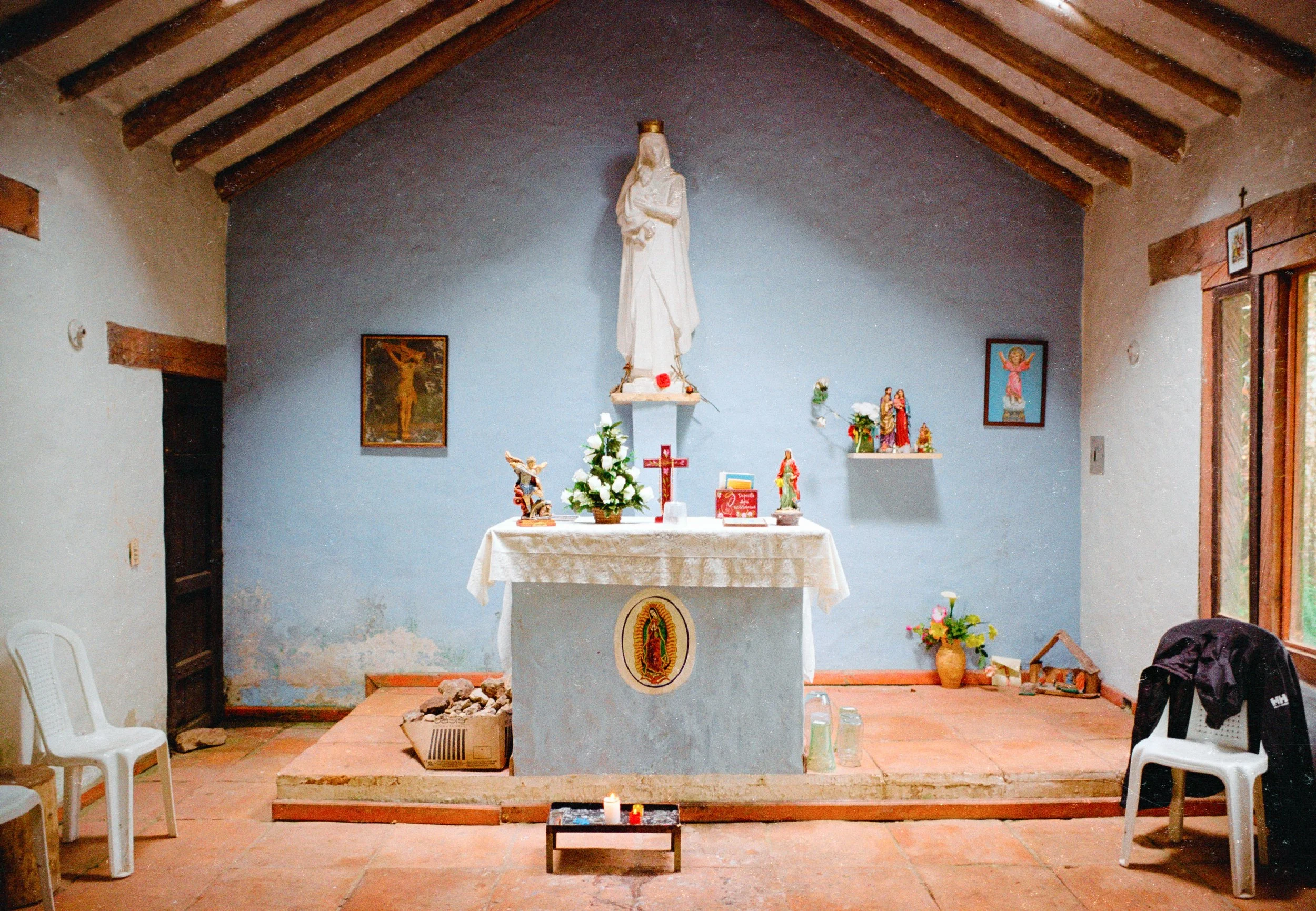
Last Summer’s Refuge from the Storm, 2025.

In “Last Summer’s Refuge from the Storm,” I photographed a modest rural chapel after harsh weather halted our ascent up Peña de Juaica. Against a pale blue wall, a white statue of the Virgin stands above an altar surrounded by flowers, candles, and an image of Our Lady of Guadalupe. Exposed wooden beams, worn plaster, and an empty plastic chair give the room a humble, lived-in character. Soft light and the warmth of Kodak Gold 200 hold the stillness of this shelter.

What began as a climb became a lesson in surrender. Turning back meant respecting the conditions and accepting what the mountain allowed that day. Inside the chapel, I found a quiet place to pause and reflect. Though no one appears in the photograph, the care given to the altar reveals an ongoing presence. I remember this refuge with gratitude, and the reminder that knowing when to stop can be part of the journey.
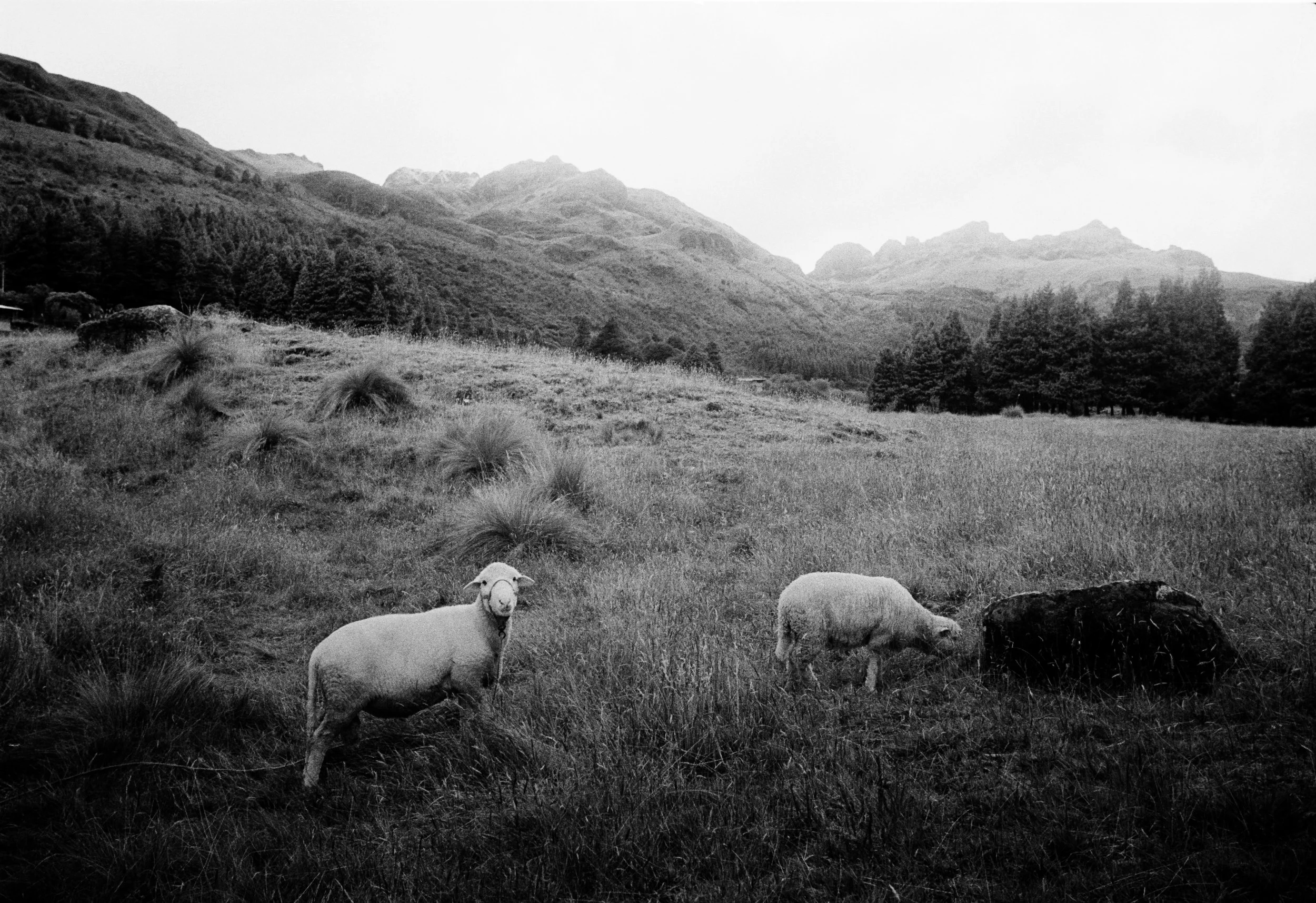
Myth of Tomorrow, 2025.

During one of my last adventures of 2025, I traveled through Cuenca and the surrounding Ecuadorian Andes, making photographs and learning about the region’s Indigenous cultures. I made “Myth of Tomorrow” while visiting a site of devotion to Mother Mary near El Cajas National Park. Two sheep stood in the grass before dark trees and layered mountains. One turned toward my camera while the other continued grazing. With the sun ahead of me, I patiently composed the scene and used wireless Lightpix flashes to illuminate the foreground, shooting Kodak Tri-X 400 with my Leica M6 and an orange filter.

The photograph brings me back to the importance of presence. I was occupied with light, timing, and composition while the sheep went about their lives. Their quiet activity reminded me to pay attention to where I stood. I chose the title because tomorrow remains an idea; this moment is where we can act, feel, and make choices. Photography helps me practice that attention, bringing me back to what is unfolding before me.
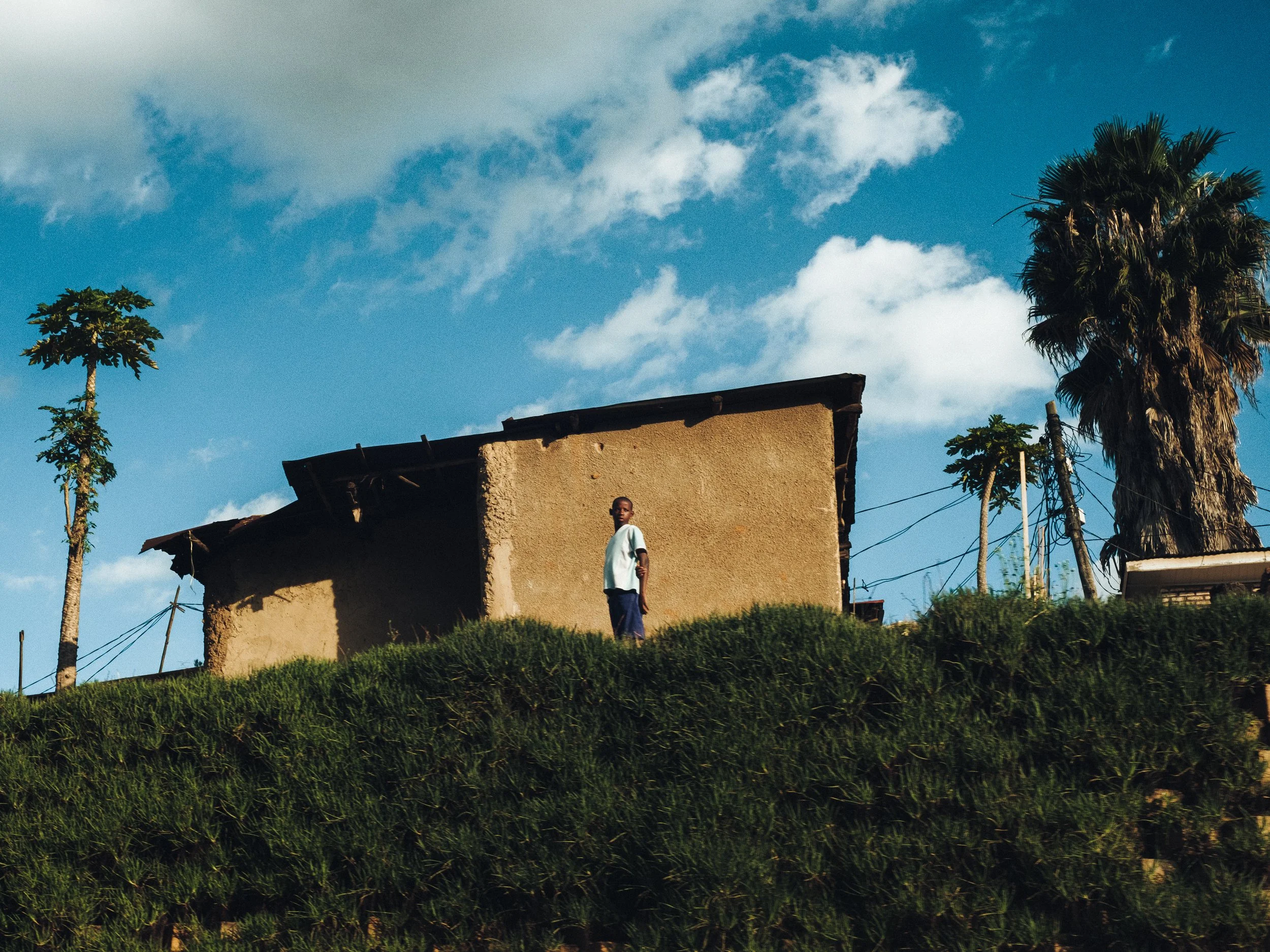
On watch Kigali, 2019.

In 2019, I traveled to Kigali, Rwanda, with my father. We share a love of cameras, and several of my journeys through Africa in my twenties were spent beside him. This time, I was also helping him look for land for a new home. Our days took us through rolling hills and villages, giving me opportunities to photograph along the way. Here, a young person turns toward my camera from a grassy slope. Behind them, sunlight warms a textured ochre wall, while trees and overhead wires reach into a blue sky filled with clouds.

I was drawn to the scale of the sky and that brief glance connecting us across the frame. Traveling with my father gave these photographs another layer of meaning. They hold memories of looking together, following unfamiliar roads, and considering where he might build a life. I returned to this RAW image many times while editing, finding my way toward the color and atmosphere you see here. It remains a small encounter from a journey I’m grateful we shared.
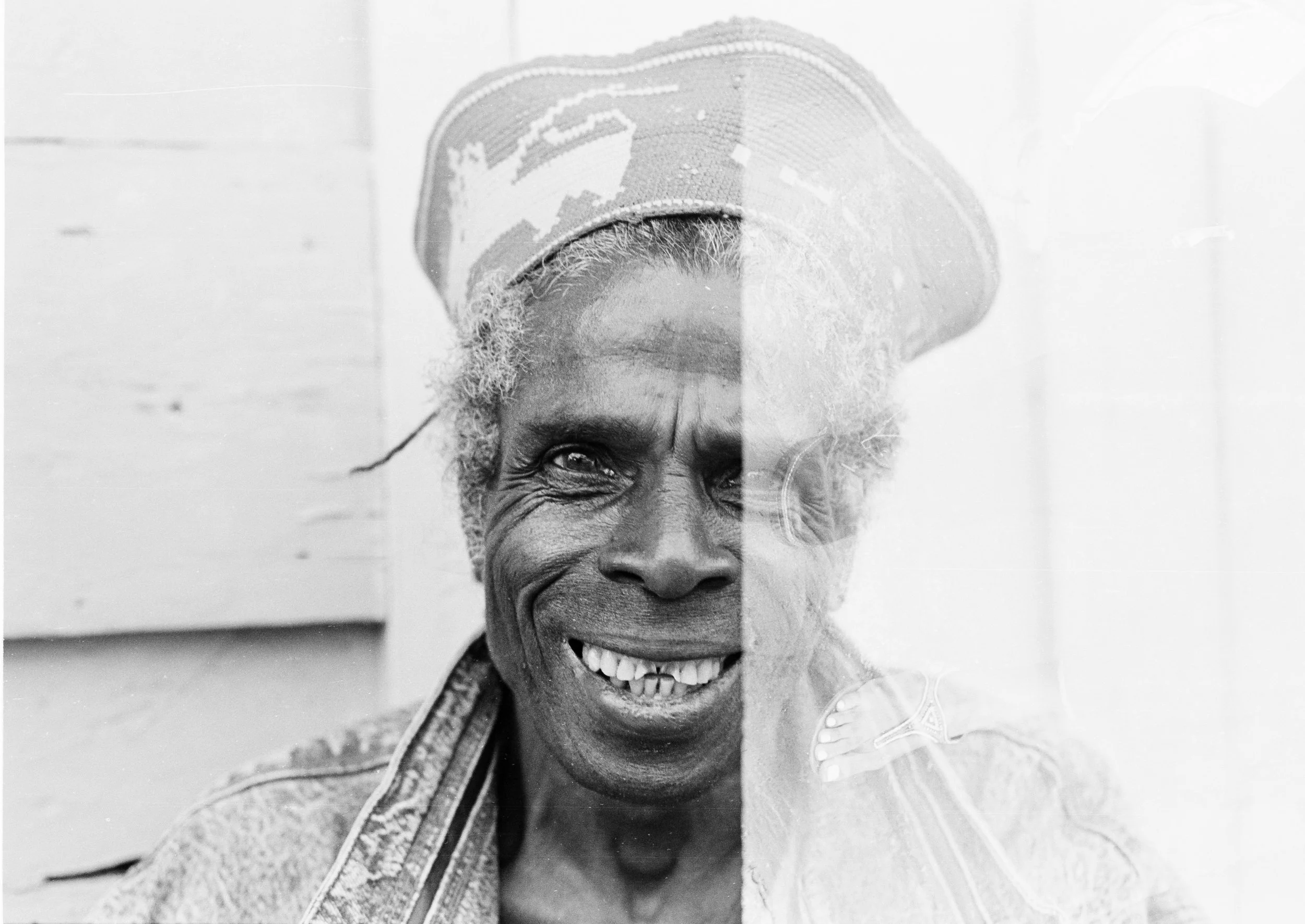
Where the Light Begins. Saint Lucia, 2016.

A smile from home, made while I was still learning to see through 35mm black-and-white film. I photographed this man during one of my first semesters studying photography and developing my own negatives. His knitted hat, patterned collar, and the lines around his eyes give the portrait its texture. But his smile is what holds me. Open and immediate, with his gaze meeting mine. What appears to be the beginning of the film strip carries a wash of light across one side of his face. Part of the portrait fades, while the other remains full of detail. I love how that uncertainty sits beside such a clear human expression.

Looking back, I see two beginnings here: the edge of a roll of film and my own first steps as a photographer. Before I fully understood exposure or development, I was already drawn to people and the quiet connection a portrait can hold. This photograph brings me back to Saint Lucia, and to the simple pleasure of seeing someone smile through the viewfinder.
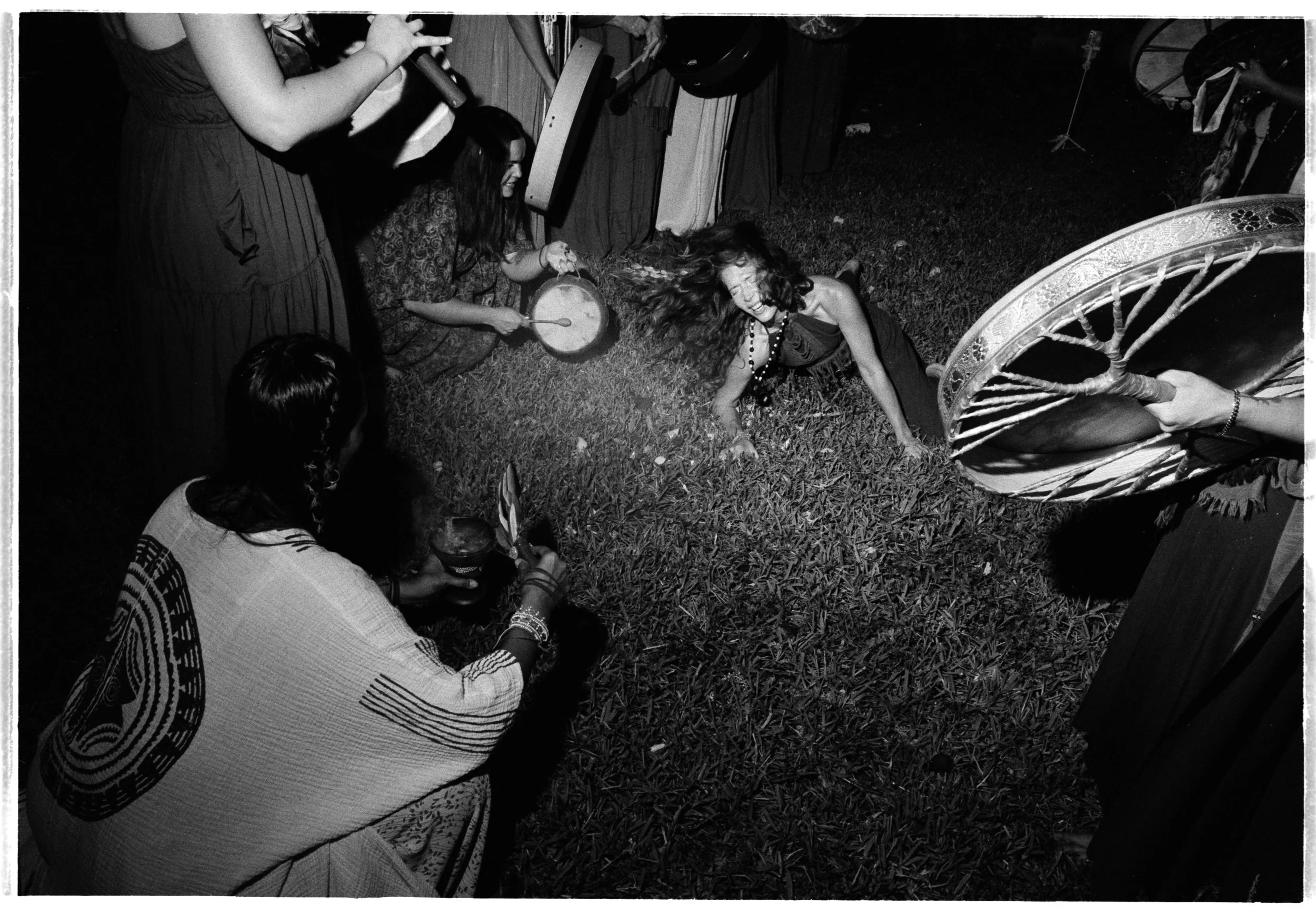
The Earth Receives Her, 2026.

The circle opens around a woman lowered to the grass, her body caught between surrender and return. Hard light cuts through the darkness, turning faces, hands, drums, and strands of moving hair into bright gestures against a field of black. The women surrounding her appear like figures gathered within a nocturnal painting. One beats a small drum close to the earth, another holds feathers and smoke toward her, while a large drum curves into the frame like a shield. Everything leans toward the woman at the center, as if the entire circle has become a single body holding her.

What appears at first to be collapse slowly reveals itself as release. She is not alone in the darkness. Rhythm, prayer, and human presence surround her while the ground receives what her body can no longer carry. The photograph holds the intensity of transformation without explaining it. It preserves the moment when ceremony moves beyond performance and becomes something lived, where drumming becomes language, witnessing becomes care, and darkness is turned into a place of healing. Photographed on Kodak Tri-X 400 with my Leica MP.
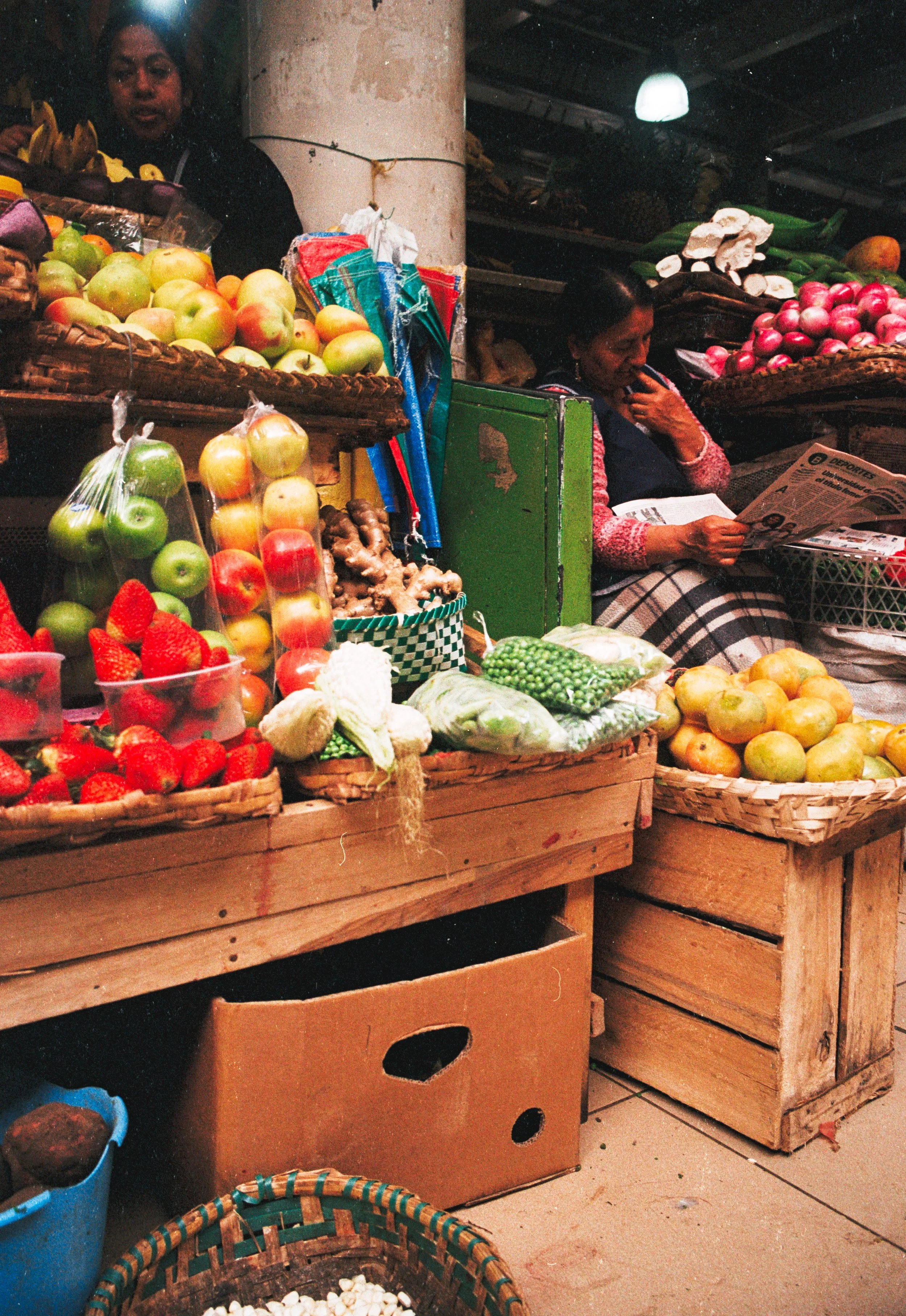
Cuenca Market side-quest, 2025

In 2025, I traveled to Ecuador with a camera and a wish to understand a little more of the world. At this market stall, baskets of apples, strawberries, citrus, and vegetables fill the frame with color. Behind a worn green partition, a woman reads a newspaper, one hand resting near her lips, while another looks toward my camera from beside a concrete column. I was drawn to these two different moments of attention, surrounded by the produce and wooden crates of a working day.

Much of my time in Ecuador was spent walking through Cuenca, letting everyday life guide my eye. Markets brought me closer to the people and labor behind what nourishes a city, but this photograph also holds a quieter detail: someone finding time to read amid it all. A frame can preserve a gesture without revealing a person’s whole story. I’m grateful for these encounters and for the reminder to stay curious, look carefully, and keep learning from the people who call this place home.
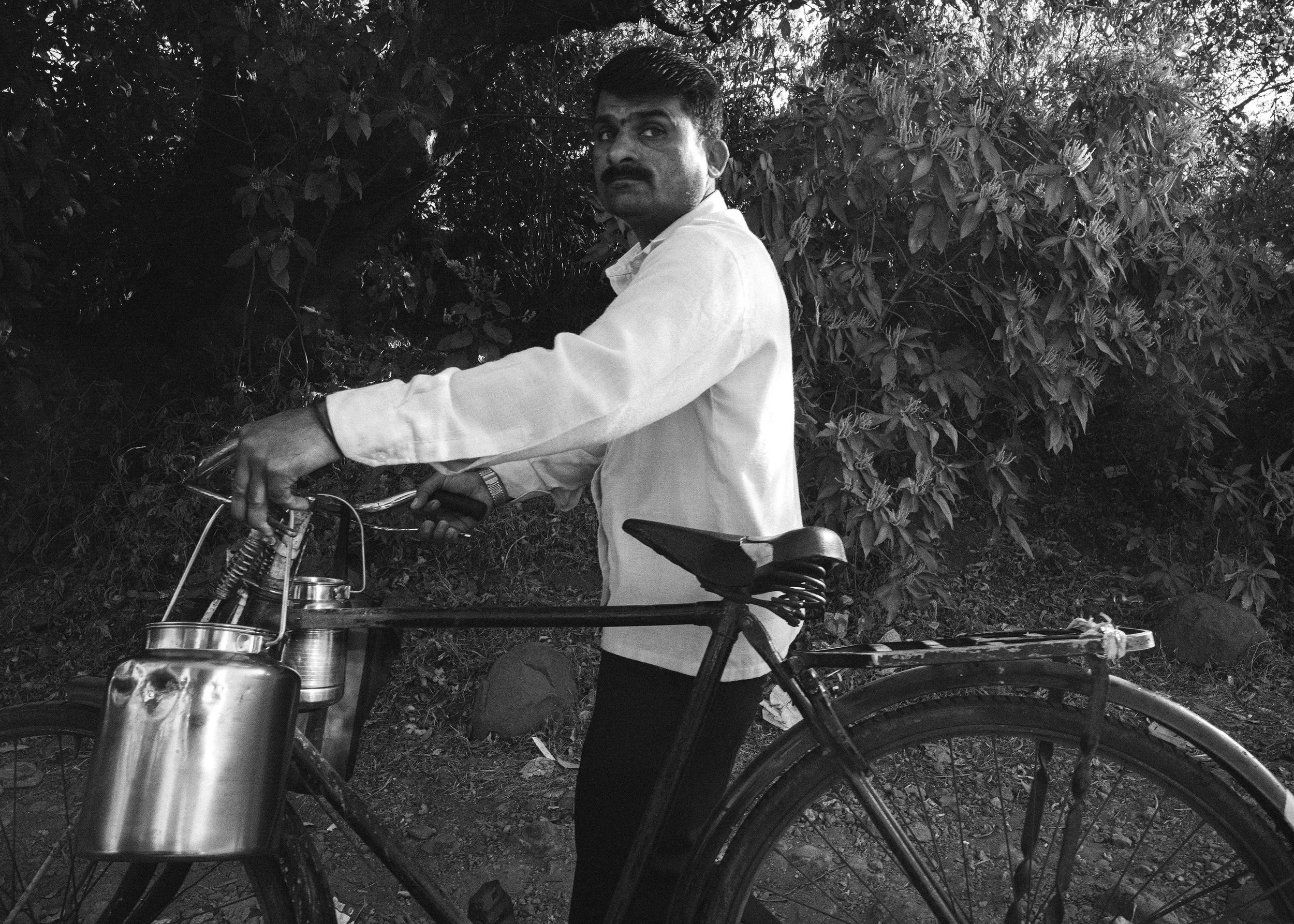
Silvery wings of Intuition, 2023.

In Lonavala, I photographed this man standing beside his bicycle, leaning toward the handlebars as he turned to meet my camera with a steady, curious expression. His light shirt stands out against the dense foliage, while metal containers hanging from the bicycle catch the light. In black and white, the textures of leaves, fabric, and worn metal bring depth to this everyday encounter.

Using my Leica M11 and 21mm Super-Elmar, I brought the man, bicycle, and surrounding landscape into one frame. I was drawn to his composed presence and the practical details of what he carried. The photograph holds a brief pause in his day, a moment of attention shared before life continued.
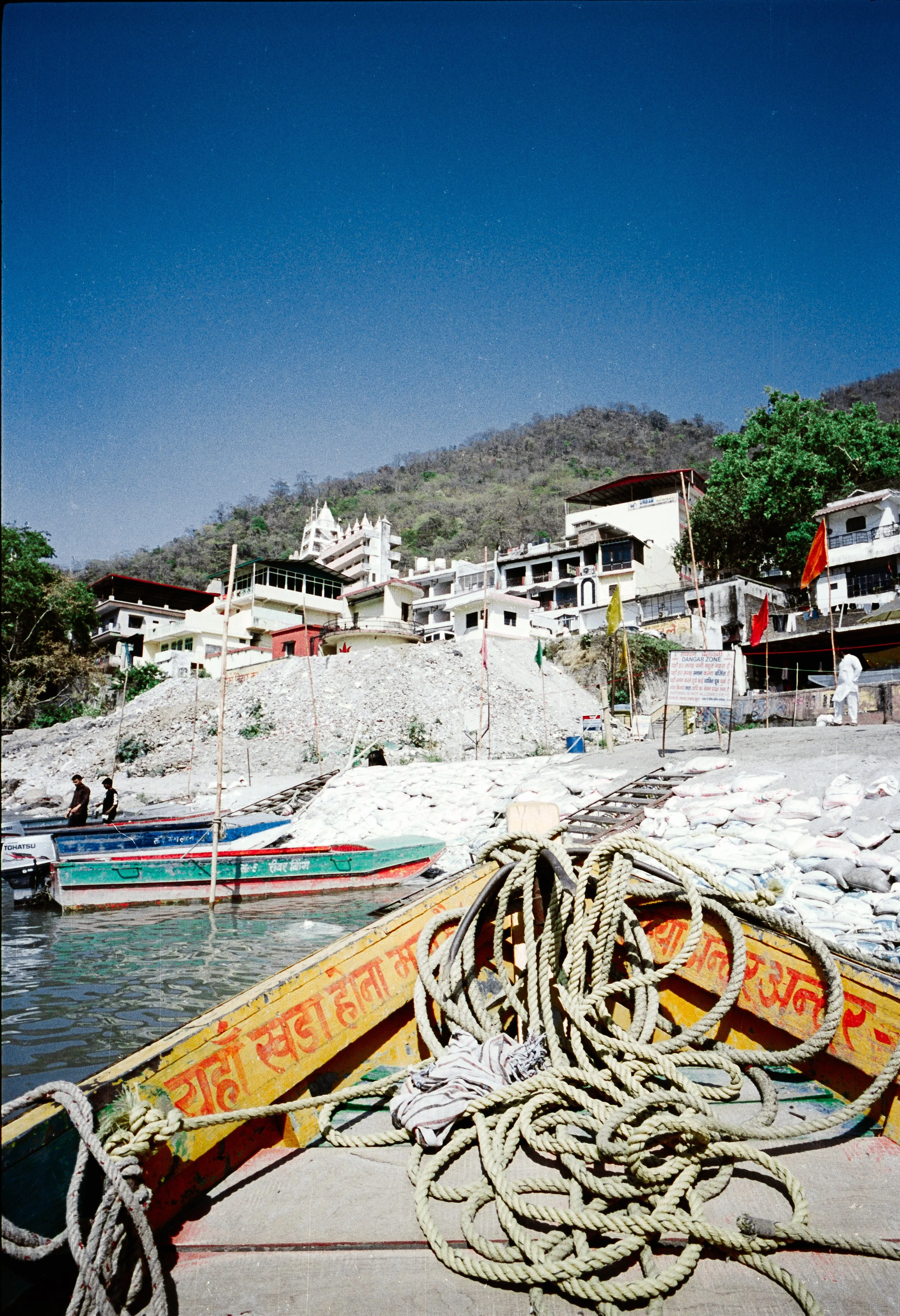
Lakshman Jhula Landing, 2024.

Landing on the shore near Lakshman Jhula in Rishikesh, I made this photograph from the bow of the ferry just before stepping onto land. The ropes gather in loose knots across the front of the boat, surrounded by hand-painted lettering worn by water and use. Beyond them, boats rest against the shore while white buildings climb into the hillside beneath an almost uninterrupted blue sky. I love how much depth exists within the frame. The bow holds you in the immediate moment, while everything beyond it feels like an invitation into what is waiting on shore.

I was crossing over with no real agenda beyond walking and making photographs. I wanted to spend time on this side of Rishikesh and allow the streets to lead me toward whatever caught my attention. Looking back, this photograph feels like the beginning of that small pilgrimage. There is something I love about arriving somewhere on foot with a camera, not knowing who I will meet or what I will see. Sometimes street photography begins before you even reach the street. Photographed on my Leica M6 with Kodak Portra 400.
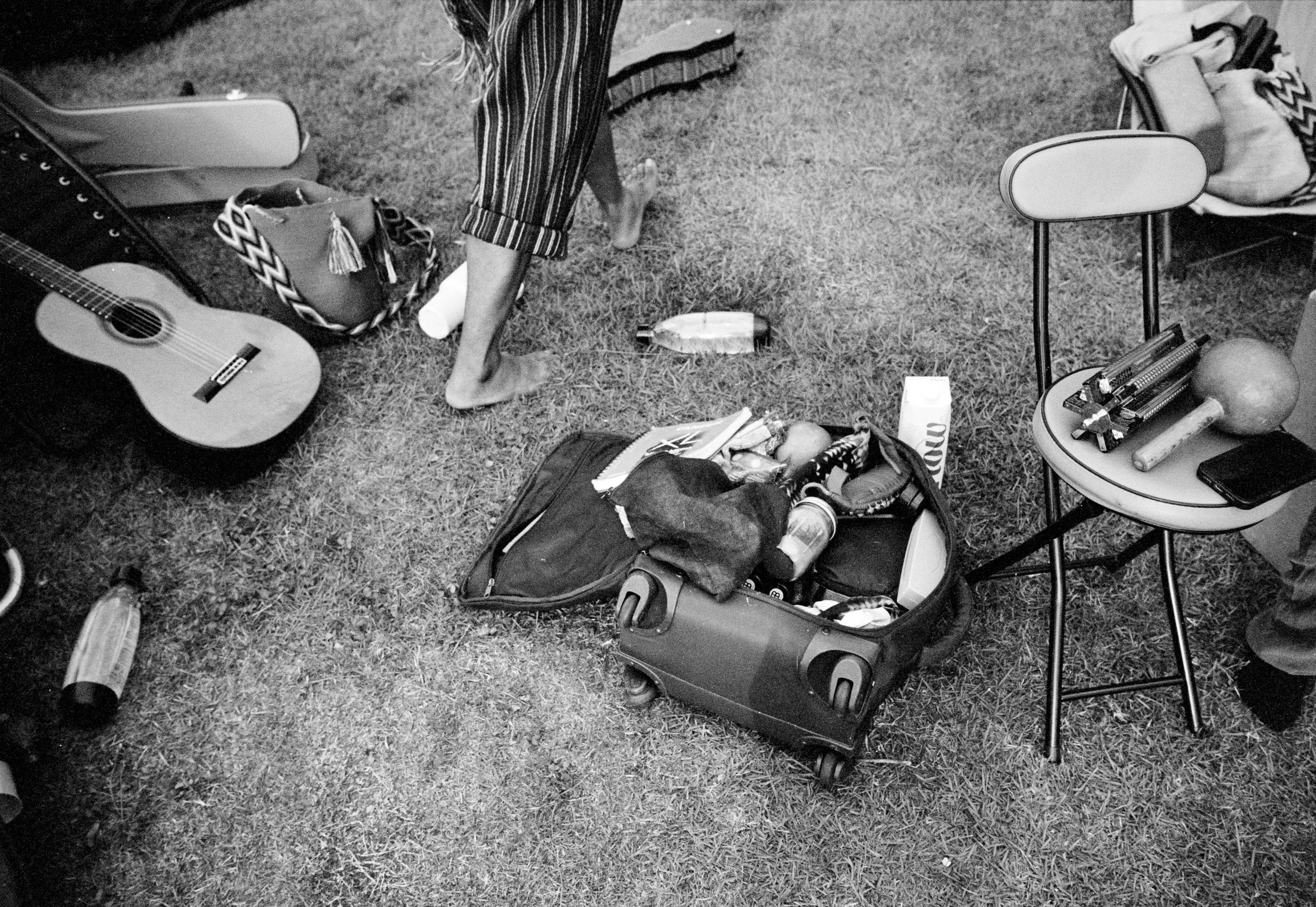
After the circled closed, 2025.

A guitar rests beside a folding chair. An open suitcase holds instruments and personal belongings, while a rattle and other instruments wait on another seat. Bare feet move across the grass as the gathering begins to pack away. I made this photograph at Southern Star Community, just after the closing circle of an ayahuasca ceremony. Invited that morning to speak with community members and share music, I arrived in the quiet that followed a night they had spent together.

I was careful about where I pointed my camera and whose image I made. The intimacy of that space asked me to listen and move gently. Here, I turned my attention toward the objects that remained, small traces of music, presence, and a shared introspective time. I cannot speak for what anyone experienced that night. What I could photograph was this moment of transition: belongings being gathered, people preparing to leave, and the ordinary gestures that follow something deeply personal.
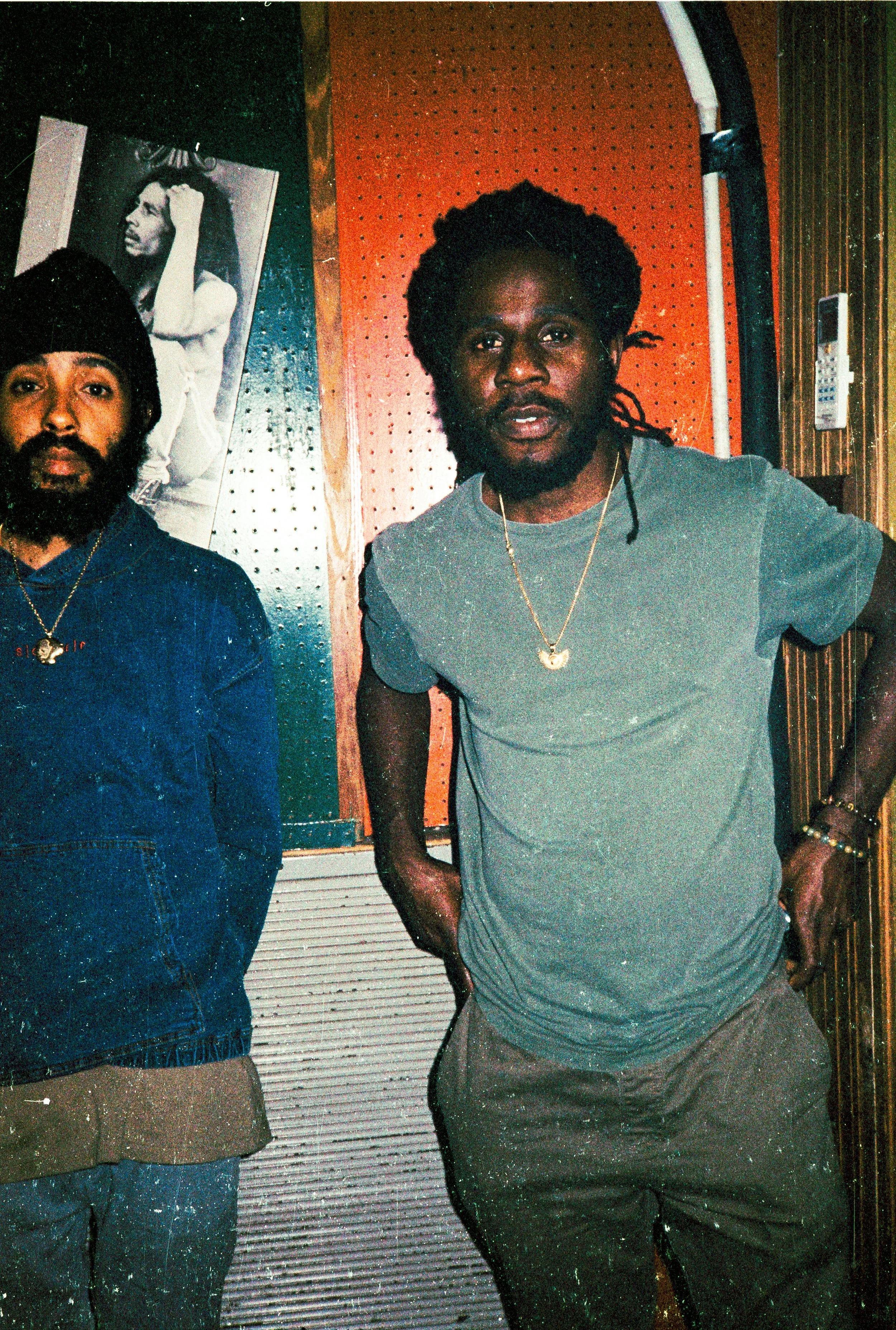
Protoje and Chronixx at Tuff Gong, 2018.

I made this photograph of Protoje and Chronixx at Tuff Gong Studios in Kingston, Jamaica, during a recording session for A Matter of Time. Protoje stands partially framed on the left, wearing a dark hoodie and knit cap, while Chronixx leans forward beside him with his hands at his hips. Their relaxed but attentive presence drew me in. Photographed on Kodak Ektar 100, the warm tones and fine grain preserve the intimacy of the studio.

Behind them, wood paneling, an orange pegboard wall, and a black-and-white portrait of Bob Marley place the moment within Jamaica’s musical lineage. I wanted to capture something of the quieter side of making music: the pauses, the attention, and the space where ideas take shape. Looking at this photograph, I see two artists creating their own work in a room that carries generations of sound.
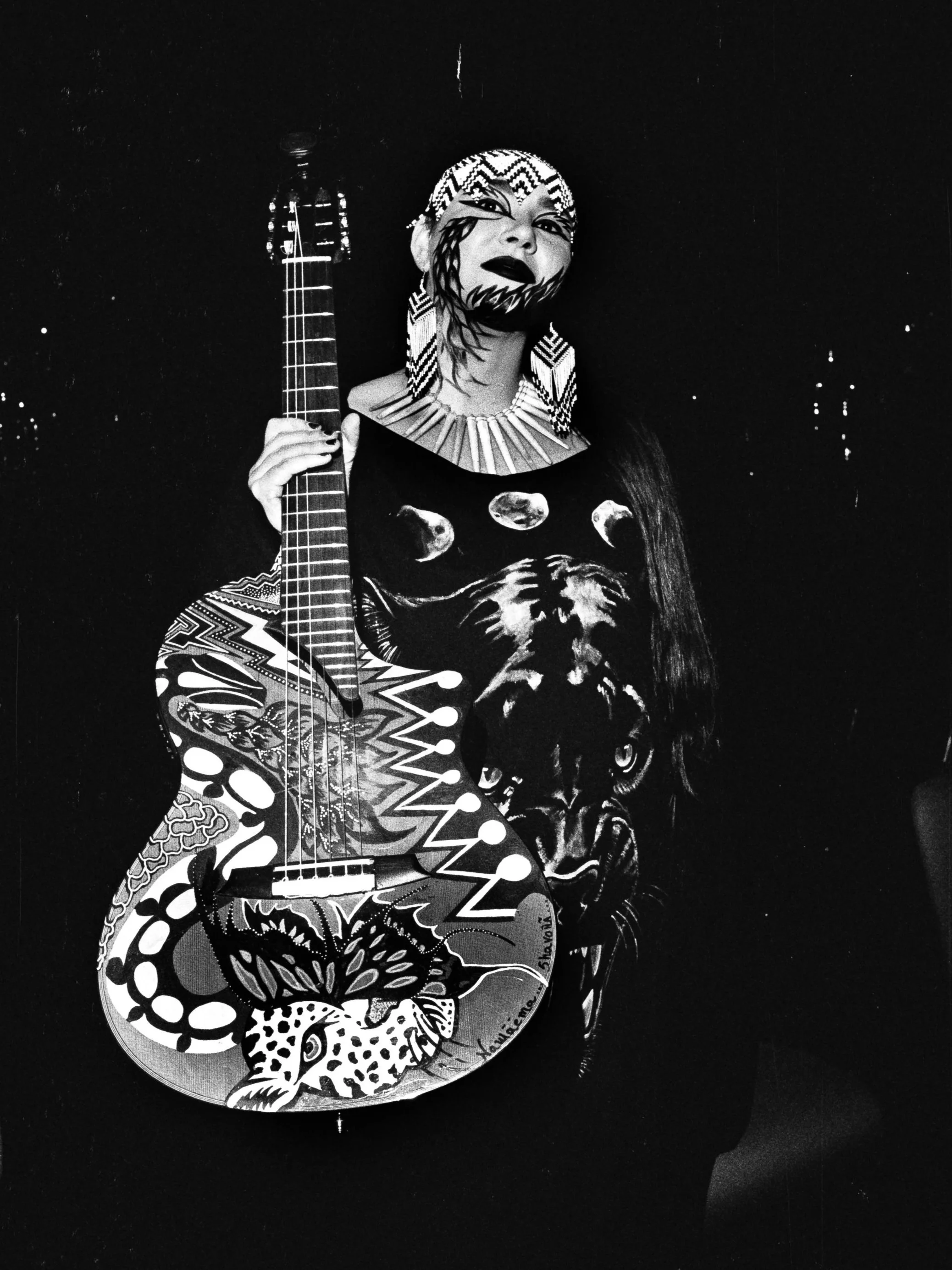
Nãwãema of Shavorã, 2026.

I photographed Nãwãema at LeSound Temple in Fort Lauderdale, one of the first gatherings I documented after returning from Peru. She holds her painted guitar upright, its animal figures and bold patterns catching the light against the dark background. Geometric beadwork frames her face, and painted lines extend across her cheeks and chin. That evening, she joined Hukena and Eriya as Shavorã, sharing music that brought together Yawanawá songs from the Brazilian Amazon and her own roots in Umbanda.

Listening to Nãwãema speak gave me more to carry home than the photographs. She cautioned against excessive use of rapé and reaching for it whenever difficult feelings arise. I appreciated her honesty about how a sacred practice could become a way of avoiding what needs our attention. This portrait brings me back to that question: what do we hear when we take time to know the people behind the songs? I share more from our conversations in “Shavorã: The Women Behind the Songs” on Photo Pilgrimage. You’re welcome to read, subscribe, and pledge your support for more stories like this.
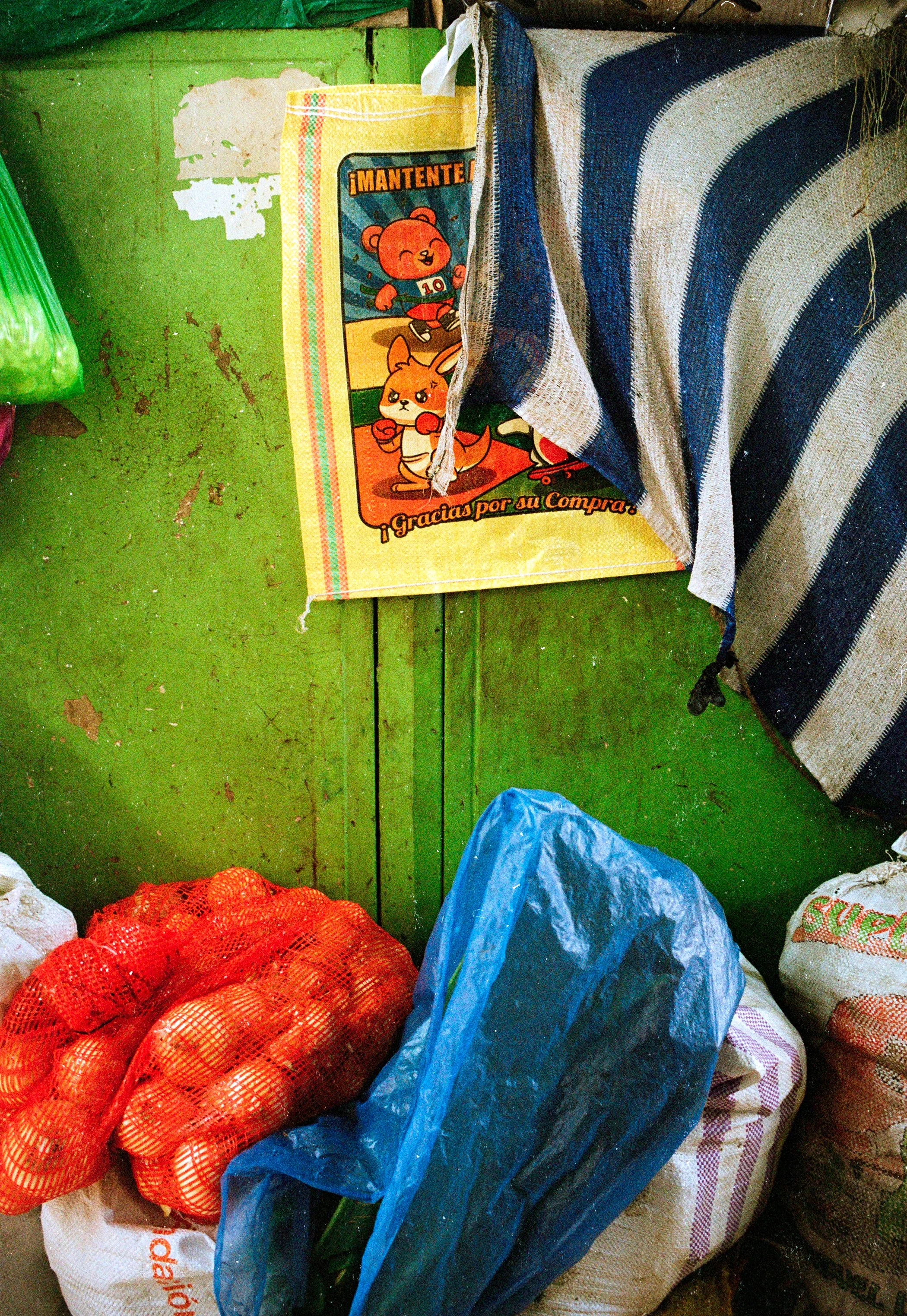
Gracias por su compra, 2025 .

In this tightly framed photograph of a market stall in Cuenca, Ecuador, a scuffed green door sits behind hanging bags, produce, and folded fabrics. A mesh sack of orange produce fills the lower left beside a wrinkled blue plastic sheet, while a navy-and-white striped blanket hangs on the right. Above them, a yellow sack decorated with cartoon animals reads “¡Gracias por su compra!”—“Thanks for your purchase.”

Shot on Kodak ColorPlus 200, the photograph holds warm colors and subtle grain that bring out worn paint, woven fibers, and crinkled plastic. I was drawn to how these ordinary things came together through daily use. Their colors and textures gave me a reason to stop and look, offering a small glimpse into the life of a working market.
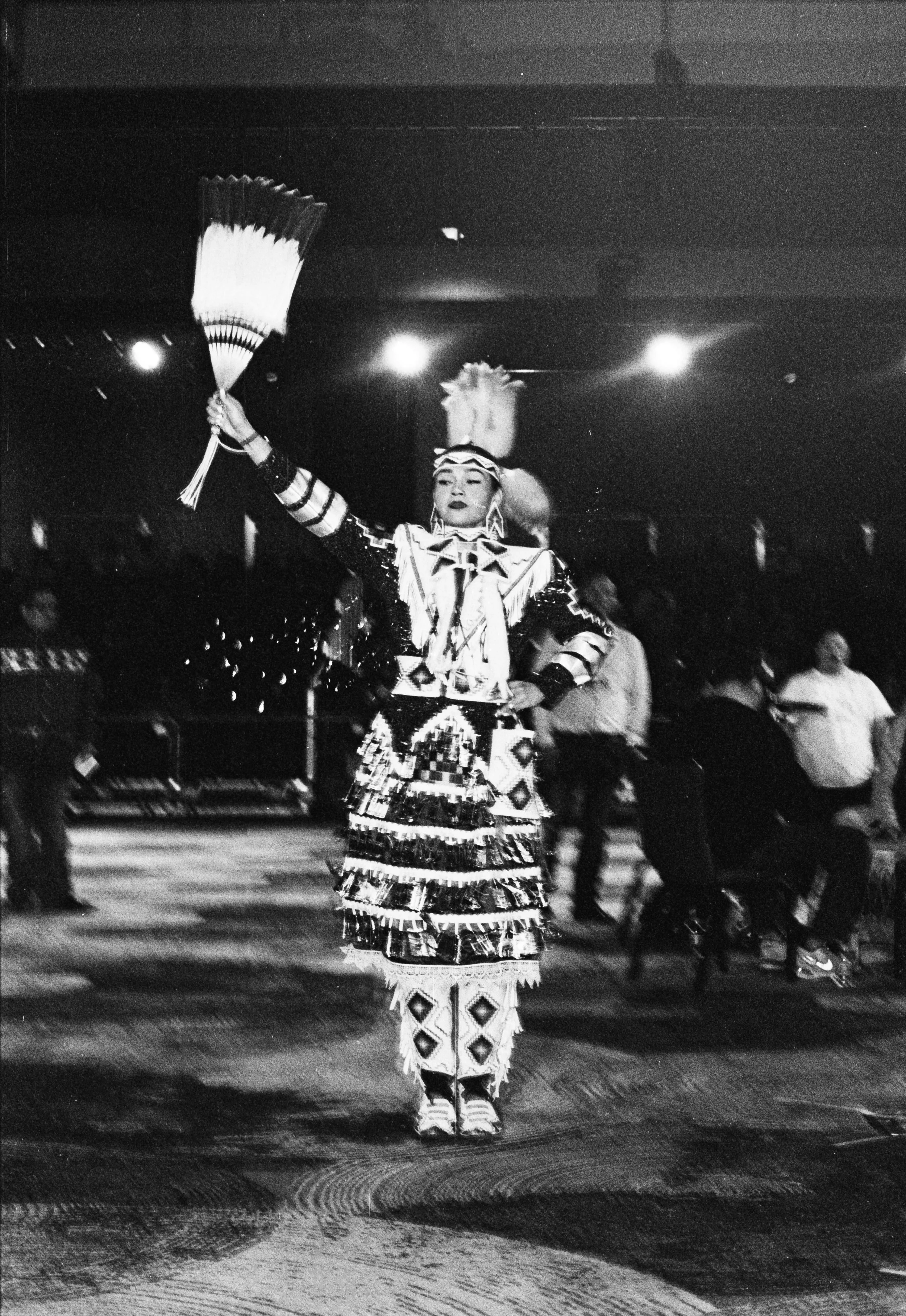
A Gesture Held in Light, 2026.

Among everyone gathered on the arena floor at the Seminole Powwow, Lelani O’ Daye caught my attention. Her feather fan rose above her head, one hand resting at her waist, as light caught the geometric patterns, fringe, and rows of metal cones across her regalia. I was drawn to the reach of her arm and the composure of her expression. Behind her, people continued moving through the gathering.

I made this portrait on Kodak Tri-X 400 with my Leica M6 and a 28mm lens, using a small off-camera flash at 1/50 of a second. The flash brought her forward while the surrounding light and movement remained in the frame. Looking at the photograph now, I’m reminded of that brief moment of recognition, when my attention settled on one person and I raised the camera, hoping to preserve something of what drew me to her.
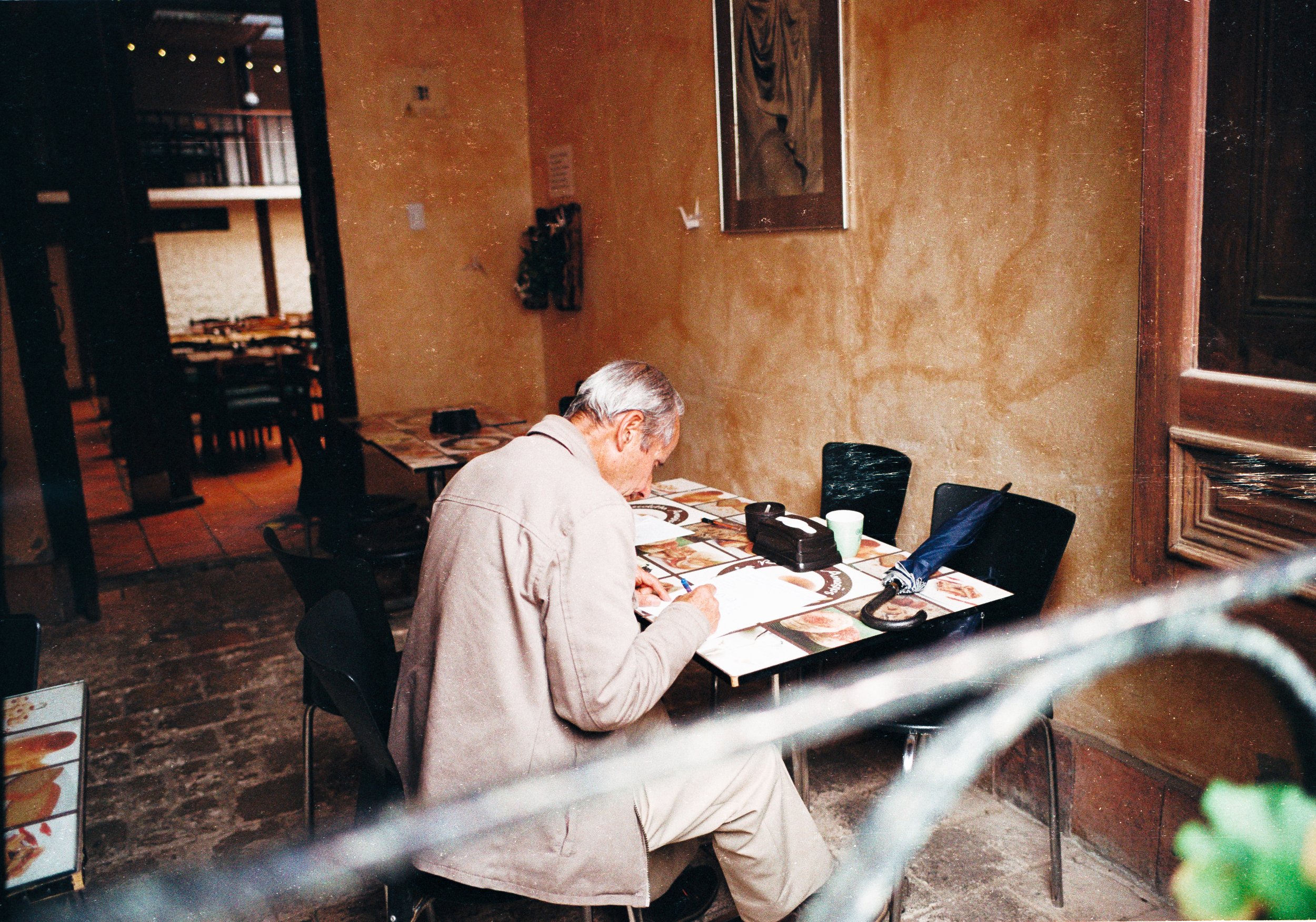
A Letter Beneath the Open Window, 2025.

A man sits alone in a café, leaning over a sheet of paper. Warm ochre walls surround him, and his pale clothing catches the light. A cup, folded umbrella, and empty chairs fill the space around him. The blurred railing in the foreground marks my view from outside. Something about the light and his posture makes the scene feel like a painting. I made this photograph while running errands in Tabio, with my Leica M6 around my neck and the focus set to roughly three meters. I often find myself looking through open windows there, into cafés, bakeries, and small restaurants where people pause during their day.

As I passed, I glanced inside and made the photograph in a split second. He appeared to be writing a letter or working on a document. I never learned what it was. It remains one of my favorite quiet moments with the M6. A reminder of how much life we can glimpse when we pay attention on an ordinary walk.
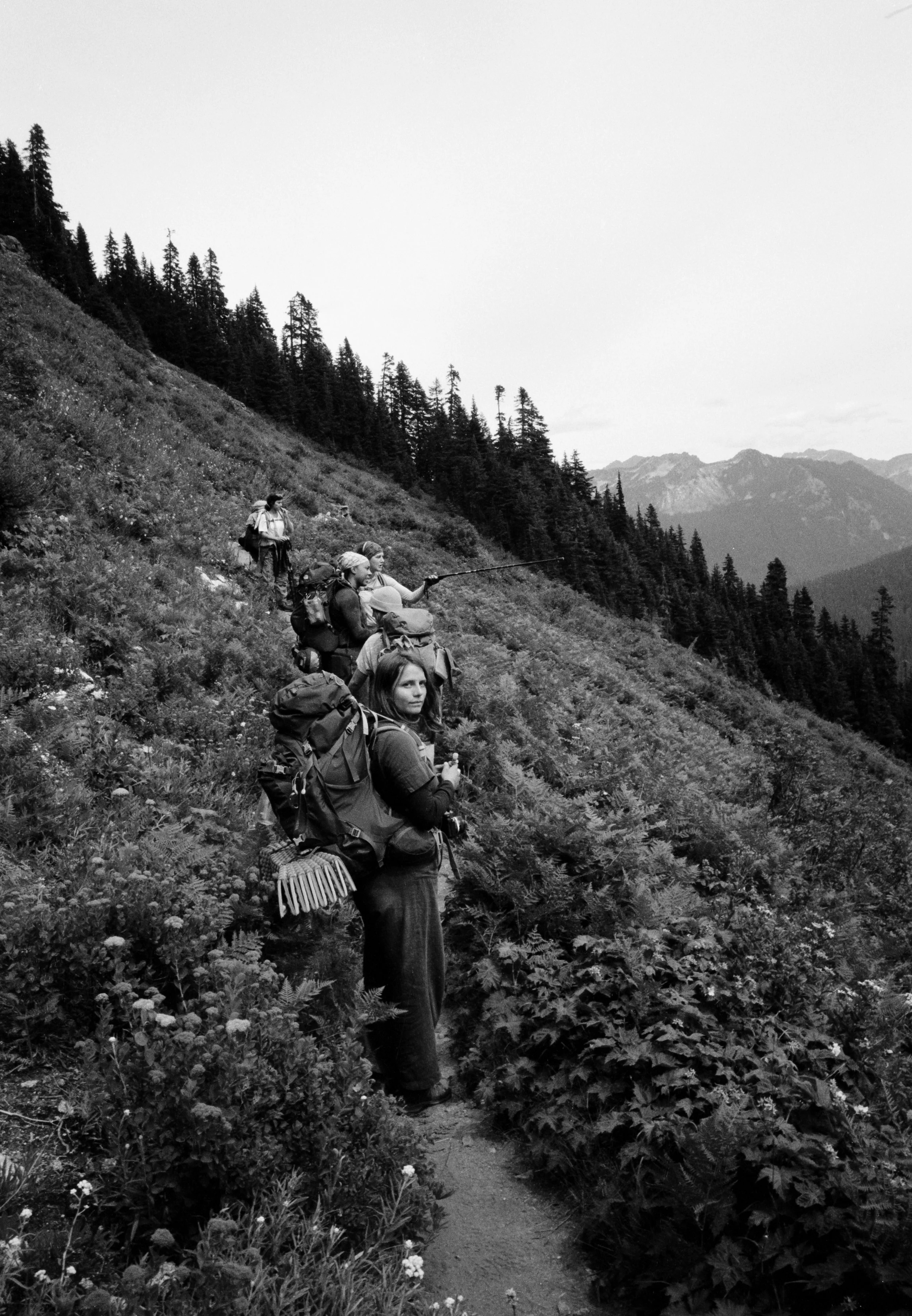
The sun’s light shines for all of us, 2025.

The sun’s light shines for all of us. On this narrow stretch of the Pacific Crest Trail, our group pauses among ferns and wildflowers, carrying full packs beneath an open sky. One companion turns toward my camera while another points a trekking pole toward the mountains. The trail crosses a steep hillside, with evergreens descending into the valley and distant ridges beyond. I made this photograph in Washington in July 2025, during an 11-mile round-trip backpacking journey. Quieting myself helped me notice more: the weight of my pack, each breath, and the people sharing the path.

Led by Mary Cronin (@pachamary04) and Rhett Rannick (@ecocentrismo), our journey used a skillshare approach, weaving Council, ritual, ecotherapy, and ecopsychology into our time outdoors. We learned from the landscape and from one another. We grew tired, paused, offered help, and kept walking. For me, courage took shape in those small acts, in meeting unfamiliar terrain with curiosity while respecting the ground beneath my feet. This photograph brings me back to that shared pause and the simple feeling of belonging within a world brightly alive.
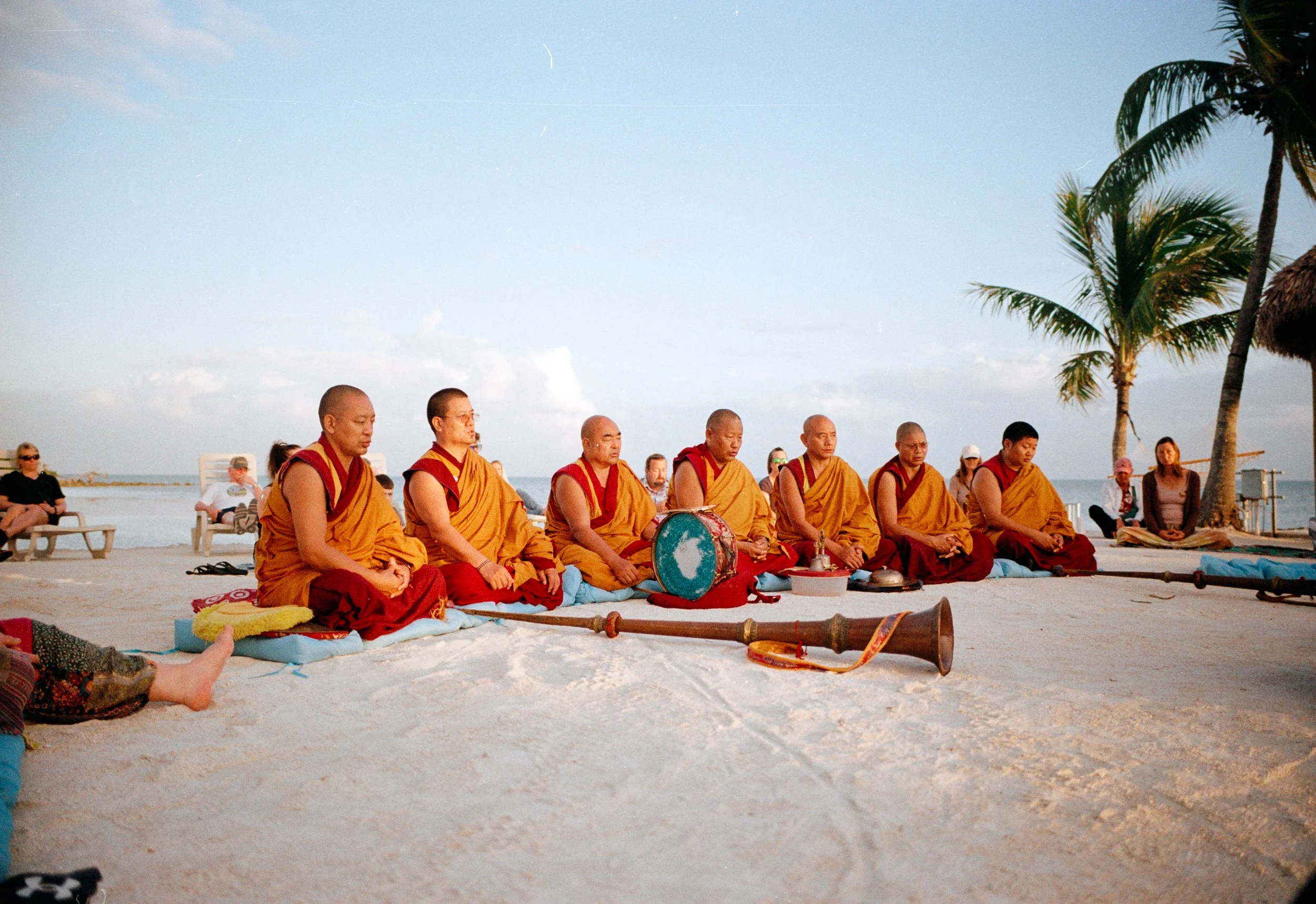
Both peace and history, 2025.

This was one of the few color photographs I made that day. The monks of Drepung Gomang Monastery sit together on the sand, their saffron and deep red robes glowing against the pale blue sky and quiet ocean. A ceremonial drum rests near the center, while a long horn stretches across the foreground like a line connecting the viewer to the gathering. Behind them, people sit in stillness beneath the palms, forming a quiet circle of witnesses around the pooja.

There is both peace and history within their presence. These monks carry a spiritual tradition preserved through displacement, devotion, and the continued practice of compassion. The photograph feels meditative, but it also speaks of endurance and a culture that has survived far from its homeland. Made with Kodak ColorPlus 200 on my Leica M6, the film holds the warmth of the robes, the softness of the evening light, and the sacred calm of a moment shared beside the sea.
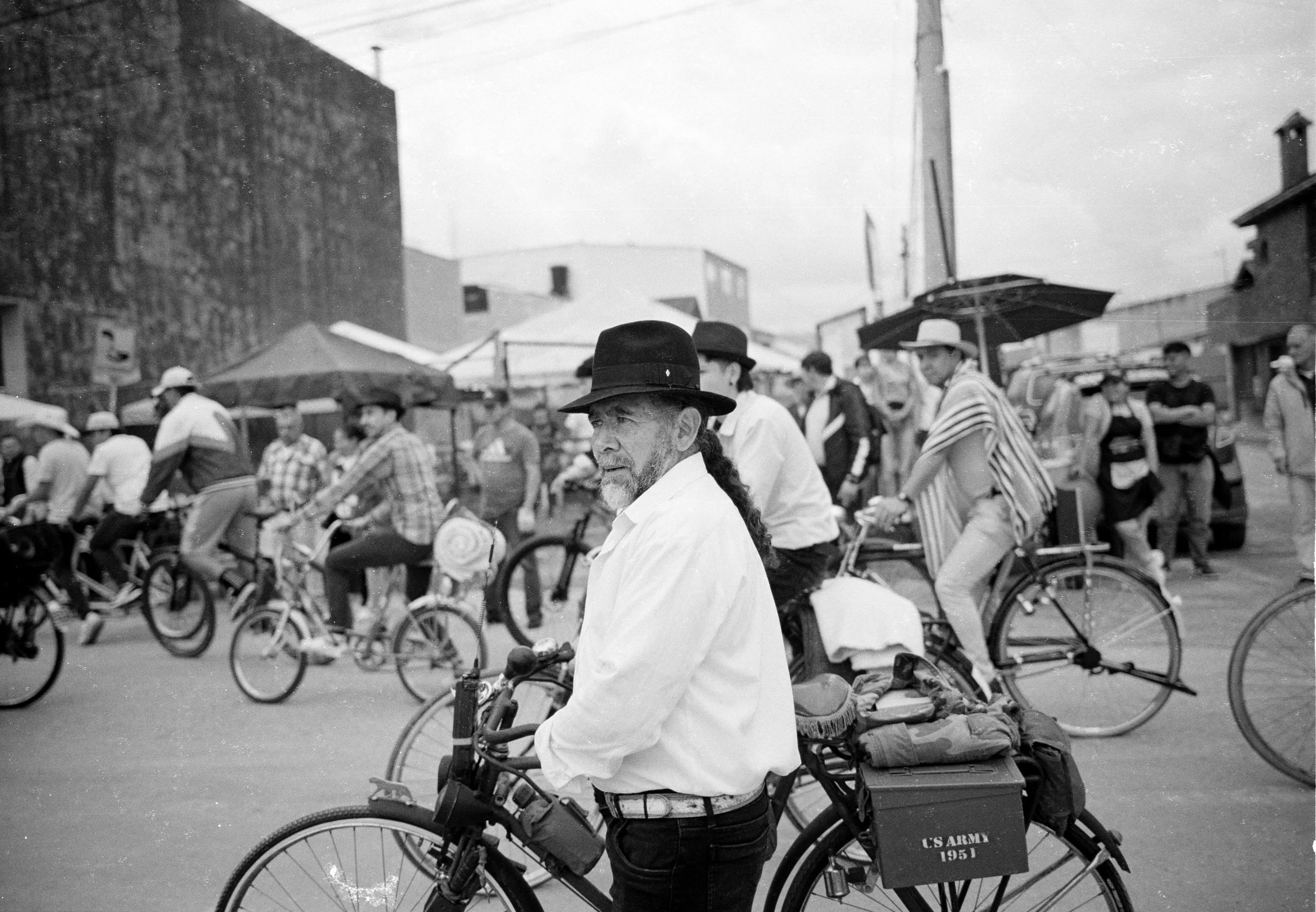
What We Carry Forward, 2025.

That morning in Tabio, horns and drums drew us into the streets for the Festival of Land and Work. Among the bicycles moving through the gathering, I noticed this man in a dark hat and white shirt, his long braid falling down his back. He turned toward my camera with one hand near the handlebars. Behind him, riders wore hats and draped ruanas, their bicycles carrying bags, blankets, and everyday belongings. I was drawn to this brief exchange of attention amid a street full of movement.
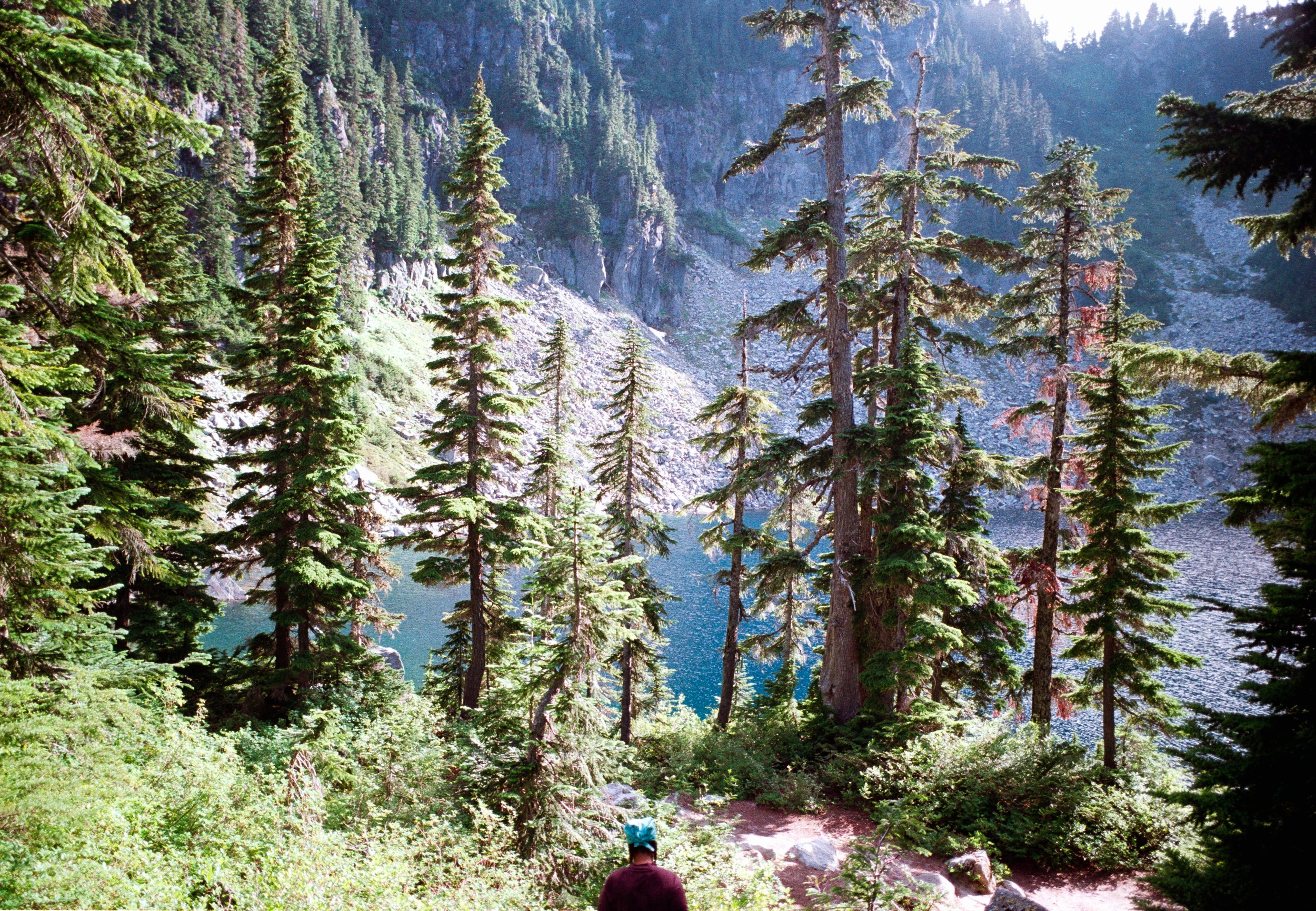
The Lake Through the Trees, 2025.

When we reached Lake Vicente, this was the view I wanted to remember. Blue water appeared between tall evergreens, beneath steep rock walls and slopes scattered with loose stone. Sunlight caught the branches and undergrowth, while a companion stood near the bottom of the frame, facing the lake. I made this photograph during our July 2025 backpacking journey in Washington. The small human presence gives a sense of the scale we had walked into.

Our group arrived together, carrying the effort of the trail and the care we had shared along it. With @pachamary04 and @ecocentrismo guiding the expedition, we had been making time to listen, reflect, and notice our surroundings. Here, I felt grateful simply to stop and look. After watching my footing for so much of the walk, I could lift my eyes and take in the water, the trees, and the mountains holding them.
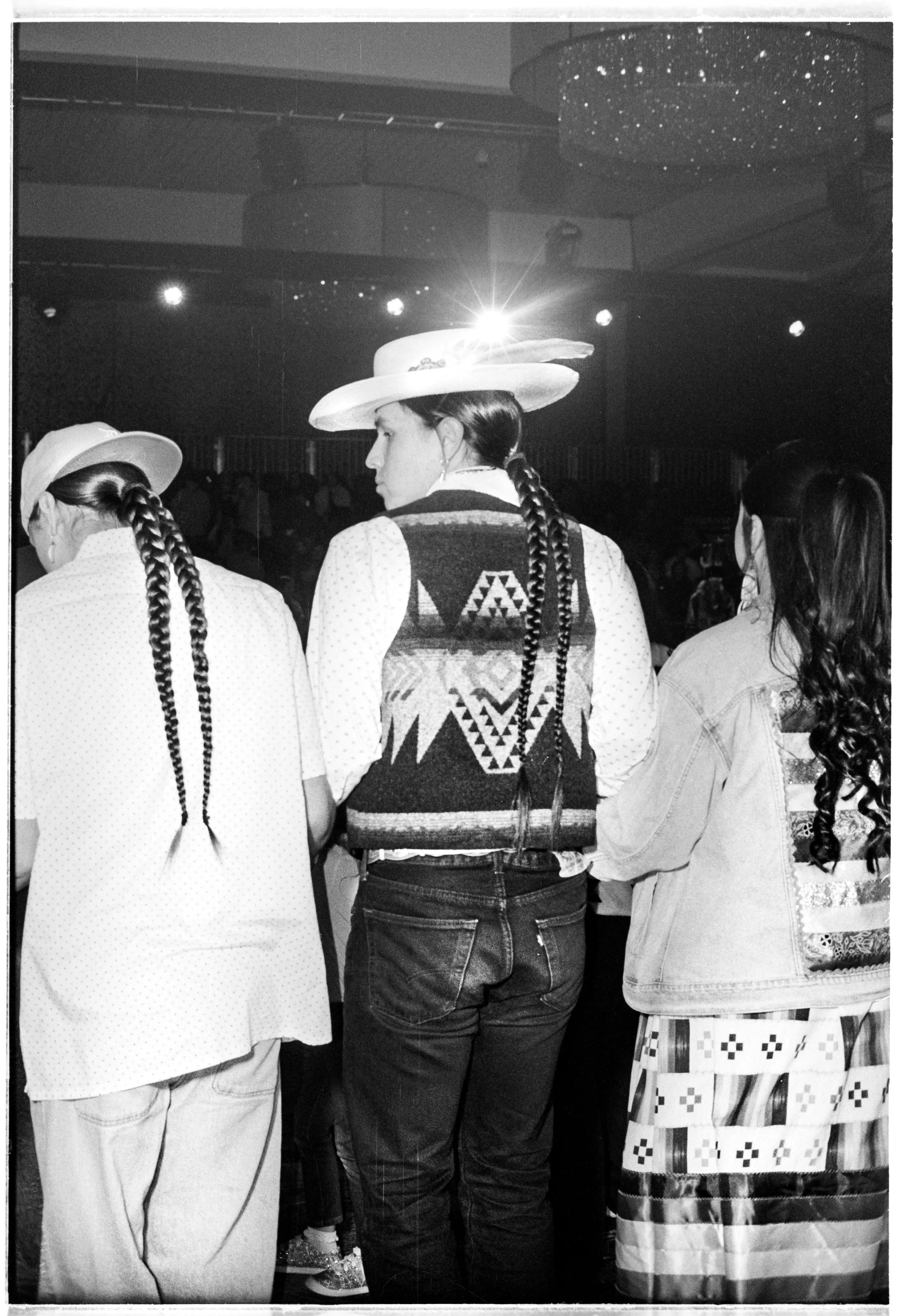
Threads of Belonging, 2026.

At my first powwow, the Seminole Powwow, I found myself watching the people gathered around the arena as closely as the dancers. In this photograph, two men stand with long paired braids falling down their backs. The central figure turns slightly, his profile beneath a broad-brimmed hat, while geometric patterns fill his vest. Beside him, another attendee faces the gathering. A light flares just above the hat, marking a small moment within an event that brought people from many nations together.

Those braids prompted me to learn more about the relationships between hair, identity, and responsibility. Their meanings differ across Indigenous nations, families, and individuals. Some teachings connect braids with spiritual balance; others associate two braids with marriage and the joining of families. Long hair can also honor ancestors and continue a family tradition. I don’t know what these men’s braids mean to them personally, but the photograph reminds me to look with curiosity and listen with respect. What catches my eye may hold a story that only its wearer can tell.
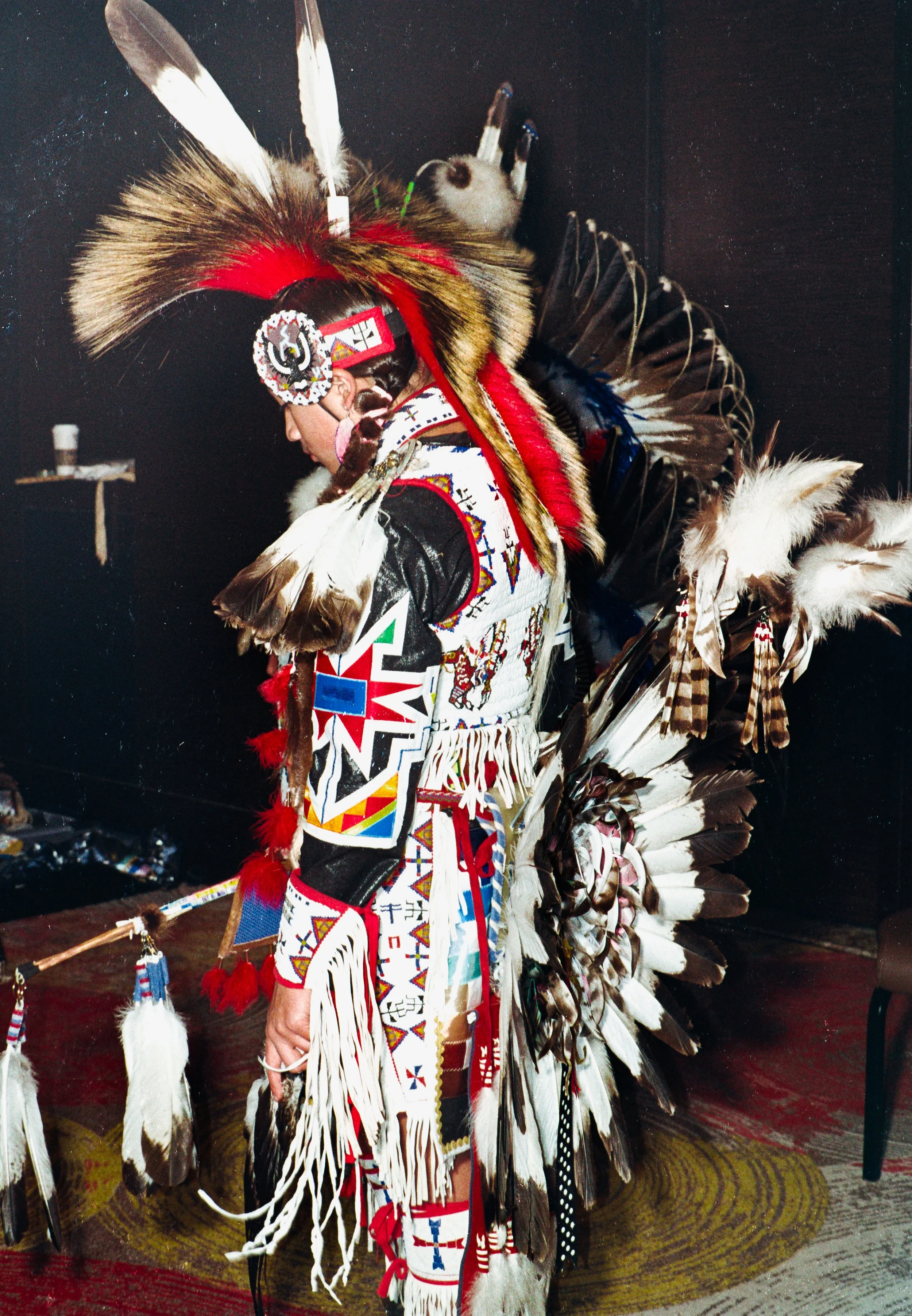
 Living Traditions, 2026.
Living Traditions, 2026.

A dancer stands in profile, head lowered, with vivid red, white, blue, and yellow patterns across their regalia. Long fringe falls along the arms and sides, while feather bustles fan outward against the dark background. The light reveals the many textures and details brought together in what they wear.

At powwows, dancers wear regalia, a term that recognizes these outfits as expressions of culture rather than costumes. Each gathering follows its own protocols, shaped by the Native nations and communities taking part. (ictnews.org)

Song, dance, friendship, and honoring come together in the arena. Veterans often lead Grand Entry, carrying eagle staffs and flags as dancers enter behind them. (ictnews.org)

What draws me to this photograph is the brief stillness. The lowered gaze, the resting hand, and the sweep of feathers give me time to look closely. A single frame within a gathering full of movement, sound, and living traditions.
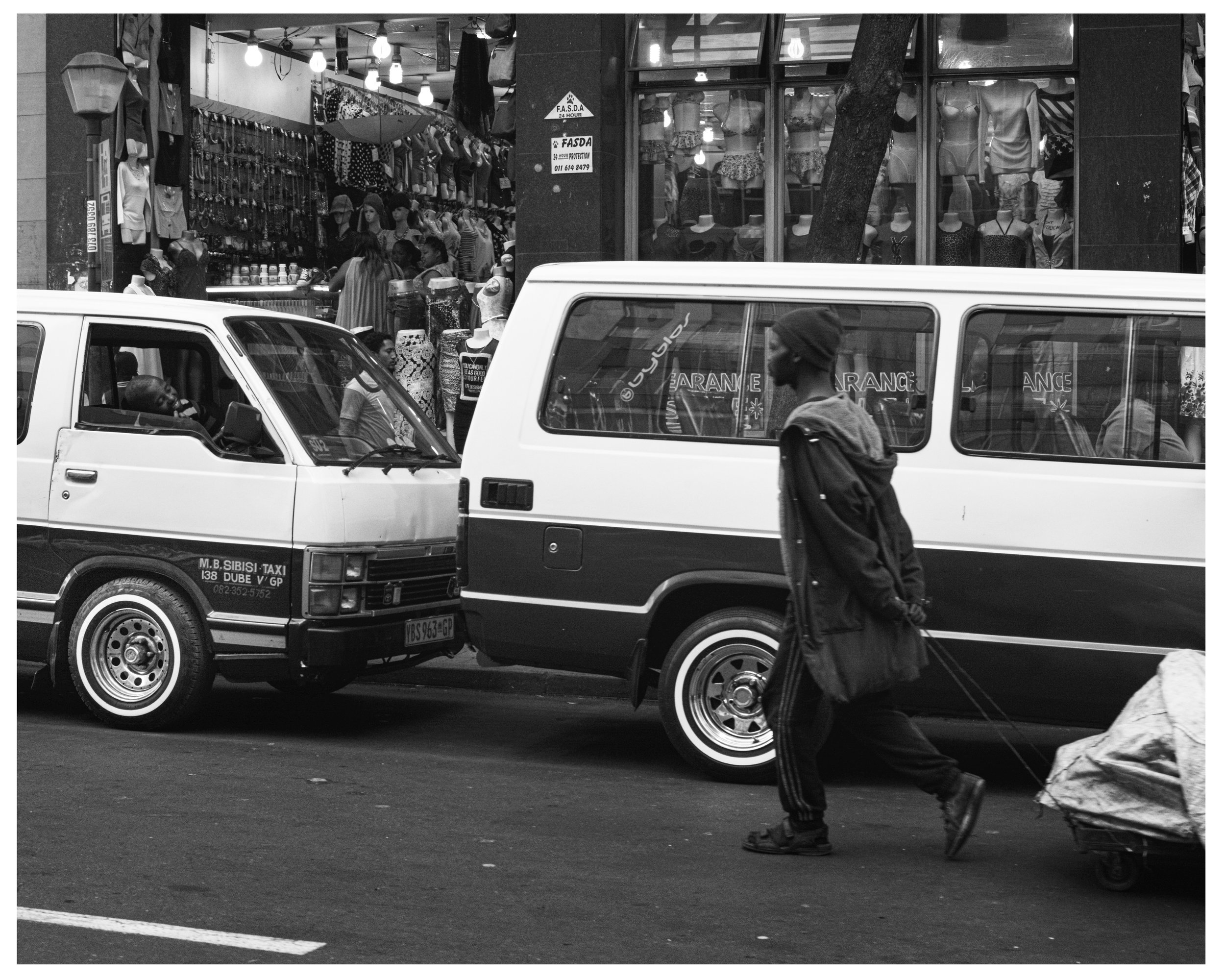
HiAce Cue, 2016.
HiAce Cue, 2016.

Two Toyota HiAce minibus taxis outside a row of clothing shops in Johannesburg. A man pulls a loaded trolley through the foreground, while mannequins, shoppers, and hanging bulbs fill the scene behind him. In black and white, the bright panels of the taxis stand out against the crowded shopfronts. Johannesburg, South Africa · Nikon D800 · 24mm
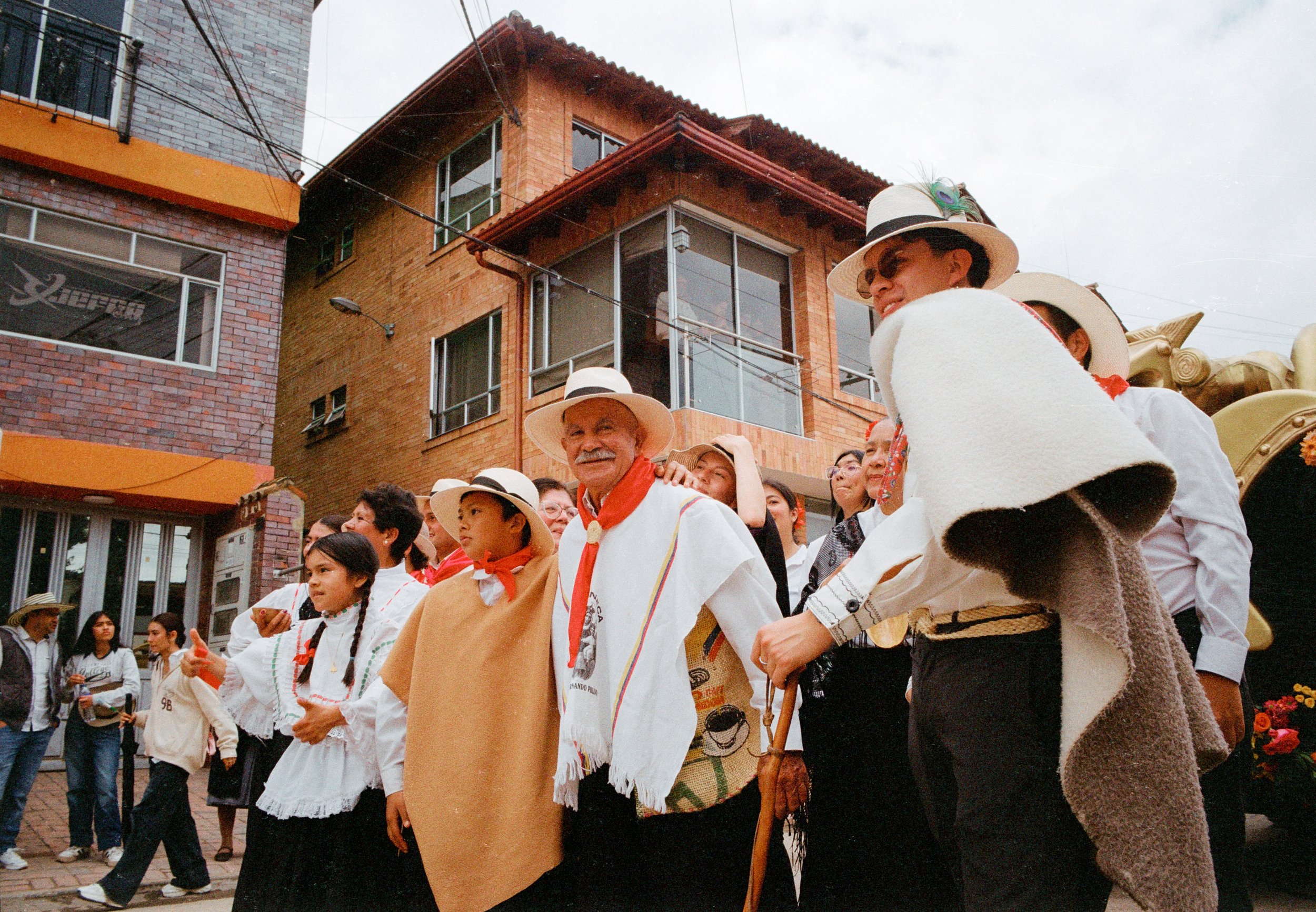
The land that nourishes, 2025.

That morning I woke to the sound of horns echoing through the pueblo, drums rolling in the distance, and footsteps filling the streets before the day had fully begun. My sisters shared the news that the Festival of Land and Work was underway, a celebration where farmers, families, and locals gather to honor tradition, ancestry, labor, and the sacred relationship between people and the earth.

After returning to Tabio from our adventures in Pitalito, I still had one remaining roll of Kodak ColorPlus 200 tucked away in my bag. It felt destined for that morning. Maria photographed with the Leica M11 while I moved through the parade route with the Leica M6, carrying Sol on my shoulders as music, dancing, and color unfolded around us. There was something deeply human about experiencing the celebration that way, one eye observing through the camera while the other remained immersed in the life of the moment itself.

The preservation of heritage has become increasingly important to me. To photograph those who grow the food that reaches our tables felt like an honor. In modern life it is easy to forget the lives behind what nourishes us, yet here in Tabio those invisible processes became visible again through weathered faces, hardworking hands, and generations of agricultural knowledge carried with quiet pride.

Tabio, often called “the land that nourishes,” reminds me deeply of Saint Lucia and celebrations like Jounen Kwéyòl, where culture, food, music, and ancestry remain intertwined.
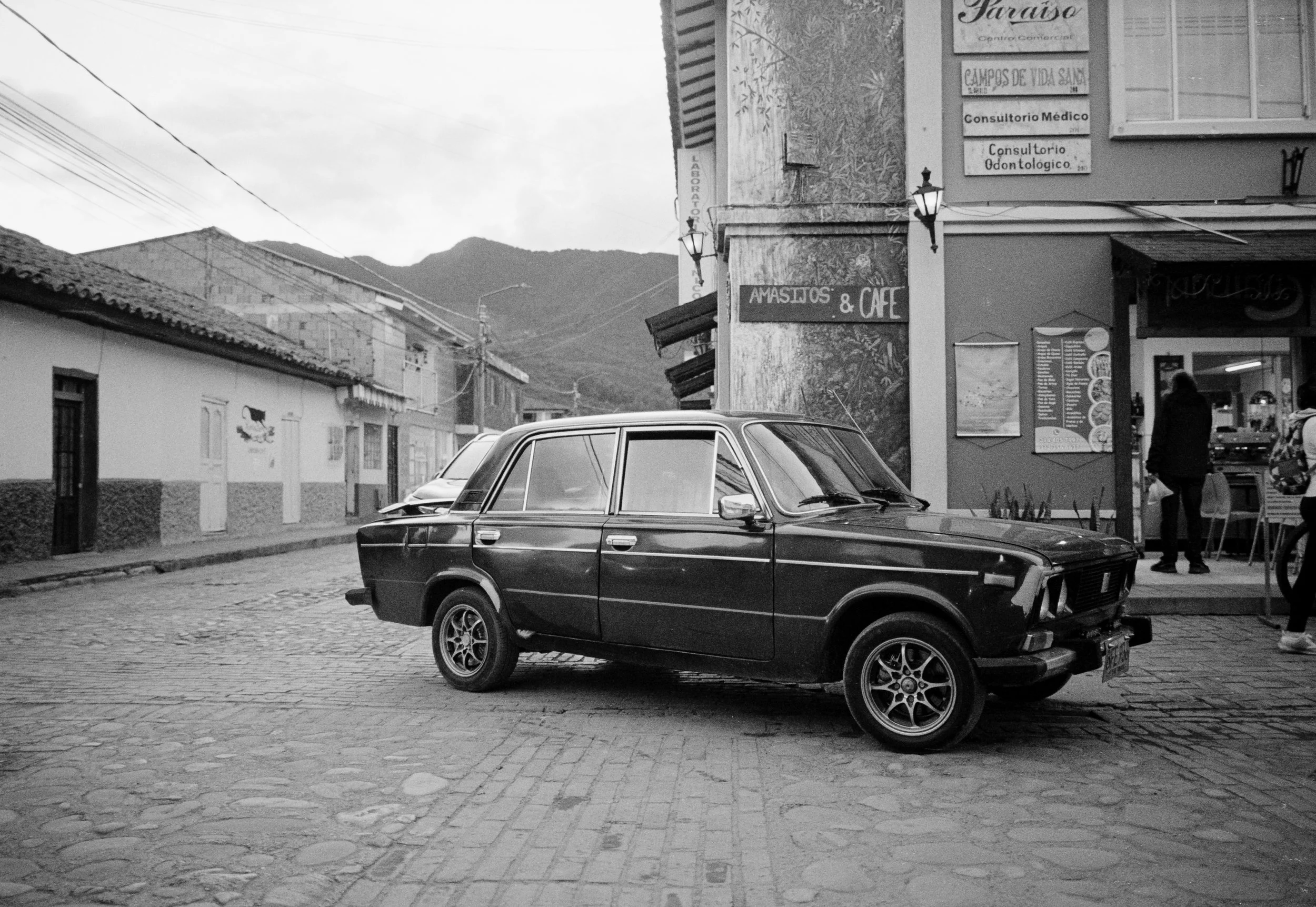
Lada rolling on cobblestone, 2025.

A dark Lada 2106 sits on a cobbled corner in Tabio, Colombia. Its chrome trim and rounded headlights catch the soft daylight outside a neighborhood café. Tiled roofs and overhead wires follow the street toward the mountains, while people gather near the doorway. Leica MP · 28mm Summicron f/2 · Kodak Tri-X 400
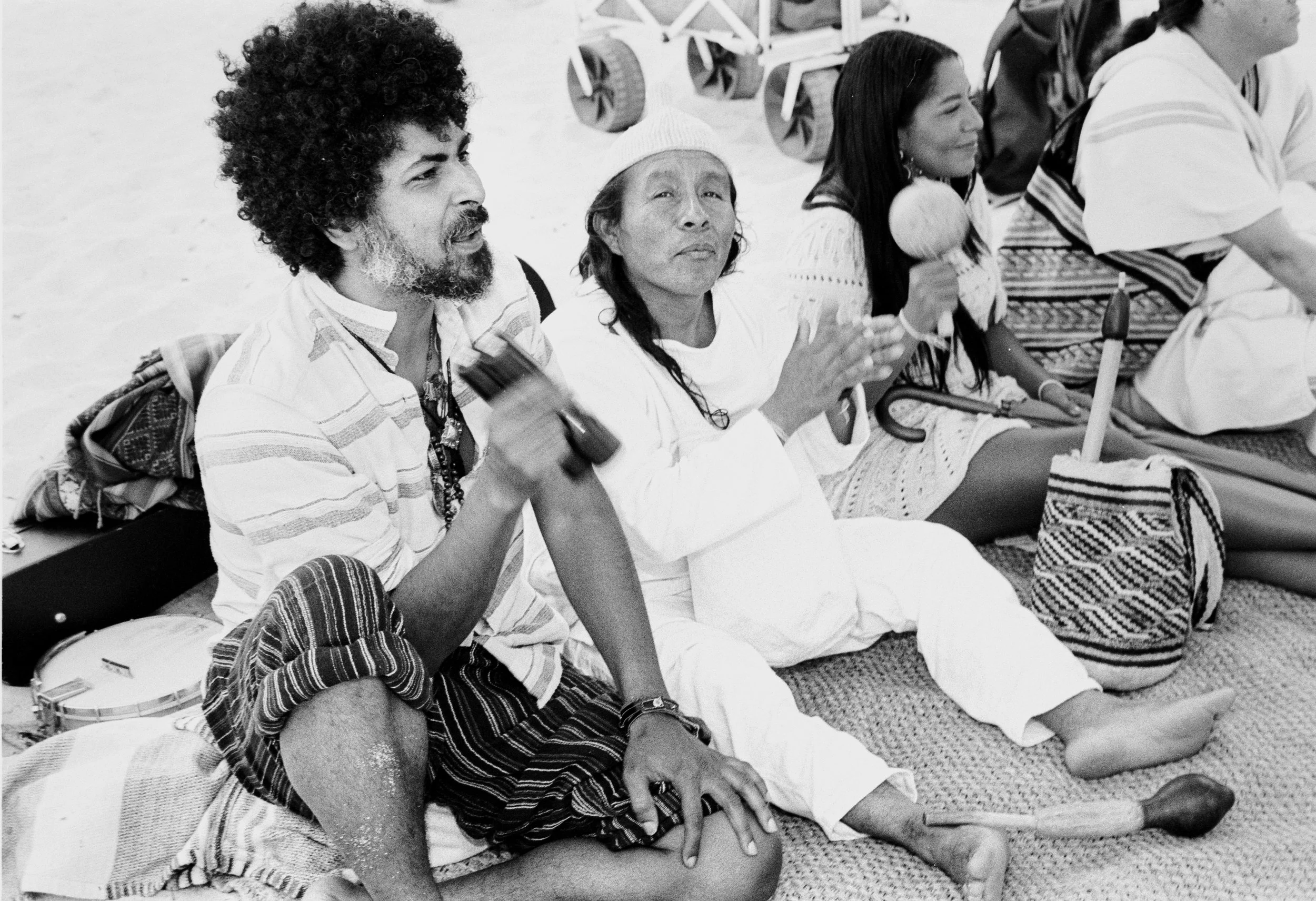
The Love We Carry On, 2025.

Seated together on woven mats, people clap and hold rattles, their hands carrying movement through this black-and-white frame. One person looks toward my camera while others turn their attention beyond it. Instruments and patterned bags rest close by. I made this photograph during Waves of Light, the Celebration of Life for Ximena Cho on Miami Beach. I was drawn to these small gestures of togetherness, to the ways people offer their presence when words alone cannot hold everything.

In honoring Ximena, I also reflect on how remembrance can become an act of care. A co-founder of ChoZen, she supported the arts, the protection of nature, Indigenous communities, and those too often underserved. The Ximena Cho Legacy Fund, established through The Miami Foundation, carries those commitments forward. This photograph reminds me that a life continues to touch the world through the people it brings together and the work they choose to continue. In loving memory of @ximenacho.

Learn more and support her legacy at ximenacho.com.
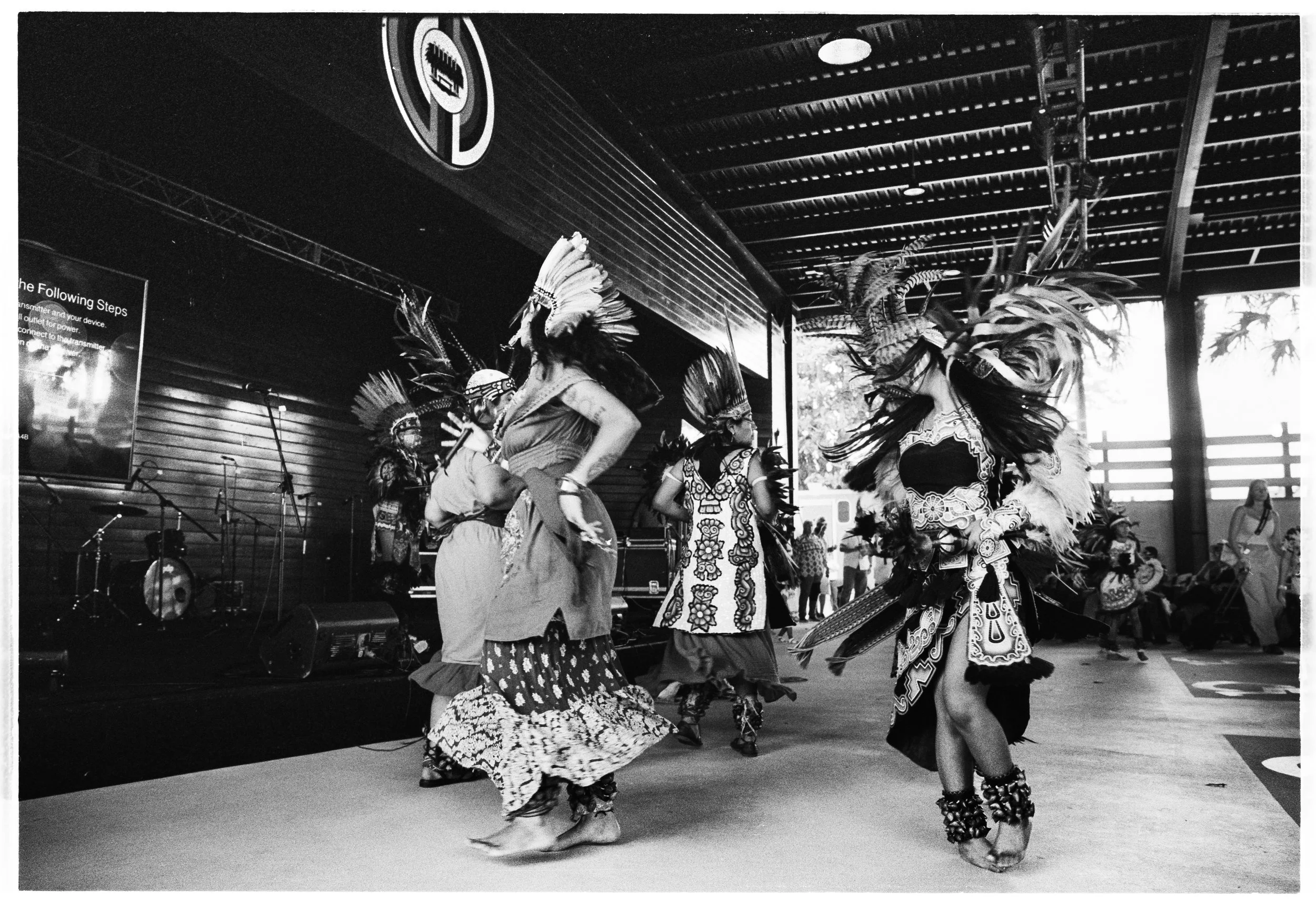
The Earth Beneath the Rhythm

Beneath the wooden beams, the @ameyalmco dancers turn through the gathering, their feathered headdresses sweeping across the frame. A skirt lifts around bare feet, ankle rattles accompany each step, and the nearest dancer’s face disappears behind a rush of feathers. Others watch from the edge of the space. I made this photograph on Tri-X during our Earth Day gathering, drawn to the overlapping movements and the way each dancer remained part of a shared rhythm.

Earlier that day, drums, smoke, and song had brought us together. Here, that feeling continued through movement. Watching the dancers, I reflected on how traditions live through people who practice them, share them, and invite younger generations to participate. The gathering reminded me to bring my care for the earth into daily life: how I treat the land, how I listen to others, and what I choose to preserve through my work. Looking at this photograph now, I can almost hear the rattles again and feel the rhythm that held my attention.
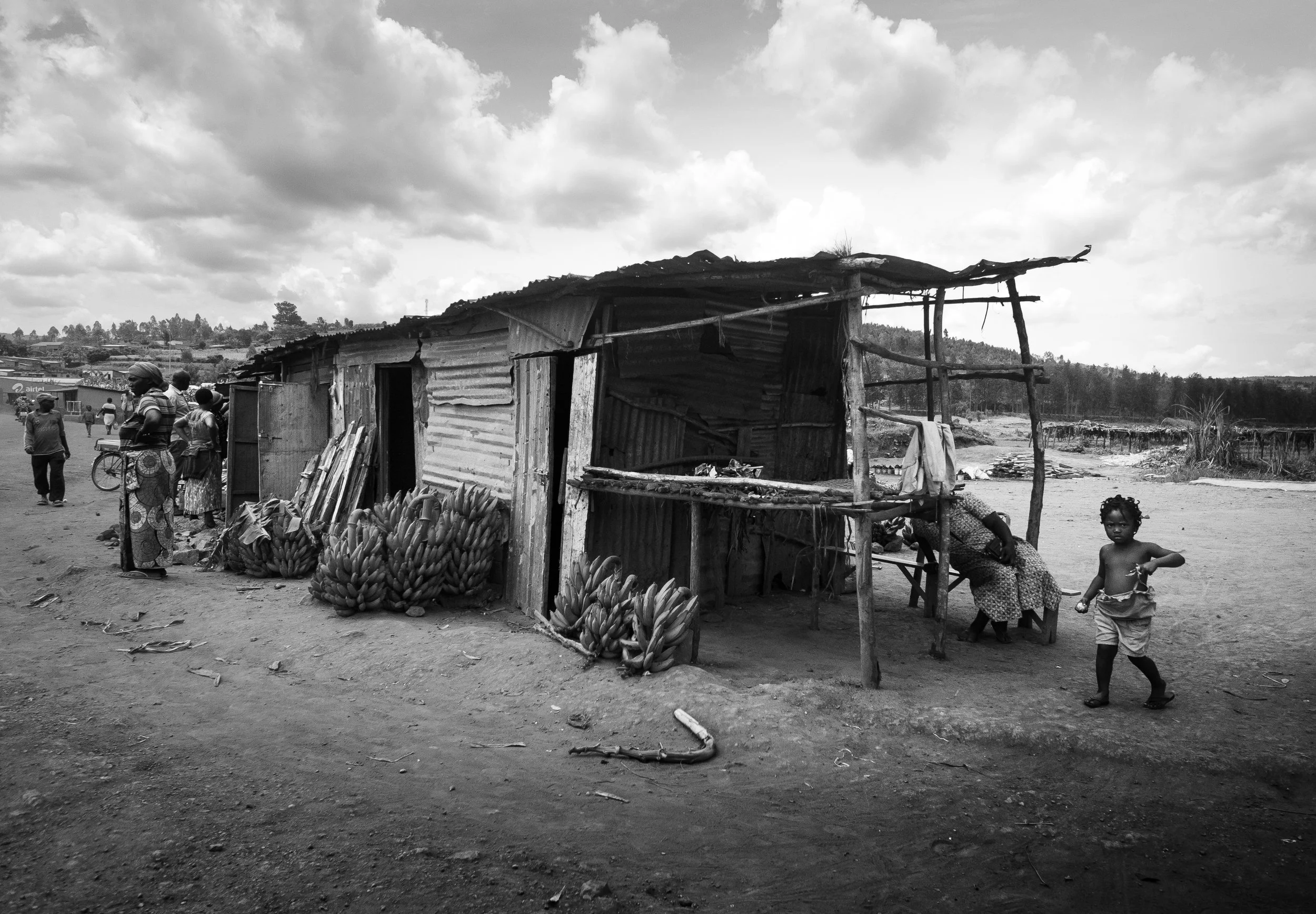
Through rolling hills, 2019

In 2019, I traveled to Kigali, Rwanda, with my father, who shares my love of photography. This journey also had a personal purpose: helping him find land for a new home. Over a week, we drove through rolling hills and rural villages, photographing along the way. Rwanda was marking 25 years since the 1994 genocide, and the remembrance stayed with me as we traveled. I was aware of how much history lay beyond what my camera could show.

In “Through Rolling Hills,” a roadside structure of corrugated metal and wood sits beside bunches of bananas. People gather near a bicycle on the left, while a child steps into the open space on the right. Hills stretch beneath a cloud-filled sky, placing these everyday activities within the wider landscape. I photographed the scene in RAW and returned to it repeatedly while editing. In black and white, the earth, metal, and clouds hold the textures of a brief encounter from a journey shared with my father.

A Shared Glance During Aarti, 2024.
Chants of the Huni Kuin, 2024.
Among the Market Colors, 2019.
The Land in Their Steps
Faith can move mountains, 2025.
Honoring Our Elders, 2026.
Sensei Zen Takai, The Zen Samurai, 2025.
ehind the Door of the Mind Exists the Shoreless Lake of Peace, 2023
Maha Bekandze, 2025.
Glimpse of One’s Essential Universality, 2023.
Hacienda Still Life, 2025.
Kalsubai Peak, 2023
Beauty Way Daryl Slim, 2025.
Sripad Bhaktivedanta Vana Maharaja, 2022.
Learning the Pace of Belonging, 2025.
No One Around to Hear It, 2025
Where Listening Becomes Stillness, 2026.
What We Made in the Pause, 2025.
Before the First Step, 2025.
The Road Back to Delhi, 2024.
Between Departures, 2025.
Taita Ivan Navarro, 2025.
Crooked the road, 2025.
Last Summer’s Refuge from the Storm, 2025.
Myth of Tomorrow, 2025.
On watch Kigali, 2019.
Where the Light Begins. Saint Lucia, 2016.
The Earth Receives Her, 2026.
Cuenca Market side-quest, 2025
Silvery wings of Intuition, 2023.
Lakshman Jhula Landing, 2024.
After the circled closed, 2025.
Protoje and Chronixx at Tuff Gong, 2018.
Nãwãema of Shavorã, 2026.
Gracias por su compra, 2025 .
A Gesture Held in Light, 2026.
A Letter Beneath the Open Window, 2025.
The sun’s light shines for all of us, 2025.
Both peace and history, 2025.
What We Carry Forward, 2025.
The Lake Through the Trees, 2025.
Threads of Belonging, 2026.
 Living Traditions, 2026.
HiAce Cue, 2016.
The land that nourishes, 2025.
Lada rolling on cobblestone, 2025.
The Love We Carry On, 2025.
The Earth Beneath the Rhythm
Through rolling hills, 2019
A Shared Glance During Aarti, 2024.

This remains one of my favorite photographs from India. During the evening aarti at Parmarth Niketan in Rishikesh, the crowd moved like a single body around me. Hands lifted diyas and oil lamps in adoration of Shiva while faces, fabrics, and gestures dissolved into streaks of red and gold. Then I noticed this young boy holding a basket of marigolds and devotional offerings. He caught my eye. I advanced the film, we exchanged a brief look, and I released the shutter with an off-camera flash.

Everything around him seems to move, yet he remains still, his gaze cutting through the blur. I love the grit, the imperfect light, and the tension between his quiet presence and the energy surrounding him. India was a time when I felt myself advancing deeply along the spiritual path, and this photograph holds something of that experience: movement and stillness, devotion and observation, all existing within the same breath. Photographed on Kodak Ektar 100.

Chants of the Huni Kuin, 2024.

Sixteen years ago, as a sophomore in high school, I could not have imagined the photographs I would be making today. My subjects and intentions have shifted, but my desire to make honest images keeps growing. In this photograph, Txana Ikakuru and Batani Huni Kuin sit beneath broad leaves, one playing guitar while the other sings beside him. Light reveals the painted patterns across their faces, the woven details of their clothing, and the feathers rising between them, casting deep shadows on the wall. I made it during a Hapé evening ceremony and concert at Cantik Villa in Homestead, Florida. They had traveled from Boa Vista in the Brazilian Amazon to share their community’s traditions, knowledge, and sacred chants. Through my position and use of light, I wanted to preserve something of the atmosphere while remaining attentive to the people before me.

Ceremonial practices have become part of my spiritual journey, inviting me to listen and reflect on what I can apply to my own life. Alongside what I have learned in India, these encounters deepen my sense that the divine can reveal itself through different faces and voices, each rooted in a distinct tradition deserving care and respect. Photography asks that same attention of me. I keep learning how light, gesture, and the relationships within a frame can help us see more clearly. Even through burnout, carrying my camera can renew my curiosity and widen my awareness. Documenting our lives and sharing each other’s stories still matters deeply to me. The world needs thoughtful photographs. Honest ones. Images that help us recognize one another.

Among the Market Colors, 2019.

At Kimironko Market in Kigali, rows of tomatoes, onions, carrots, and green peppers fill trays and baskets beneath a dark roof. Narrow strips of daylight shine overhead, catching the produce and the worn cloth covering the displays. A seated woman looks toward my camera, her bright yellow skirt and floral blouse adding another layer of color. Around her, people lean over the stalls and pass through the edges of the frame. I made this photograph during my 2019 journey through Rwanda with my father.

Kimironko brings together everyday food shopping with stalls selling fabrics, clothing, and locally made goods. Walking through the market gave me time to notice the work behind each display and the people tending it. I was drawn to the arrangement of colors, but the woman’s glance gave the photograph its center. Looking at it now, I remember being a visitor in someone else’s working day, grateful for a brief encounter within the life of the city.

The Land in Their Steps

That morning in Tabio, horns and drums drew us into the streets for the Festival of Land and Work. In this photograph, a young pair dances amid wide-brimmed hats, ruffled blouses, and skirts lifted into motion. Behind them, someone watches from an upstairs balcony. I was drawn to how the celebration filled an ordinary street, bringing generations together through gestures and rhythms learned and shared.

With Sol on my shoulders and my Leica M6 in hand, I felt grateful to witness a community honoring the work that sustains it. These dancers brought me back to the farmers and families whose labor makes its way to our tables, often without our knowing their names. I thought of Saint Lucia and Jounen Kwéyòl, of the ways food, music, dress, and memory bring us together. Preserving heritage begins with people continuing to practice it, teaching the steps, telling the stories, and making room for the next generation to join.

Faith can move mountains, 2025.

At Latille Falls in Saint Lucia, I paused before this Rastafarian altar honoring Emperor Haile Selassie I and Empress Menen. Their framed portraits sit beneath a painted arch, surrounding a central image of the Virgin and Child. Cross motifs, flowers, patterned cloth, drums, and tambourines fill the space, while painted lions watch from the side. Red, gold, and green extend across the altar and overhead beams. Photographing it on Kodak ColorPlus 200, I was drawn to the warmth of the colors and the care with which these objects had been brought together.

Saint Lucia is my homeland, an island of deep greens, changing blues, mountain ridges, and voices moving between English and Kwéyòl. Our histories live in our food, music, language, and the different ways people express their faith. Returning with a camera helps me give familiar places another moment of attention. Here, that meant looking closely at a small sanctuary within the landscape, where devotion takes visible form through photographs, instruments, and things carefully kept. Home lives in these details too, in what people cherish and make room for.

Honoring Our Elders, 2026.

In “Honoring Our Elders,” I was drawn to the quiet presence of this Native American elder amid the movement of the powwow. Seen in profile, his face and the layered feathers of his regalia held my attention. I chose black and white to bring focus to his expression, the textures, and the stillness I felt in that moment. Making this photograph reminded me how much there is to learn when I slow down and observe.

The younger figure in the foreground led me to reflect on the generations gathered here, and how traditions continue through participation, teaching, and care. During the Grand Entry, veterans, leaders, and respected community members are honored. I’m grateful to have witnessed this gathering and to share a photograph that, for me, speaks to the importance of honoring our elders, listening to their stories, and respecting the living cultures they help carry forward.

Sensei Zen Takai, The Zen Samurai, 2025.

The Discipline of Presence. I’ve had a few opportunities now to photograph Sensei Zen Takai, The Zen Samurai, and each time I walk away understanding a little more about what sits underneath his practice. I made this photograph during an event by Chozen at The HUB, watching him move while everyone around him became quiet and attentive. What keeps drawing me back is that the movement never feels like movement for its own sake. There is discipline behind it, but also stillness. Awareness. A relationship between the body, the mind, and whatever is happening in the present moment.

Sensei describes his work as carrying forward the wisdom of a 16-generation Samurai lineage while finding ways for those teachings to remain useful in contemporary life. His practice moves through martial arts, meditation, calligraphy, poetry, movement, and other forms, with an emphasis on balance, intuition, emotional regulation, and what he calls maintaining a beginner’s mind. I especially appreciate that last part. His philosophy is not built around arriving at some final level of mastery. Even the teacher remains a student, continuing up the mountain alongside everyone else.

Photography has given me access to so many worlds that I may never have entered otherwise. Sometimes I meet someone once and make a photograph. Other times I’m fortunate enough to return, observe again, and slowly understand more. Photographing Sensei has been the latter. Each encounter reveals another layer, and I’m beginning to understand that some practices cannot be understood by simply watching them once. They ask for repetition. Attention. Time. Maybe photography works the same way. We keep returning to the world, trying to become quiet enough to see a little more clearly than we did before.

ehind the Door of the Mind Exists the Shoreless Lake of Peace, 2023

In “Behind the Door of the Mind Exists the Shoreless Lake of Peace, 2023,” I photographed a house front with my Leica M11 and a 21mm lens, placing its closed door at the center. Soft blue walls meet red, yellow, and green details, while a yellow cloth overhead warms the light. Clouded glass, cracked paint, and worn edges give the scene a lived-in texture. I was drawn to the balance of color and the stillness of this ordinary entrance.

The door became a way for me to reflect on the mind and the peace we seek within it. Its glass hints at something beyond without revealing it, inviting patience and attention. The title expresses my sense that peace can be encountered by becoming still enough to notice what is already present. Making this photograph was a moment of that practice: pausing, looking closely, and allowing a familiar form to deepen my reflection.

Maha Bekandze, 2025.

In “Maha Bekandze,” I photographed a line of Tibetan monks seated outdoors at night, their backs turned toward the camera and their heads slightly bowed. Light catches their layered robes and textured ceremonial headpieces, while palm trees recede into darkness. Shoes and bags rest at their feet, grounding this shared moment of prayer in the everyday details of their lives.

Made during a fire ceremony with monks connected to Drepung Gomang Monastery, the photograph reflects spiritual practice and the preservation of Tibetan traditions in exile. The title draws on a healing chant, echoing the care and compassion I associate with this gathering. For me, the image holds stillness alongside resilience, inviting attention to the people who sustain these teachings and share them across communities.

Glimpse of One’s Essential Universality, 2023.

I made “Glimpse of One’s Essential Universality” in Ellora, photographing a passing truck from the back of a moving bike. Using my Leica M11, a 21mm lens, and a slow shutter, I captured its yellows, oranges, and greens stretching across the frame. The road tilts, edges blur, and roadside figures nearly disappear into the movement. The photograph holds something of my first encounter with India: heat, color, and life unfolding faster than I could take it in.

As part of Swayam Jyotis, this image reflects my growing awareness of impermanence and the limits of perception. The blur carries the feeling of being immersed in a place while still learning how to see it. Its title speaks to a fleeting recognition of connection, a sense of something shared within the constant movement of life. Looking at it now, I return to that moment of traveling, observing, and allowing the experience to unfold.

Hacienda Still Life, 2025.

I made this photograph shooting Kodak Tri-X 400 at a hacienda where I stayed in Ecuador, as part of my travels through Cuenca and the surrounding Andes. An empty armchair against a worn wall, people gathered around a guitarist, and framed family photographs drew my attention to the lives held within a place. The film’s grain and contrast bring out the textures of walls, fabric, and skin, giving these everyday scenes the feeling of memory.

Across the series, interiors, portraits, roads, and mountain landscapes trace my movement between solitude and shared experience. I was interested in how people inhabit the land and how history remains visible in ordinary details. These photographs hold small impressions of what I encountered, shaped by curiosity and a wish to look carefully. They remind me how much there is to learn by spending time in a place and paying attention.

Kalsubai Peak, 2023

In “Kalsubai Peak, 2023,” I photographed a small red temple after a six-hour ascent begun in darkness with fellow yogis. White painted figures and animals wrap its walls, while morning light falls across the uneven ground. A railing and a trident tied with cloth stand to the right beneath an open sky. The 21mm Super Elmar lens allowed me to hold the temple and its surroundings together, giving a sense of the space we had climbed into.

The photograph carries my memory of that effort: fatigue, distractions, and the support of those walking beside me. Looking at it, I think about the restless mind and the clarity that sometimes comes through sustained attention. The open sky became a reminder of the self beyond life’s changing conditions. Reaching the summit gave me a moment to rest, look outward, and meet the journey with a wider perspective.

Beauty Way Daryl Slim, 2025.

I had the privilege of spending time with Darryl Slim, a Diné (Navajo) elder and traditional wellness educator, who guided us through a Beauty Way ceremony.

It was an opportunity to listen, learn more about the spiritual traditions of this land, and reflect on how I move through life. I left thinking about morality and principle. About keeping my word. About making choices that bring my actions closer to what I believe.

Darryl grew up in Sand Springs and Pinon on the Diné Nation. He learned traditional medicine from his grandparents, Danny and Aurora Joe. Today, he shares those teachings through ceremony, retreats, and personal mentoring, supporting people through grief, family challenges, and questions about their direction in life.

What stays with me is the responsibility to practice what I receive. To carry these lessons into how I speak, how I treat others, and how I care for the land beneath my feet.

Thank you, Darryl, for welcoming us and sharing your time, prayers, and guidance. I’m grateful for the opportunity to learn from you.

Learn more about his work at darrylslim.com.

Background and offerings drawn from Darryl’s website⁠.

Sripad Bhaktivedanta Vana Maharaja, 2022.

I made this photograph of Sripad Bhaktivedanta Vana Maharaja during a fire ceremony at Sacred Vedic Arts in South Florida. Seated on a patterned cushion, he looks down at an open text as flames rise beside offerings of fruit and flowers. Devotees gather around him in the sunlight, sharing the ceremony. He was the first guru I met, at a time when I was beginning to study Vedic teachings and deepen my relationship with the divine. He gave me the name Nityananda, which I carry as a reminder of eternal bliss.

Born in West Bengal, Vana Maharaja entered the Gaudiya Vaishnava monastic community in 1981. He studied under Srila Bhaktivedanta Narayana Gosvami Maharaja and received initiation from Srila Bhaktivedanta Vamana Gosvami Maharaja. His life’s work centers on bhakti, loving devotion to Radha and Krishna, which he shares through teaching around the world. Looking at this photograph brings me back to those early days of listening and learning, when devotion began taking shape through prayer, community, and the guidance of teachers I was fortunate to meet.

Learning the Pace of Belonging, 2025.

From behind my companions, I watched the trail open toward a valley of evergreens and a distant mountain ridge. Full packs, trekking poles, and layers against the mountain air filled the foreground, while the forest stretched far beyond us. I made this photograph during our July 2025 backpacking journey on Washington’s Pacific Crest Trail. Looking at it now, I remember how walking together brought attention back to simple things: finding steady footing, noticing someone’s pace, and making room for a pause.

Led by @pachamary04 and @ecocentrismo, our 11-mile round-trip expedition followed a skillshare approach, bringing Council, ritual, and ecopsychology into our time outdoors. There was room to listen to one another and to notice what the landscape stirred within us. For me, belonging became tangible through the shared effort of the walk—the weight we carried, the care we offered, and the forest surrounding us. Each step was a chance to practice being present in a world we are already part of.

No One Around to Hear It, 2025

In this photograph from Tabio, a man leans forward on a vintage blue Fordson Dexta tractor, pausing amid the activity of the town square. Behind him, people gather near a monument, a Colombian flag waves, and pastel buildings sit beneath green hills and a clouded sky. Shot on Kodak ColorPlus 200, the scene holds soft blues and earthy tones, punctuated by the tractor’s red wheel rims.

I titled the photograph “No one around to hear it.” His stillness within the gathering made me think about the thoughts we carry privately, even when surrounded by others. I cannot know what occupied his mind, but his posture drew my attention to that possibility. The image holds a shared public space and a moment that feels quietly personal.

Where Listening Becomes Stillness, 2026.

Light spills from behind Ablaye Cissoko, tracing his shoulder while small points of light scatter across the darkness above him. Seated at the microphone, his face partly in shadow, he holds my attention within a frame softened by grain and a blurred figure in the foreground. I made this photograph during the Well-Being Concert presented by @liveartsmiami in partnership with Carnegie Hall. It was an unforgettable night, one that invited me to slow down, listen, and let the music guide my attention.

Born in Kolda, Senegal, into a family of griots, @ablayecissoko carries a lineage of storytelling and music through his voice and kora, the West African harp-lute. His work brings Mandinka traditions into conversation with contemporary music and artists from around the world. As someone who tells stories through photographs, I felt drawn to that continuity: a person carrying what he has inherited while making something distinctly his own. This portrait brings me back to the quiet pleasure of being there, sharing a room with others and giving ourselves time to listen.

What We Made in the Pause, 2025.

During our July 2025 backpacking trip on Washington’s Pacific Crest Trail, we stopped to rest and make something together. On the forest floor, our group arranged cones, twigs, leaves, flowers, and lichen into a natural mandala. In this photograph, a companion leans forward to place another piece near its center. Hiking boots edge into the frame, and a small tea set rests on a patchwork cloth nearby. I was drawn to the care in that gesture, each person contributing to a pattern taking shape between us.

This was part of the intentional time we shared with @pachamary04 and @ecocentrismo, bringing creativity and reflection into the journey. Making the mandala gave me a reason to look closer at what surrounded us: the shape of a leaf, the texture of a cone, the small colors against the soil. Our attention settled into the work of our hands. Looking at this photograph, I remember how much a simple pause can hold when we give it our attention.

Before the First Step, 2025.

On my first day in Ecuador in 2025, I was walking through Guayaquil with my camera when I came across a local celebration filled with art, cacao, music, and traditional dance. These women were preparing to dance when I made this photograph. Lace and layered ruffles fill the frame, with large circular earrings and patterned fabric woven around their pinned hair. Two turn toward one another, while the woman nearest me looks beyond the frame, her hand resting at her waist. I was drawn to this moment of gathering before the dancing began.

Finding my way through an unfamiliar city, I felt grateful to encounter people sharing something meaningful to them. The photograph brings me back to the small gestures around a celebration: a conversation, a glance, the time spent getting ready. These moments matter to me as much as the dance itself. I photographed this on Ilford HP5 400 with my Leica M6, a 28mm Summicron f/2 lens, and an orange filter, holding the textures and expressions of that first day in black and white.

The Road Back to Delhi, 2024.

After leaving the ashram, I began the six-hour journey back to Delhi with only a couple rolls of film remaining. Through the green-tinted windows of a passing bus, a woman wrapped in red met my camera with a direct gaze while another passenger faded into shadow beside her. The silver frames and horizontal bars divide the scene into painted panels of turquoise, white, black, and red. Made in an instant between two moving vehicles, the photograph holds the quiet tension of departure: unfamiliar lives briefly meeting before the road carries each of us in a different direction.

Between Departures, 2025.

On an overcast day at Frenchtown Marina in St. Thomas, I stopped before this small boat resting at the water’s edge. Its worn paint, the upright posts, and the low dock drew my eye toward the harbor and hills beyond. Photographed on Kodak Tri-X 400 with my Leica MP and a 28mm lens, the soft light gave me space to study the textures of a place shaped by salt, weather, and use.

Frenchtown, historically known as Carenage, became home to families who migrated from Saint Barthélemy during the nineteenth century. Fishing helped sustain the community; residents built boats, made nets, and fashioned fish traps. Learning this history deepens what I see here. Coming from Saint Lucia, I feel close to these island stories of movement and making a living beside the sea. I don’t know this particular boat’s journeys, but its presence made me pause and consider the lives that begin and return along this shore

Taita Ivan Navarro, 2025.

I made this portrait of Taita Ivan Navarro during a hike through the mountains of Ecuador, just before we sat together for ceremonial prayer. He crouches close to the grass, one hand raised and the other resting across his knee. Sunlight catches his long hair and gray beard beneath a broad-brimmed hat, while the trees soften into green behind him. I remember his quiet manner, his deep eyes, and how comfortably he moved through the land. He was an excellent musician, too, someone whose presence encouraged me to slow down and listen.

Originally from Chile, Taita Ivan brings more than four decades of experience to his ceremonial work. His offerings include limpias, spiritual cleansing practices, and ceremonies centered on connection with nature. What stayed with me was the person I encountered on that walk: thoughtful, attentive, and generous with what he knew. This photograph holds a pause before our gathering began, when I could give him my attention and carry a small memory of our time together.

Crooked the road, 2025.

My Ecuadorian journey began in Guayaquil, where I met my friend Danil before our expedition to Cuenca. We left the Airbnb to explore the streets beneath an overcast sky. There was a melancholy to the day and a noticeable police presence, but I felt safe walking with my Leica M6 and 28mm Summicron. Of the fifteen rolls I brought, two were Ilford HP5 400. I enjoy these unplanned walks. They give me time to find my footing in a new place, and the camera’s discreet design helps me photograph without drawing much attention.

This VW Bus stood out from that first roll. I’ve always loved them as street furniture, carrying traces of another era into the present. I’m constantly looking for older, uncommon things, and vintage vehicles bring music, romance, and imagined journeys to mind. There is something tender about photographing a machine that has lasted this long, still here before it finally runs out of steam. Its wear reminds me that a life well traveled leaves marks. I keep walking, looking, and learning as I go.

Last Summer’s Refuge from the Storm, 2025.

In “Last Summer’s Refuge from the Storm,” I photographed a modest rural chapel after harsh weather halted our ascent up Peña de Juaica. Against a pale blue wall, a white statue of the Virgin stands above an altar surrounded by flowers, candles, and an image of Our Lady of Guadalupe. Exposed wooden beams, worn plaster, and an empty plastic chair give the room a humble, lived-in character. Soft light and the warmth of Kodak Gold 200 hold the stillness of this shelter.

What began as a climb became a lesson in surrender. Turning back meant respecting the conditions and accepting what the mountain allowed that day. Inside the chapel, I found a quiet place to pause and reflect. Though no one appears in the photograph, the care given to the altar reveals an ongoing presence. I remember this refuge with gratitude, and the reminder that knowing when to stop can be part of the journey.

Myth of Tomorrow, 2025.

During one of my last adventures of 2025, I traveled through Cuenca and the surrounding Ecuadorian Andes, making photographs and learning about the region’s Indigenous cultures. I made “Myth of Tomorrow” while visiting a site of devotion to Mother Mary near El Cajas National Park. Two sheep stood in the grass before dark trees and layered mountains. One turned toward my camera while the other continued grazing. With the sun ahead of me, I patiently composed the scene and used wireless Lightpix flashes to illuminate the foreground, shooting Kodak Tri-X 400 with my Leica M6 and an orange filter.

The photograph brings me back to the importance of presence. I was occupied with light, timing, and composition while the sheep went about their lives. Their quiet activity reminded me to pay attention to where I stood. I chose the title because tomorrow remains an idea; this moment is where we can act, feel, and make choices. Photography helps me practice that attention, bringing me back to what is unfolding before me.

On watch Kigali, 2019.

In 2019, I traveled to Kigali, Rwanda, with my father. We share a love of cameras, and several of my journeys through Africa in my twenties were spent beside him. This time, I was also helping him look for land for a new home. Our days took us through rolling hills and villages, giving me opportunities to photograph along the way. Here, a young person turns toward my camera from a grassy slope. Behind them, sunlight warms a textured ochre wall, while trees and overhead wires reach into a blue sky filled with clouds.

I was drawn to the scale of the sky and that brief glance connecting us across the frame. Traveling with my father gave these photographs another layer of meaning. They hold memories of looking together, following unfamiliar roads, and considering where he might build a life. I returned to this RAW image many times while editing, finding my way toward the color and atmosphere you see here. It remains a small encounter from a journey I’m grateful we shared.

Where the Light Begins. Saint Lucia, 2016.

A smile from home, made while I was still learning to see through 35mm black-and-white film. I photographed this man during one of my first semesters studying photography and developing my own negatives. His knitted hat, patterned collar, and the lines around his eyes give the portrait its texture. But his smile is what holds me. Open and immediate, with his gaze meeting mine. What appears to be the beginning of the film strip carries a wash of light across one side of his face. Part of the portrait fades, while the other remains full of detail. I love how that uncertainty sits beside such a clear human expression.

Looking back, I see two beginnings here: the edge of a roll of film and my own first steps as a photographer. Before I fully understood exposure or development, I was already drawn to people and the quiet connection a portrait can hold. This photograph brings me back to Saint Lucia, and to the simple pleasure of seeing someone smile through the viewfinder.

The Earth Receives Her, 2026.

The circle opens around a woman lowered to the grass, her body caught between surrender and return. Hard light cuts through the darkness, turning faces, hands, drums, and strands of moving hair into bright gestures against a field of black. The women surrounding her appear like figures gathered within a nocturnal painting. One beats a small drum close to the earth, another holds feathers and smoke toward her, while a large drum curves into the frame like a shield. Everything leans toward the woman at the center, as if the entire circle has become a single body holding her.

What appears at first to be collapse slowly reveals itself as release. She is not alone in the darkness. Rhythm, prayer, and human presence surround her while the ground receives what her body can no longer carry. The photograph holds the intensity of transformation without explaining it. It preserves the moment when ceremony moves beyond performance and becomes something lived, where drumming becomes language, witnessing becomes care, and darkness is turned into a place of healing. Photographed on Kodak Tri-X 400 with my Leica MP.

Cuenca Market side-quest, 2025

In 2025, I traveled to Ecuador with a camera and a wish to understand a little more of the world. At this market stall, baskets of apples, strawberries, citrus, and vegetables fill the frame with color. Behind a worn green partition, a woman reads a newspaper, one hand resting near her lips, while another looks toward my camera from beside a concrete column. I was drawn to these two different moments of attention, surrounded by the produce and wooden crates of a working day.

Much of my time in Ecuador was spent walking through Cuenca, letting everyday life guide my eye. Markets brought me closer to the people and labor behind what nourishes a city, but this photograph also holds a quieter detail: someone finding time to read amid it all. A frame can preserve a gesture without revealing a person’s whole story. I’m grateful for these encounters and for the reminder to stay curious, look carefully, and keep learning from the people who call this place home.

Silvery wings of Intuition, 2023.

In Lonavala, I photographed this man standing beside his bicycle, leaning toward the handlebars as he turned to meet my camera with a steady, curious expression. His light shirt stands out against the dense foliage, while metal containers hanging from the bicycle catch the light. In black and white, the textures of leaves, fabric, and worn metal bring depth to this everyday encounter.

Using my Leica M11 and 21mm Super-Elmar, I brought the man, bicycle, and surrounding landscape into one frame. I was drawn to his composed presence and the practical details of what he carried. The photograph holds a brief pause in his day, a moment of attention shared before life continued.

Lakshman Jhula Landing, 2024.

Landing on the shore near Lakshman Jhula in Rishikesh, I made this photograph from the bow of the ferry just before stepping onto land. The ropes gather in loose knots across the front of the boat, surrounded by hand-painted lettering worn by water and use. Beyond them, boats rest against the shore while white buildings climb into the hillside beneath an almost uninterrupted blue sky. I love how much depth exists within the frame. The bow holds you in the immediate moment, while everything beyond it feels like an invitation into what is waiting on shore.

I was crossing over with no real agenda beyond walking and making photographs. I wanted to spend time on this side of Rishikesh and allow the streets to lead me toward whatever caught my attention. Looking back, this photograph feels like the beginning of that small pilgrimage. There is something I love about arriving somewhere on foot with a camera, not knowing who I will meet or what I will see. Sometimes street photography begins before you even reach the street. Photographed on my Leica M6 with Kodak Portra 400.

After the circled closed, 2025.

A guitar rests beside a folding chair. An open suitcase holds instruments and personal belongings, while a rattle and other instruments wait on another seat. Bare feet move across the grass as the gathering begins to pack away. I made this photograph at Southern Star Community, just after the closing circle of an ayahuasca ceremony. Invited that morning to speak with community members and share music, I arrived in the quiet that followed a night they had spent together.

I was careful about where I pointed my camera and whose image I made. The intimacy of that space asked me to listen and move gently. Here, I turned my attention toward the objects that remained, small traces of music, presence, and a shared introspective time. I cannot speak for what anyone experienced that night. What I could photograph was this moment of transition: belongings being gathered, people preparing to leave, and the ordinary gestures that follow something deeply personal.

Protoje and Chronixx at Tuff Gong, 2018.

I made this photograph of Protoje and Chronixx at Tuff Gong Studios in Kingston, Jamaica, during a recording session for A Matter of Time. Protoje stands partially framed on the left, wearing a dark hoodie and knit cap, while Chronixx leans forward beside him with his hands at his hips. Their relaxed but attentive presence drew me in. Photographed on Kodak Ektar 100, the warm tones and fine grain preserve the intimacy of the studio.

Behind them, wood paneling, an orange pegboard wall, and a black-and-white portrait of Bob Marley place the moment within Jamaica’s musical lineage. I wanted to capture something of the quieter side of making music: the pauses, the attention, and the space where ideas take shape. Looking at this photograph, I see two artists creating their own work in a room that carries generations of sound.

Nãwãema of Shavorã, 2026.

I photographed Nãwãema at LeSound Temple in Fort Lauderdale, one of the first gatherings I documented after returning from Peru. She holds her painted guitar upright, its animal figures and bold patterns catching the light against the dark background. Geometric beadwork frames her face, and painted lines extend across her cheeks and chin. That evening, she joined Hukena and Eriya as Shavorã, sharing music that brought together Yawanawá songs from the Brazilian Amazon and her own roots in Umbanda.

Listening to Nãwãema speak gave me more to carry home than the photographs. She cautioned against excessive use of rapé and reaching for it whenever difficult feelings arise. I appreciated her honesty about how a sacred practice could become a way of avoiding what needs our attention. This portrait brings me back to that question: what do we hear when we take time to know the people behind the songs? I share more from our conversations in “Shavorã: The Women Behind the Songs” on Photo Pilgrimage. You’re welcome to read, subscribe, and pledge your support for more stories like this.

Gracias por su compra, 2025 .

In this tightly framed photograph of a market stall in Cuenca, Ecuador, a scuffed green door sits behind hanging bags, produce, and folded fabrics. A mesh sack of orange produce fills the lower left beside a wrinkled blue plastic sheet, while a navy-and-white striped blanket hangs on the right. Above them, a yellow sack decorated with cartoon animals reads “¡Gracias por su compra!”—“Thanks for your purchase.”

Shot on Kodak ColorPlus 200, the photograph holds warm colors and subtle grain that bring out worn paint, woven fibers, and crinkled plastic. I was drawn to how these ordinary things came together through daily use. Their colors and textures gave me a reason to stop and look, offering a small glimpse into the life of a working market.

A Gesture Held in Light, 2026.

Among everyone gathered on the arena floor at the Seminole Powwow, Lelani O’ Daye caught my attention. Her feather fan rose above her head, one hand resting at her waist, as light caught the geometric patterns, fringe, and rows of metal cones across her regalia. I was drawn to the reach of her arm and the composure of her expression. Behind her, people continued moving through the gathering.

I made this portrait on Kodak Tri-X 400 with my Leica M6 and a 28mm lens, using a small off-camera flash at 1/50 of a second. The flash brought her forward while the surrounding light and movement remained in the frame. Looking at the photograph now, I’m reminded of that brief moment of recognition, when my attention settled on one person and I raised the camera, hoping to preserve something of what drew me to her.

A Letter Beneath the Open Window, 2025.

A man sits alone in a café, leaning over a sheet of paper. Warm ochre walls surround him, and his pale clothing catches the light. A cup, folded umbrella, and empty chairs fill the space around him. The blurred railing in the foreground marks my view from outside. Something about the light and his posture makes the scene feel like a painting. I made this photograph while running errands in Tabio, with my Leica M6 around my neck and the focus set to roughly three meters. I often find myself looking through open windows there, into cafés, bakeries, and small restaurants where people pause during their day.

As I passed, I glanced inside and made the photograph in a split second. He appeared to be writing a letter or working on a document. I never learned what it was. It remains one of my favorite quiet moments with the M6. A reminder of how much life we can glimpse when we pay attention on an ordinary walk.

The sun’s light shines for all of us, 2025.

The sun’s light shines for all of us. On this narrow stretch of the Pacific Crest Trail, our group pauses among ferns and wildflowers, carrying full packs beneath an open sky. One companion turns toward my camera while another points a trekking pole toward the mountains. The trail crosses a steep hillside, with evergreens descending into the valley and distant ridges beyond. I made this photograph in Washington in July 2025, during an 11-mile round-trip backpacking journey. Quieting myself helped me notice more: the weight of my pack, each breath, and the people sharing the path.

Led by Mary Cronin (@pachamary04) and Rhett Rannick (@ecocentrismo), our journey used a skillshare approach, weaving Council, ritual, ecotherapy, and ecopsychology into our time outdoors. We learned from the landscape and from one another. We grew tired, paused, offered help, and kept walking. For me, courage took shape in those small acts, in meeting unfamiliar terrain with curiosity while respecting the ground beneath my feet. This photograph brings me back to that shared pause and the simple feeling of belonging within a world brightly alive.

Both peace and history, 2025.

This was one of the few color photographs I made that day. The monks of Drepung Gomang Monastery sit together on the sand, their saffron and deep red robes glowing against the pale blue sky and quiet ocean. A ceremonial drum rests near the center, while a long horn stretches across the foreground like a line connecting the viewer to the gathering. Behind them, people sit in stillness beneath the palms, forming a quiet circle of witnesses around the pooja.

There is both peace and history within their presence. These monks carry a spiritual tradition preserved through displacement, devotion, and the continued practice of compassion. The photograph feels meditative, but it also speaks of endurance and a culture that has survived far from its homeland. Made with Kodak ColorPlus 200 on my Leica M6, the film holds the warmth of the robes, the softness of the evening light, and the sacred calm of a moment shared beside the sea.

What We Carry Forward, 2025.

That morning in Tabio, horns and drums drew us into the streets for the Festival of Land and Work. Among the bicycles moving through the gathering, I noticed this man in a dark hat and white shirt, his long braid falling down his back. He turned toward my camera with one hand near the handlebars. Behind him, riders wore hats and draped ruanas, their bicycles carrying bags, blankets, and everyday belongings. I was drawn to this brief exchange of attention amid a street full of movement.

The Lake Through the Trees, 2025.

When we reached Lake Vicente, this was the view I wanted to remember. Blue water appeared between tall evergreens, beneath steep rock walls and slopes scattered with loose stone. Sunlight caught the branches and undergrowth, while a companion stood near the bottom of the frame, facing the lake. I made this photograph during our July 2025 backpacking journey in Washington. The small human presence gives a sense of the scale we had walked into.

Our group arrived together, carrying the effort of the trail and the care we had shared along it. With @pachamary04 and @ecocentrismo guiding the expedition, we had been making time to listen, reflect, and notice our surroundings. Here, I felt grateful simply to stop and look. After watching my footing for so much of the walk, I could lift my eyes and take in the water, the trees, and the mountains holding them.

Threads of Belonging, 2026.

At my first powwow, the Seminole Powwow, I found myself watching the people gathered around the arena as closely as the dancers. In this photograph, two men stand with long paired braids falling down their backs. The central figure turns slightly, his profile beneath a broad-brimmed hat, while geometric patterns fill his vest. Beside him, another attendee faces the gathering. A light flares just above the hat, marking a small moment within an event that brought people from many nations together.

Those braids prompted me to learn more about the relationships between hair, identity, and responsibility. Their meanings differ across Indigenous nations, families, and individuals. Some teachings connect braids with spiritual balance; others associate two braids with marriage and the joining of families. Long hair can also honor ancestors and continue a family tradition. I don’t know what these men’s braids mean to them personally, but the photograph reminds me to look with curiosity and listen with respect. What catches my eye may hold a story that only its wearer can tell.

Living Traditions, 2026.

A dancer stands in profile, head lowered, with vivid red, white, blue, and yellow patterns across their regalia. Long fringe falls along the arms and sides, while feather bustles fan outward against the dark background. The light reveals the many textures and details brought together in what they wear.

At powwows, dancers wear regalia, a term that recognizes these outfits as expressions of culture rather than costumes. Each gathering follows its own protocols, shaped by the Native nations and communities taking part. (ictnews.org)

Song, dance, friendship, and honoring come together in the arena. Veterans often lead Grand Entry, carrying eagle staffs and flags as dancers enter behind them. (ictnews.org)

What draws me to this photograph is the brief stillness. The lowered gaze, the resting hand, and the sweep of feathers give me time to look closely. A single frame within a gathering full of movement, sound, and living traditions.

HiAce Cue, 2016.

Two Toyota HiAce minibus taxis outside a row of clothing shops in Johannesburg. A man pulls a loaded trolley through the foreground, while mannequins, shoppers, and hanging bulbs fill the scene behind him. In black and white, the bright panels of the taxis stand out against the crowded shopfronts. Johannesburg, South Africa · Nikon D800 · 24mm

The land that nourishes, 2025.

That morning I woke to the sound of horns echoing through the pueblo, drums rolling in the distance, and footsteps filling the streets before the day had fully begun. My sisters shared the news that the Festival of Land and Work was underway, a celebration where farmers, families, and locals gather to honor tradition, ancestry, labor, and the sacred relationship between people and the earth.

After returning to Tabio from our adventures in Pitalito, I still had one remaining roll of Kodak ColorPlus 200 tucked away in my bag. It felt destined for that morning. Maria photographed with the Leica M11 while I moved through the parade route with the Leica M6, carrying Sol on my shoulders as music, dancing, and color unfolded around us. There was something deeply human about experiencing the celebration that way, one eye observing through the camera while the other remained immersed in the life of the moment itself.

The preservation of heritage has become increasingly important to me. To photograph those who grow the food that reaches our tables felt like an honor. In modern life it is easy to forget the lives behind what nourishes us, yet here in Tabio those invisible processes became visible again through weathered faces, hardworking hands, and generations of agricultural knowledge carried with quiet pride.

Tabio, often called “the land that nourishes,” reminds me deeply of Saint Lucia and celebrations like Jounen Kwéyòl, where culture, food, music, and ancestry remain intertwined.

Lada rolling on cobblestone, 2025.

A dark Lada 2106 sits on a cobbled corner in Tabio, Colombia. Its chrome trim and rounded headlights catch the soft daylight outside a neighborhood café. Tiled roofs and overhead wires follow the street toward the mountains, while people gather near the doorway. Leica MP · 28mm Summicron f/2 · Kodak Tri-X 400

The Love We Carry On, 2025.

Seated together on woven mats, people clap and hold rattles, their hands carrying movement through this black-and-white frame. One person looks toward my camera while others turn their attention beyond it. Instruments and patterned bags rest close by. I made this photograph during Waves of Light, the Celebration of Life for Ximena Cho on Miami Beach. I was drawn to these small gestures of togetherness, to the ways people offer their presence when words alone cannot hold everything.

In honoring Ximena, I also reflect on how remembrance can become an act of care. A co-founder of ChoZen, she supported the arts, the protection of nature, Indigenous communities, and those too often underserved. The Ximena Cho Legacy Fund, established through The Miami Foundation, carries those commitments forward. This photograph reminds me that a life continues to touch the world through the people it brings together and the work they choose to continue. In loving memory of @ximenacho.

Learn more and support her legacy at ximenacho.com.

The Earth Beneath the Rhythm

Beneath the wooden beams, the @ameyalmco dancers turn through the gathering, their feathered headdresses sweeping across the frame. A skirt lifts around bare feet, ankle rattles accompany each step, and the nearest dancer’s face disappears behind a rush of feathers. Others watch from the edge of the space. I made this photograph on Tri-X during our Earth Day gathering, drawn to the overlapping movements and the way each dancer remained part of a shared rhythm.

Earlier that day, drums, smoke, and song had brought us together. Here, that feeling continued through movement. Watching the dancers, I reflected on how traditions live through people who practice them, share them, and invite younger generations to participate. The gathering reminded me to bring my care for the earth into daily life: how I treat the land, how I listen to others, and what I choose to preserve through my work. Looking at this photograph now, I can almost hear the rattles again and feel the rhythm that held my attention.

Through rolling hills, 2019

In 2019, I traveled to Kigali, Rwanda, with my father, who shares my love of photography. This journey also had a personal purpose: helping him find land for a new home. Over a week, we drove through rolling hills and rural villages, photographing along the way. Rwanda was marking 25 years since the 1994 genocide, and the remembrance stayed with me as we traveled. I was aware of how much history lay beyond what my camera could show.

In “Through Rolling Hills,” a roadside structure of corrugated metal and wood sits beside bunches of bananas. People gather near a bicycle on the left, while a child steps into the open space on the right. Hills stretch beneath a cloud-filled sky, placing these everyday activities within the wider landscape. I photographed the scene in RAW and returned to it repeatedly while editing. In black and white, the earth, metal, and clouds hold the textures of a brief encounter from a journey shared with my father.

show thumbnails